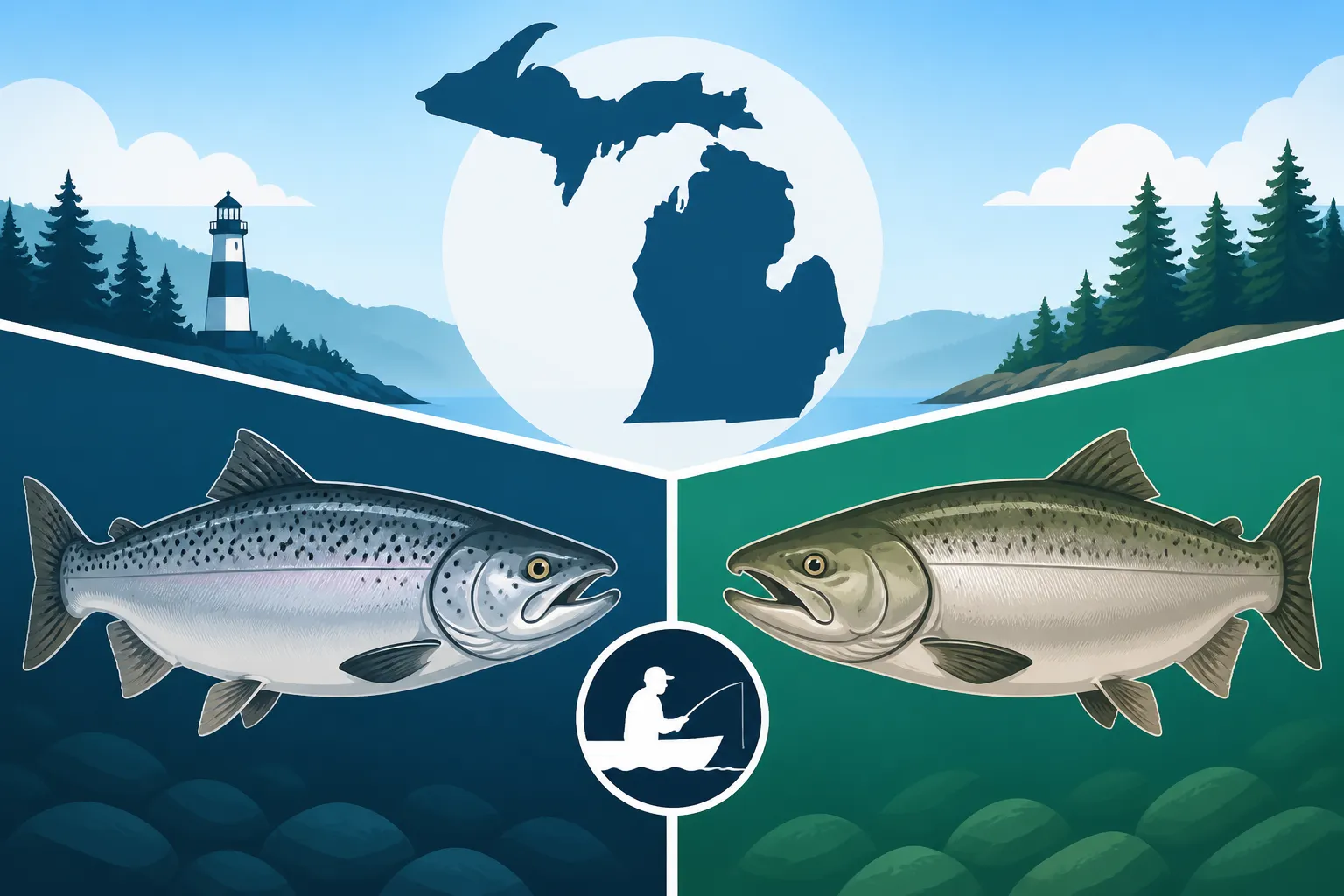
How to Tell a Coho Salmon From a Chinook Salmon
Ever hooked into a powerful salmon in one of Michigan's magnificent Great Lakes or a mighty river, only to stare at it on the deck and wonder, "Is this a Coho or a Chinook?" It's a common dilemma for anglers, and frankly, it can be frustrating when regulations, personal records, or simply the desire to know what you caught depend on accurate identification. This guide is designed to help you confidently distinguish between these two magnificent salmon species, making your next Michigan fishing adventure more informed and enjoyable.
The Frustration of Salmon Identification on the Water
Let's be honest, trying to identify a fish that's just come out of the water, probably flopping around, and definitely covered in slime, is tough. For many Michigan anglers, especially those new to salmon fishing or just visiting the state, the differences between Coho and Chinook salmon can seem incredibly subtle. You might have heard whispers of "black mouth" or "spotty tail," but in the heat of the moment, with the adrenaline pumping after a strong fight, those details can blur. You want to celebrate your catch, perhaps take a photo, and quickly get it in the cooler or back in the water if it's a catch-and-release. The last thing you need is a moment of doubt, wondering if you've correctly identified your prized salmon. It's a common hurdle, and it's completely understandable why so many struggle with it. Even seasoned anglers sometimes pause, double-checking the tell-tale signs to be sure.
Key Differences: Physical Traits to Look For
When you've got a salmon in hand, the most reliable way to tell if it's a Coho or a Chinook is to look closely at its physical characteristics. Forget the general "salmon look" for a moment and zero in on these specific features. This is where the rubber meets the road, and a few key visual cues can give you the definitive answer you're looking for. It's like being a detective, looking for the crucial evidence that separates two very similar suspects.
Mouth and Gum Line
This is often considered the most definitive identifier, a true "smoking gun" when it comes to separating Coho from Chinook. Take a moment to open the fish's mouth and examine the gum line.
With a Chinook Salmon, often affectionately called "Kings" in Michigan, you'll find that their entire mouth, including the gums, is predominantly black. It's a uniform dark coloration inside the mouth. You'll see black on the roof of the mouth and along the gum line of both the upper and lower jaws. It's usually unmistakable, providing a strong contrast to their shiny silver scales. Imagine you've just landed a beautiful silver bullet on Lake Michigan near Grand Haven after a fierce fight. The first thing many experienced captains will tell you to check is that mouth. If it's all black inside, congratulations, you've likely got yourself a King. You can read more about these impressive fish in Chinook Salmon in Michigan's Great Lakes.
Coho Salmon, on the other hand, will have a white or very light-colored gum line on their lower jaw. While the roof of their mouth might still be dark, that lower gum line will stand out as being much lighter. They also often have small, distinct black spots on their tongue and inner lower jaw. It's a subtle but critical difference. So, if you're wrestling with a spirited jumper on the Manistee River and wonder if it's a "Silver," checking for that white gum line is your best bet. A good waterproof fishing field guide, easily found on Amazon, can be an invaluable tool to keep on your boat or in your tackle box for quick reference pictures of these features.
Tail Spotting and Shape
After the mouth, the tail is your next best friend for identification. Don't just glance; really observe the patterns and overall shape.
Chinook Salmon typically display spots on both the upper and lower lobes of their caudal (tail) fin. These spots are often quite numerous and can extend across much of the fin, giving it a somewhat "dirty" or heavily speckled appearance. The tail itself is usually broad and slightly forked, though it can appear more squared off on larger, older fish. Think of it like a scatter plot of spots covering a large canvas. These spots might not be huge, but their widespread presence is a key indicator. How Big Do Chinook Salmon Get in the Great Lakes can give you an idea of the sizes where these tail patterns become very prominent.
For Coho Salmon, the spotting pattern on the tail is usually more confined. You'll generally find spots only on the upper lobe of the caudal fin, and often they are fewer in number and less pronounced than on a Chinook. Sometimes, the tail might appear almost entirely spotless, or with just a few faint spots near the top edge. The tail also tends to be more distinctly forked than a Chinook's, with a more symmetrical "V" shape. If you're pondering How Big Do Coho Salmon Get in Michigan, remember that even smaller Coho will exhibit this more subtle tail spotting.
Body Shape and Coloration
While less definitive than mouth or tail features, the general body shape and coloration can offer supporting clues, especially as the fish mature or approach their spawning phase.
Chinook Salmon are famously robust. They're often described as having a "football" shape – thick, deep-bodied, and powerful. Their coloration in the Great Lakes is typically a brilliant silver, often with a darker back that can range from blue-green to almost black. As they approach spawning season and move into rivers, their silver sheen gives way to a darker, more bronze, or even reddish-brown hue, particularly in males who develop a pronounced kype (hooked jaw). This change can make them even more challenging to identify without checking the mouth.
Coho Salmon tend to be more streamlined and slender compared to Chinooks, with a somewhat more elongated profile. They also maintain a bright, silvery coloration for longer, often even into their spawning runs. Their backs are usually a distinct dark blue or blue-green, contrasting sharply with their silver sides. During the spawning season, particularly in males, they can develop a deep reddish or brick-orange coloration along their sides, which is often more vibrant and widespread than the spawning colors seen in Chinooks. Coho Salmon Fishing in Michigan often involves targeting these beautifully colored fish.
Here's a quick comparison table to keep these key physical differences straight:
| Feature | Chinook Salmon (King Salmon) | Coho Salmon (Silver Salmon) |
|---|---|---|
| Mouth/Gums | Entire mouth, including gums, is predominantly black. | Gums on lower jaw are white or very light; often black spots on tongue/lower jaw. |
| Tail Spotting | Spots typically present on both upper and lower lobes of the tail fin. | Spots usually found only on the upper lobe of the tail fin, or very few/faint spots. |
| Tail Shape | Broad, often squared off or only slightly forked. | More distinctly forked, often forming a symmetrical "V". |
| Body Shape | More robust, "football" shaped, deep-bodied. | More streamlined, slender, and elongated. |
| Coloration (Great Lakes) | Bright silver sides, dark blue-green to black back. | Bright silver sides, distinct dark blue-green back. |
| Coloration (Spawning) | Darker, bronze, or reddish-brown (especially males with kype). | More vibrant red/orange along sides (especially males). |
Behavioral Cues and Habitat Hints
Beyond just their looks, how and where these salmon behave can also offer valuable clues to their identity. While not as foolproof as examining their physical traits, these behavioral patterns can add to your confidence, especially if you're trying to make a quick judgment before landing the fish.
Size and Weight Expectations
One of the most immediate indicators of which salmon you might have on the line is its sheer size and fighting power.
Chinook Salmon are the undisputed "Kings" for a reason. They grow significantly larger than Coho in Michigan waters. While a younger Chinook might be mistaken for a Coho, mature Kings regularly reach double-digit weights, with many in the 15-30 pound range, and some truly massive fish exceeding 40 pounds. When you feel that unrelenting power and long runs, especially from a deep strike, you're often tied into a Chinook. Their immense size and strength are legendary among Great Lakes anglers. If you're really into documenting your catches, consider a portable digital scale and measuring tape, many reliable options are available on Amazon, to get accurate data.
Coho Salmon, while still formidable fighters, generally top out at smaller sizes. A good-sized Coho in Michigan might be in the 5-12 pound range, with larger ones occasionally pushing 15-20 pounds. They are known for their acrobatic jumps and spirited runs, often staying closer to the surface. If you're consistently catching fish in the smaller range that are putting on an aerial show, you might be in a good Coho bite. While it's certainly possible to catch a smaller Chinook or a larger Coho, using size as a general guide can help narrow down your identification.
Spawning Run Timing
The time of year and location can also give you hints, as Coho and Chinook have slightly different migratory patterns and spawning schedules in Michigan's rivers.
Chinook Salmon typically initiate their spawning runs earlier in the fall than Coho. Their primary migration into Michigan's rivers, like the Pere Marquette or Manistee, usually begins in late August and peaks through September. While some early fish might enter rivers in August and stragglers can be found into October, the prime time for targeting mature Kings in river systems is often considered September. Knowing this can help you anticipate which species you're more likely to encounter during a particular fishing trip. You can learn more about this season in Fall Salmon Run in Michigan Rivers.
Coho Salmon usually begin their significant river runs a bit later than Chinooks, often peaking in October and sometimes extending well into November, especially in milder years. They'll follow the Chinook into the rivers, utilizing similar spawning grounds but on a slightly delayed schedule. If you're fishing a river in late October or early November, particularly after the bulk of the King run has passed, you might find yourself more heavily in Coho territory. Best Months for Salmon Fishing in Michigan can offer a broader view of these patterns across species.
Feeding Habits and Preferred Baits
Understanding what these fish eat and how they feed in the Great Lakes can also subtly inform your identification efforts, particularly when trolling.
Chinook Salmon are opportunistic predators with a strong preference for larger baitfish like alewives, smelt, and gobies. In the open waters of the Great Lakes, they often feed deeper in the water column, frequently targeted with downriggers and deep-diving lures. Their aggressive nature and pursuit of substantial meals contribute to their rapid growth. If you're consistently picking up fish on baits run deep, it often leans towards a King. Trolling for Chinook Salmon on Lake Michigan details many of the techniques used.
Coho Salmon also feed on baitfish, but they tend to be more surface-oriented in their feeding habits, especially during certain times of the year. They are known for chasing schools of baitfish near the surface, and are often caught on shallower-running spoons or plugs, and even flies or small stickbaits. Their more erratic and acrobatic fights can also be a tell-tale sign of a Coho. Experienced anglers often carry a variety of lures, from spoons to crankbaits, and you'll find an incredible selection for both Chinook and Coho on Amazon, perfect for stocking your tackle box before your next trip.
Why Accurate Identification Matters
Beyond satisfying your angler's curiosity, correctly identifying your catch has significant practical implications for fishing in Michigan. It’s not just about knowing what you caught; it’s about responsible angling, adhering to regulations, and contributing to the health of our fisheries.
Understanding Regulations and Limits
This is perhaps the most critical reason to accurately identify your salmon. Michigan's fishing regulations, as outlined in publications like the official digest, can sometimes have different bag limits or even size restrictions for various salmon species. For instance, while generally both Chinook and Coho fall under a combined salmon/trout daily possession limit, there could be specific exceptions or rules in certain areas or during particular seasons. Misidentifying your fish could inadvertently lead to exceeding a specific species' limit, resulting in a violation.
Imagine a scenario where you've caught several fish, and you're unsure if you've hit your limit for one species but are still under for another. Having a clear understanding of the differences means you can confidently keep what's legal and release what's not, ensuring you're always fishing within the law. It's not worth the risk of a fine or losing your fishing privileges over a simple identification error. Always consult Michigan Fishing Regulations Every Angler Should Know and Michigan Bag and Size Limits Explained before heading out.
Conservation Efforts and Data Collection
The Michigan Department of Natural Resources (DNR) relies heavily on accurate data to manage our fisheries effectively. Angler reports, creel surveys, and even biological samples contribute to the DNR's understanding of fish populations, spawning success, and the overall health of the ecosystem. When anglers can accurately report what they've caught, it provides invaluable information that helps biologists make informed decisions about stocking programs, habitat restoration, and future regulation changes.
By taking the time to properly identify whether you've landed a Chinook or a Coho, you're becoming an active participant in conservation. Your knowledge contributes to a larger picture that ensures sustainable fishing opportunities for generations to come. It’s about being part of the solution and helping to protect the very resources we love to pursue. Michigan Salmon Species Explained dives deeper into the different salmon species managed in Michigan.
Personal Records and Bragging Rights
Let's face it, we all love a good fish story, and knowing exactly what you caught adds immense value to that narrative! Imagine claiming a new personal best for a Coho, only to later realize it was a smaller Chinook, or vice-versa. It can be a little deflating, right? Accurate identification ensures your personal records are legitimate and that your bragging rights are well-deserved.
Furthermore, if you ever aspire to pursue a state record, precise identification is paramount. Every detail matters, and confirming the species is the first step in that exciting journey. Sometimes, the distinction can be subtle, and having a magnifying glass (or just your reading glasses!) can help examine those tell-tale gum spots, perfect for a quick search on Amazon if you need one. So, next time you land a beautiful salmon, take pride in knowing exactly which magnificent species it is, and share your story with confidence!
Disclaimer
This article is for general informational purposes only and does not constitute professional advice. Laws, prices and regulations vary by location and change over time. Consult a qualified professional for guidance on your specific situation.