Yellow Perch Identification in Michigan
You are sitting on a cold bucket over a hole in the ice or floating above a weed edge in early spring, pulling up panfish after panfish, and suddenly you pause. Is that distinct striped fish actually a yellow perch, or could it be a juvenile walleye, a stray white perch, or an invasive competitor? Misidentifying fish on the water leads to accidental rule infractions, ruined freezer plans, and endless frustration when sorting your daily catch. This guide gives you absolute clarity on yellow perch identification in Michigan, breaking down physical traits, habitat-driven color shifts, and subtle differences between lookalike species so you can fish with confidence.
Key Physical Characteristics of Michigan Yellow Perch
Recognizing a yellow perch starts with understanding its fundamental anatomy. While many freshwater fish share similar shapes or sizes, the yellow perch (Perca flavescens) carries a combination of markings, fin configurations, and body contours that make it one of the most distinctive panfish in North America. When you swing a fish over the gunwale or onto the ice, taking note of a few primary features will immediately narrow down your identification.
Body Shape and Scale Texture
Yellow perch exhibit a classic, slightly elongated yet deep-bodied panfish profile. Unlike the broad, flat disc shape of a bluegill or crappie, a yellow perch is oval in cross-section, giving it a solid, plump feel in your hand. The back slopes gently upward from the snout to the front of the dorsal fin before tapering back toward a narrow tail wrist. Younger perch tend to look somewhat slender, but as these fish mature into mature adults, they develop a distinctly high-backed, broad silhouette often referred to by local anglers as a humpback shape.
The scales of a yellow perch are ctenoid, meaning they feature tiny, comb-like projections along their rear edges. When you hold a perch, its sides feel noticeably rough and sandpaper-like compared to the smooth, slimy skin of a trout or bullhead. These firm, tightly imbricated scales provide an effective suit of armor against sharp underwater weeds, zebra mussel beds, and small predators. This tactile feedback is often the very first clue anglers notice when unhooking a catch on a cold morning.
Understanding this bodily structure is crucial for every angler studying Yellow Perch Fishing in Michigan. The muscular frame behind the head houses firm, white meat, but from an identification standpoint, that hump-backed curve and rough, armored exterior separate true perch from soft-scaled panfish species immediately.
Distinctive Coloration and Dark Vertical Bars
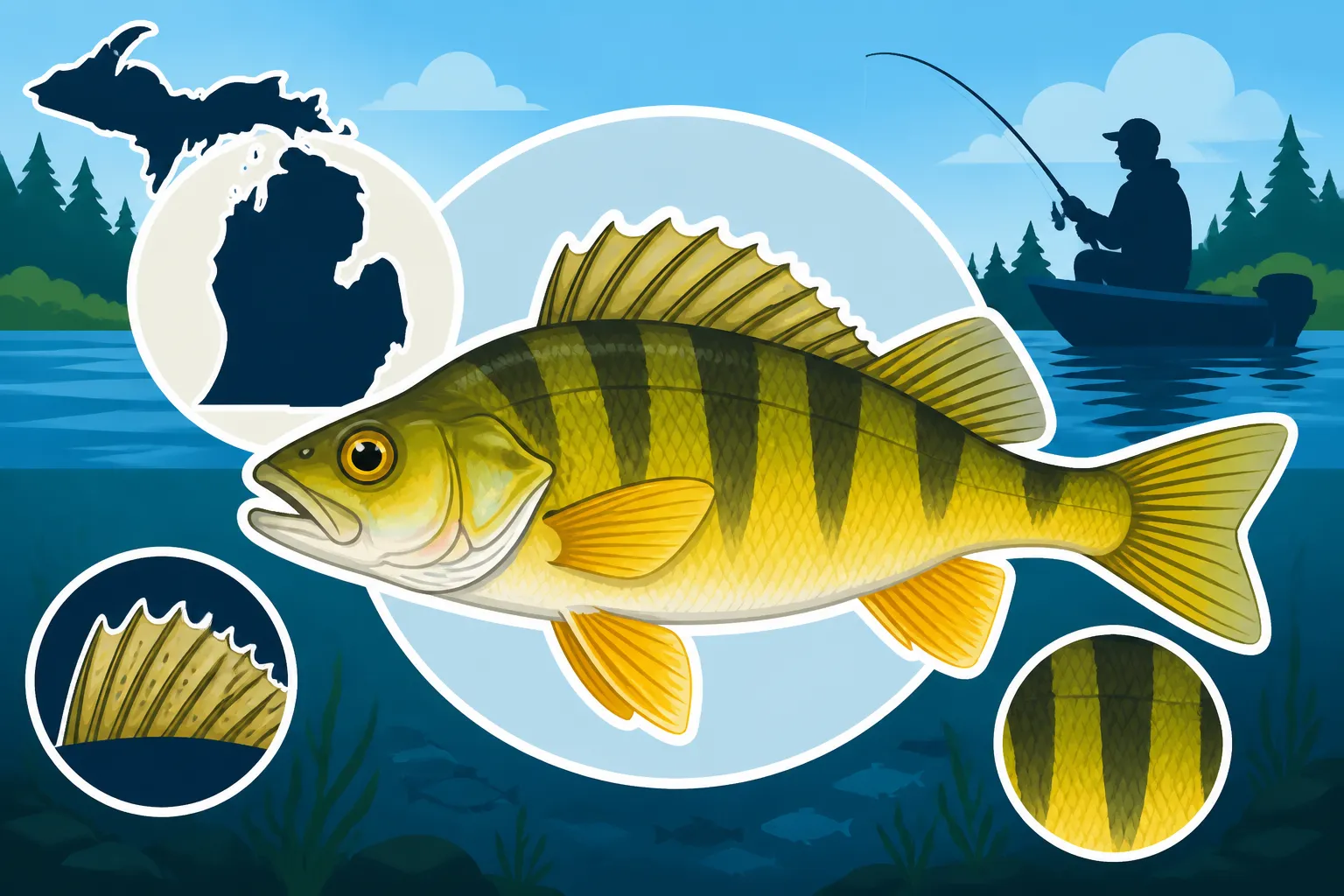
Color is the most striking visual marker of a yellow perch, though exact shades vary based on water clarity and depth. Typically, the upper back exhibits a rich olive-green to dark golden-brown hue that gradually lightens along the flanks. The belly is brilliant white or pale cream. What makes the fish instantly recognizable are the six to eight dark, wedge-shaped vertical bars running down its sides. These bars start near the dorsal ridge and taper downward toward the abdomen, creating a high-contrast pattern designed to break up the fish’s silhouette among submerged vegetation.
The intensity of these bars changes depending on environmental factors. In clear, weed-rich inland lakes like Houghton Lake or Higgins Lake, the dark bars appear almost black against a bright brassy-yellow background. In murky, riverine environments like the Saginaw River system, the background yellow may mute into a dull gray or pale brass, but those vertical bands remain clearly defined.
It is important not to rely entirely on color tone alone, as stress, sunlight exposure, and livewell conditions can cause a perch to lighten or darken dramatically within a few minutes of capture. However, the presence of those distinct vertical wedges extending below the lateral line is a primary mark of a true yellow perch.
Fin Structure and Eye Characteristics
Examining the fins provides conclusive proof of a yellow perch’s identity. Like all members of the perch family (Percidae), yellow perch possess two completely separate dorsal fins on their back. The anterior (front) dorsal fin is supported by 12 to 14 sharp, stiff spiny rays capable of delivering a painful prick if handled carelessly. The posterior (rear) dorsal fin is soft-rayed and flexible. Crucially, there is a visible gap or deep notch separating these two fins, rather than a continuous fin membrane.
The lower fins—specifically the pelvic and anal fins—often feature a vibrant reddish-orange or deep amber color, particularly during the cold water months and spring spawning periods. The anal fin contains two sharp spines at its leading edge followed by soft rays. The caudal (tail) fin is moderately forked, providing fast bursts of acceleration to catch minnows or flee from northern pike and walleye.
The eyes of a yellow perch are large, round, and positioned slightly forward on the head, reflecting its role as a sight-dependent predator. The iris usually displays a reflective golden or yellow tint. Unlike walleye, which possess a cloudy, milky tapetum lucidum that glows under direct light, a yellow perch’s eye remains clear with a dark pupil, allowing you to quickly differentiate between the two species even in low-light conditions.
Comparing Yellow Perch to Common Lookalike Species in Michigan
Even experienced Michigan anglers occasionally second-guess a catch when pulling up fish from deep water or stained rivers. Several species share physical traits with the yellow perch, either because they belong to the same biological family or because they occupy identical aquatic niches. Knowing how to perform a side-by-side visual audit on the water prevents compliance issues and helps you keep accurate logbooks.
| Feature | Yellow Perch | White Perch | Juvenile Walleye |
|---|---|---|---|
| Body Coloration | Brassy yellow/olive | Silver to dark gray | Olive-brown/tan |
| Markings | 6-8 dark vertical bars | No dark vertical bars | Faint blotches/saddles |
| Dorsal Fin Notch | Distinct separation | Joined at base | Distinct separation |
| Dorsal Fin Spot | Dark spot at rear base | No distinct rear spot | Dark blotch at rear |
| Eye Appearance | Clear golden iris | Bright silver eye | Cloudy/milky reflective |
| Tail Fin Tip | Uniform coloration | Uniform coloration | White tip on lower lobe |
Yellow Perch vs White Perch
Despite their similar common names, yellow perch and white perch are not in the same biological family. White perch (Morone americana) are actually members of the temperate bass family, closely related to white bass and striped bass, and are an invasive species in many Michigan watersheds. Recognizing the difference is critical, as harvest management goals for invasive white perch differ from native game management strategies.
Visually, white perch lack the dark vertical bars that define yellow perch. A white perch features a uniform silvery-white to graphite-gray body without any distinct vertical striping. While a stressed yellow perch might lose some of its brilliant golden hue, its dark side bars never disappear completely. If you hold a fish with a silver metallic body and smooth, unpatterned flanks, you are holding a white perch.
Another major anatomical difference lies in the dorsal fin structure. The spiny and soft dorsal fins of a white perch are connected by a thin membrane near the base, whereas a yellow perch’s dorsal fins are physically detached. Furthermore, white perch have significantly longer, stouter anal spines. If you double-check your identification using a pocket laminated field guide ordered off Amazon before your trip, you will easily spot these key structural variances before deciding which fish go into the cooler.
Yellow Perch vs Juvenile Walleye
Because yellow perch and walleye (Sander vitreus) belong to the same Percidae family, small walleye can look remarkably similar to adult yellow perch at a glance. Both feature elongated bodies, rough ctenoid scales, dual dorsal fins, and sharp gill covers. Misidentifying a undersized juvenile walleye as a yellow perch can result in an accidental regulatory violation, as walleye are subject to strict minimum size limits across the state. Understanding Walleye Identification and Size in Michigan is essential for avoiding this costly mistake.
To tell them apart, focus first on the lower lobe of the tail fin. A walleye features a bright white, milky patch on the tip of the lower tail lobe, whereas a yellow perch’s tail fin is entirely uniform in color from top to bottom. Additionally, walleye possess dark, irregular blotches or wide saddle markings across their back rather than clean, tapered vertical bars running down the sides.
The eyes and mouth also reveal their identity. Walleye possess sharp, prominent canine teeth along their jaws for catching fish, whereas yellow perch have small, brush-like villiform teeth that feel like coarse sandpaper rather than sharp needles. Combined with the walleye’s characteristic cloudy, reflective eyes, these details ensure you never mistake a young walleye for a keeper perch.
Yellow Perch vs Ruffe and Invasive Lookalikes
Anglers fishing in Great Lakes harbors, particularly around Lake Superior and northern Lake Michigan, must remain alert for Eurasian ruffe (Gymnocephalus cernua). The ruffe is a small, invasive percid introduced via ballast water that competes directly with native panfish for food and benthic habitat.
The most reliable way to distinguish a yellow perch from a ruffe is by inspecting the dorsal fin. A ruffe has one continuous dorsal fin with no gap between the spiny anterior portion and the soft posterior portion. The spiny section of a ruffe’s dorsal fin is proportionately massive compared to its body and features small dark spots speckling the membrane between the spines.
Ruffe also lack the dark vertical bars of a yellow perch, displaying a mottled brown or drab olive body with dark flecks scattered haphazardly across the back. Their heads are smooth and scaleless with large, glass-like eyes. Catching an invasive species like a ruffe requires immediate reporting to the Michigan Department of Natural Resources (DNR), making correct identification a matter of ecological stewardship.
Habitat-Based Identification and Color Variations Across Michigan
Yellow perch are extraordinarily adaptable, thriving in shallow inland ponds, deep glacial lakes, turbid river systems, and the vast expanse of the Great Lakes. However, environmental factors such as water clarity, substrate composition, diet, and sunlight penetration directly impact their visual appearance. Understanding how location changes a perch’s color palette helps you confirm your catch no matter where you splash your boat.
Great Lakes Yellow Perch Traits
Fish pulled from the open waters of Lake Erie, Saginaw Bay, or Lake Michigan often look dramatically different from inland specimens. In these vast, clear waters—often filtered heavily by invasive quagga mussels—perch adapt to a pelagic lifestyle where camouflage against open water and light sandy bottoms is paramount.
Great Lakes yellow perch frequently display a pale, washed-out golden tint or a shimmering silver-yellow background. Their vertical dark bars remain present, but they may appear dark slate gray or soft brownish-green rather than deep ink-black. The lower pelvic and anal fins on open-water Great Lakes perch are often pale yellow or light pinkish-orange rather than the fiery crimson seen in swampy inland waters.
However, open-water Great Lakes perch are famous for their structural girth. The abundant food supply—consisting of round gobies, alewives, and benthic invertebrates—allows them to develop deep shoulders and thick fillets. If you spend time exploring St. Clair River and Detroit River Perch Fishing, you will quickly notice that river-run Great Lakes perch retain a brighter metallic sheen across their sides due to constant movement in clear, current-driven channels.
Inland Lake Yellow Perch Characteristics
Inland lakes across Michigan present a completely different aesthetic. In weed-filled, tannic-stained lakes, yellow perch develop high-contrast coloration designed to help them blend into dense stands of Eurasian watermilfoil, cabbage, and bulrushes.
An inland perch often boasts a dark forest-green back, a brilliant amber-yellow flank, and jet-black vertical bars that extend far down toward a stark white belly. The pelvic and anal fins on these inland fish are routinely bright reddish-orange, especially during early spring and late fall. This vivid color scheme is an evolutionary response to dark water and complex weed beds, where hiding from shallow-water predators like largemouth bass and northern pike requires maximum visual breakup.
Anglers targeting panfish in stained waters like Houghton Lake, Hamlin Lake, or various Upper Peninsula impoundments can expect to land fish with these exceptionally vibrant palettes. When snapping photos under direct sunlight, slipping on a quality pair of polarized sunglasses purchased on Amazon allows you to clearly read these intense color patterns through surface glare while sorting your livewell.
River and Flowage Perch Patterns
Riverine environments, including major systems like the Grand, Muskegon, and Au Sable rivers, create another distinct visual profile for yellow perch. Flowing water forces fish to burn more calories, resulting in a somewhat leaner, more streamlined body shape compared to their deep-bodied lake counterparts.
Perch living in turbid or muddy river bottoms often take on an overall muted, brownish-yellow hue. The dark vertical bars might appear wider and less defined at the edges, blending gradually into the surrounding scale pattern. This diffuse coloration matches the silt, decaying leaf litter, and submerged timber typical of mid-state river systems.
Despite these subtle environmental shifts, the fundamental anatomy remains unchanged. The split dorsal fin, rough scales, clear eyes, and array of vertical bars persist regardless of current or water clarity. Checking these anatomical features ensures that environmental color variations never trick you into misidentifying your catch.
Seasonal Changes and Maturity Markers in Yellow Perch
As yellow perch move through their annual life cycle, their physical appearance undergoes predictable transformations. Hormone fluctuations during spawning, seasonal changes in diet, and natural aging all leave visible markers on the fish. Recognizing these seasonal shifts allows you to gauge the health of the fishery and better understand the maturity of the population you are catching.
Spring Spawning Dress and Color Intensity
Spring is the time of year when yellow perch display their most brilliant coloration. As water temperatures rise into the mid-40s to low-50s Fahrenheit, perch migrate into shallow weed beds, flooded brush, and sheltered bays to deposit their eggs. During this period, hormonal surges dramatically enhance their pigments.
Males in particular develop intense, glowing orange or fiery red pelvic, anal, and pectoral fins. The yellow along their flanks brightens to a neon gold, and the contrast between their vertical bars and background scales reaches its annual peak. This high-contrast “spawning dress” serves as a visual signal in shallow, murky spring waters.
Females also show distinct spring markers, though primarily through body shape rather than fin color. A pre-spawn female perch becomes immensely distended around her midsection, holding long, accordion-like strands of eggs known as egg ribbons. Handling these egg-heavy females with extreme care ensures successful reproduction and supports future fish populations across Michigan waters.
Identifying Male vs Female Yellow Perch
Outside of the spring spawning window, telling male and female yellow perch apart visually requires a close look at subtle physical cues and body proportions. While both sexes share the same basic color traits, mature females consistently grow larger and wider than males of the same age class.
- Females: Tend to have a deeper body profile with a pronounced hump behind the head, especially once they exceed 9 inches in length. Their abdomen remains soft and slightly rounded even in summer.
- Males: Generally remain sleeker and more slender throughout their lives. Males rarely reach the extreme “jumbo” sizes that make Michigan perch famous, with most mature males topping out around 8 to 10 inches.
- Vent Examination: During the late winter and spring seasons, gently inspecting the vent (urogenital opening) near the anal fin reveals clear sex markers. The female vent appears slightly enlarged, round, and reddish, while the male vent is smaller, V-shaped, and less pronounced.
Understanding sex distribution in a school is valuable for harvest selection. Many conservation-minded anglers choose to keep moderate-sized male perch for the skillet while releasing large, deep-bodied female “jumbos” to preserve strong genetic stock in heavily pressured lakes.
Jumbo Perch Traits and Trophy Identification
In the lexicon of Michigan angling, a yellow perch crossing the 12-inch threshold earns the coveted title of a “jumbo.” These trophy panfish are almost exclusively older females that have enjoyed optimal forage conditions over several years.
Jumbo perch possess distinct physical characteristics that go beyond simple length:
- Pronounced Humpback: The area directly behind the skull rises steeply, giving the head a small, tucked-in appearance relative to the thick, muscular body.
- Broad Girth: The body thickness behind the gills becomes remarkably wide, often requiring a larger landing net to handle safely without tearing mouth tissue.
- Worn Fin Edges: Older, trophy-sized perch frequently show minor fraying or rounding on the tips of their spiny dorsal rays and tail fins from years of navigating rough substrates and weed beds.
- Deep Golden Armor: The scale patterns on mature jumbos develop a rich, antique brass color with thick, dark bars that appear deeply etched into the hide.
Landing a true jumbo perch is a highlight of any trip. To measure these impressive fish accurately on the ice or boat deck, keeping an collapsible, easy-to-clean bump board or measuring tape from Amazon right in your bucket ensures you record exact lengths for state master angler submissions.
Field Identification Tools and Angler Regulations
Accurate fish identification is not just a satisfying skill; it is a fundamental legal requirement for anyone fishing in Michigan. The Michigan Department of Natural Resources establishes specific bag limits, possession rules, and harvest seasons designed to maintain balanced aquatic ecosystems. Knowing how to apply your identification skills under real-world fishing conditions keeps your trips safe, fun, and legal.
Differentiating Yellow Perch Under Michigan Regulations
In Michigan, yellow perch are classified as a panfish, but harvest regulations can vary depending on whether you are fishing inland waters or specific Great Lakes boundary zones. Knowing how many fish you can keep requires checking the current regulations digest and accurately identifying every fish that enters your livewell.
For instance, panfish daily limits generally permit a generous total harvest, but specific waters may impose unique restrictions or species-specific caps. If you spend a day on the water, you must be certain that every fish counted toward your perch limit is indeed a yellow perch and not an invasive white perch or a juvenile gamefish like a walleye. Keeping up to date on Michigan Daily Bag Limits by Species is the best way to avoid accidental citations during DNR field checks.
Special regulations exist on famous panfish destinations like Lake St. Clair, where localized perch management strategies protect the world-class fishery. If you plan a trip to this region, reviewing the rules outlined in Michigan Yellow Perch Limit on Lake St. Clair will clarify daily possession limits and seasonal variations before you hit the water.
Essential Gear for Quick Field Identification
When fish are coming fast over the side of the boat or through an ice hole, sorting them quickly minimizes handling stress on fish you intend to release. Having the right tools organized in your boat or sled makes the identification and sorting process effortless.
Essential identification and sorting gear includes:
- Polarized Sunglasses: Cuts surface glare so you can see the distinctive vertical bars on fish swimming near your boat or beneath your ice hole.
- Laminated Species Guide: A waterproof field guide stored in your tackle box provides instant side-by-side anatomical comparisons for ambiguous catches.
- LED Headlamp or Deck Light: Essential for low-light situations during early morning or evening perch bites when color perception drops off sharply.
- Measuring Bump Board: A rigid board with a vertical lip allows you to quickly verify length while confirming physical markers.
Organizing these basic tools inside a durable, weather-resistant bag or utility box sourced from Amazon ensures that everything you need for quick identification is within arm’s reach. Setting up a dedicated storage system like the ones discussed in Best Tackle Box Setup for Michigan Anglers keeps your deck clear and your focus where it belongs—catching fish.
Whether you are targeting perch during mid-summer on Saginaw Bay, learning How to Catch Perch Through the Ice in Michigan, or searching for the Best Perch Fishing Spots in Michigan, mastering yellow perch identification ensures you respect the resource, obey state laws, and fully enjoy one of Michigan’s finest freshwater traditions.
Disclaimer
This article is for general informational purposes only and does not constitute professional advice. Laws, prices and regulations vary by location and change over time. Consult a qualified professional for guidance on your specific situation.