Walleye vs Sauger: What’s the Difference
Few things are as frustrating for a Michigan angler as pulling up a beautiful fish, only to stare at it, scratching your head, and wondering: "Is this a walleye or a sauger?" These two popular game fish, while closely related, have distinct features and, crucially, can have different regulations, leading to unnecessary confusion and potential legal headaches. This guide will meticulously break down the differences between walleye and sauger, equipping you with the knowledge to confidently identify your catch in Michigan waters every single time.
The Tale of Two Cousins: Understanding Walleye and Sauger
It's completely understandable why so many anglers, even seasoned ones, find themselves puzzled when trying to distinguish a walleye from a sauger. They share so many superficial similarities – elongated bodies, sharp teeth, and that distinctively large, glassy eye that gives the walleye its name. But beneath these resemblances lie critical differences that are not just fascinating from a biological perspective, but also vital for ethical and legal fishing in Michigan.
Why the Confusion is So Common
The primary reason for the widespread confusion between walleye and sauger stems from their shared lineage and overlapping habitats. Both are members of the perch family (Percidae) and are often found in the same river systems and connecting Great Lakes waters here in Michigan. Imagine you’re out on the Detroit River, known for its fantastic fishing, and you hook into what looks like a walleye. It's got that torpedo shape, those sharp teeth, and a somewhat muted coloring. Without knowing the specific tell-tale signs, it's easy to assume it's one of Michigan's most sought-after game fish. This shared appearance, coupled with the excitement of a catch, can make precise identification a real challenge on the water, especially when you're trying to quickly determine if your fish meets the legal size or bag limits. The stakes can be higher than you think, as misidentifying a fish and keeping an illegal one can result in fines and other penalties.
It doesn't help that their names sometimes get mixed up conversationally, or that regional variations in appearance can sometimes blur the lines slightly. For instance, a walleye caught in a very clear, deep lake might look a little different from one caught in a turbid river, making it even harder for the untrained eye to spot the nuanced differences that truly set it apart from a sauger. Anglers might also be more familiar with walleye due to their widespread popularity, and thus simply assume any fish fitting the general description is a walleye. But taking the time to learn the specific markers is an essential part of becoming a truly knowledgeable and responsible angler in Michigan.
A Quick Biological Overview
Let's dive a little deeper into the biology of these two remarkable fish. The walleye, scientifically known as Sander vitreus, is arguably Michigan's most iconic and prized game fish. They are celebrated for their delicious, flaky white meat and their challenging fight, making them a top target for anglers across the state, from the expansive waters of Saginaw Bay to the clear depths of Higgins Lake. Walleye are native to much of North America, and thrive in cooler, deeper waters of large lakes and rivers, often seeking out low-light conditions to feed. They can grow to impressive sizes, with large females often reaching well over 25 inches.
The sauger, Sander canadensis, is a close cousin to the walleye and shares a similar torpedo-shaped body and general coloration. While perhaps not as widely known or as large as the walleye, sauger are highly regarded for their own delicious flavor and are a challenging catch in their own right. They tend to prefer more turbid, shallower waters, especially in larger river systems like the Detroit River or parts of the St. Clair River. Sauger generally don't grow as large as walleye, typically topping out around 18-20 inches, though larger specimens are occasionally caught. Both species are predatory fish, preying on smaller fish, crayfish, and insects. Understanding these basic biological differences is the first step toward appreciating their distinct characteristics and why accurate identification is so important for the Michigan angler.
Spotting the Differences: Key Identification Marks
When you've got a fish in hand and you're trying to figure out if it's a walleye or a sauger, there are a few key visual cues that will almost always give you the answer. Forget about general color or size for a moment, and zoom in on these specific anatomical features. These are the "secret handshake" details that Michigan DNR officers look for, and they'll become your go-to identifiers once you know them.
Dorsal Fin Distinctions – The Easiest Clue
Hands down, the single most reliable way to tell a walleye from a sauger is to look at their dorsal fins – specifically, the first, spiny dorsal fin. This is the fin located closest to the head, often standing erect when the fish is excited or out of water.
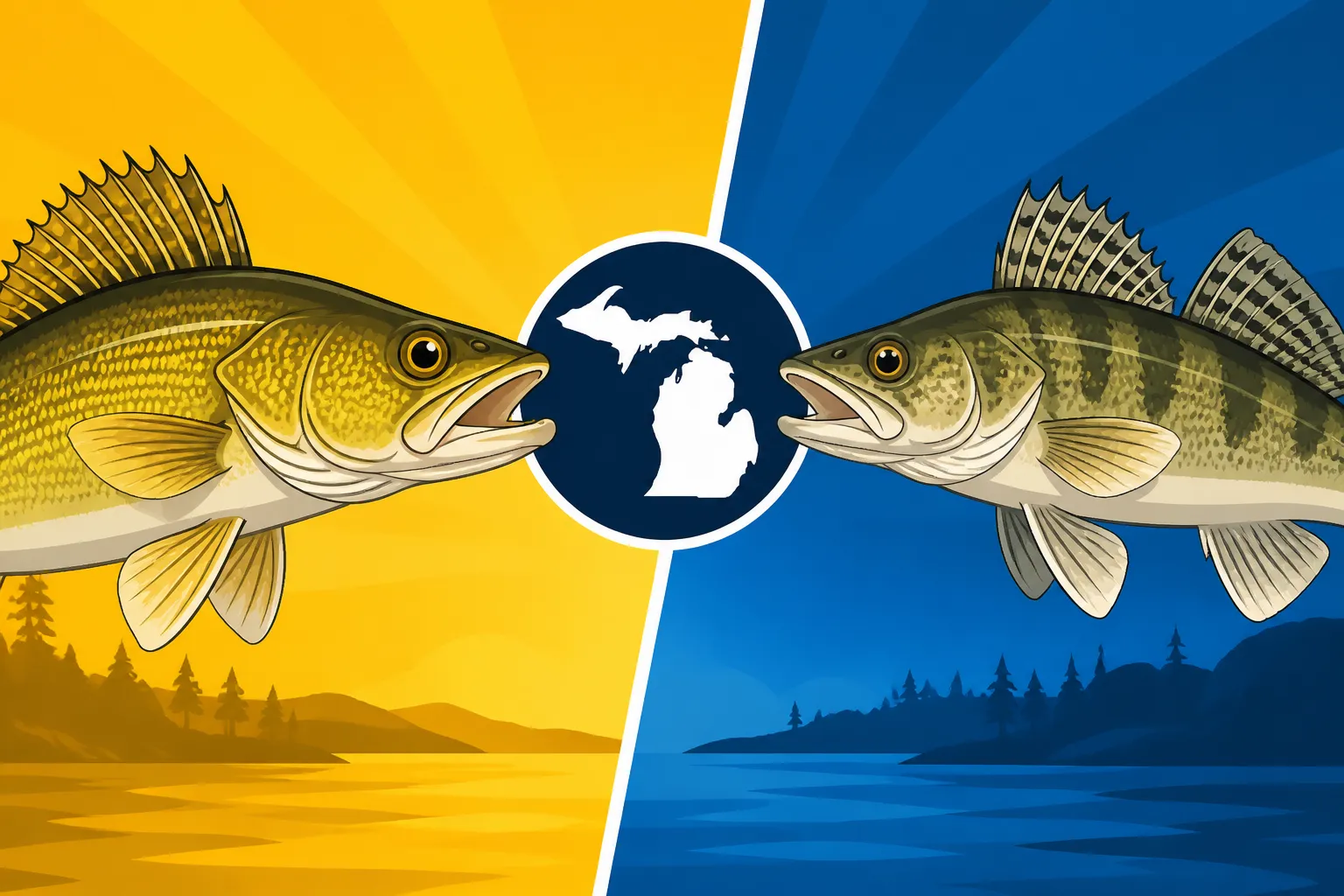
For a sauger, you will notice distinct dark spots or blotches arranged in rows on the membranes of its spiny dorsal fin. These spots are usually quite clear and often create a banded or mottled pattern across the fin. Think of it like a leopard print, but on a fin. This is almost always present and is a fantastic indicator. You'll likely see two or three rows of these dark spots.
Now, for a walleye, the spiny dorsal fin is usually clear or has very faint, indistinct mottling, but it will not have those pronounced dark spots arranged in rows. Instead, a walleye has a prominent, opaque black blotch at the very back of the spiny dorsal fin, near where it meets the second, soft-rayed dorsal fin. This is a solid, dark thumbprint-like mark, not a pattern of individual spots. If you see that big, solid black mark and no rows of spots, you're almost certainly holding a walleye. This distinction is so crucial that it's often the first thing experienced anglers and conservation officers check. Making this identification quickly can save you from accidentally breaking Michigan Fishing Regulations Every Angler Should Know.
Body Markings and Coloration
While less definitive than the dorsal fin, body markings and overall coloration can provide additional clues, especially once you're comfortable with the dorsal fin trick. Keep in mind that fish coloration can vary significantly based on water clarity, diet, and even depth, so don't rely solely on this.
A walleye typically has a more uniform, brassy or olive-green coloration across its back, fading to a lighter, often golden-yellow or white belly. They might have some subtle darker mottling or saddles along their sides, but these are usually less pronounced and blend more smoothly into the overall body color. The walleye's scales often have a somewhat iridescent sheen, giving them a beautiful, almost jewel-like quality, particularly when fresh out of the water. Their flanks can sometimes show faint vertical bars, but these are not nearly as distinct or irregular as what you'd see on a sauger.
The sauger, on the other hand, tends to have a more distinct and irregular mottled pattern along its sides and back. These are often dark, saddle-like blotches that extend down from the back, breaking up the lateral line. The overall body color of a sauger is generally a more drab brown or gray, lacking the prominent golden or brassy tones of a walleye. This mottled appearance helps them camouflage effectively in the turbid, often rocky or sandy river bottoms where they prefer to hunt. Think of it as a more camouflaged, almost reptilian pattern compared to the walleye's smoother transition.
Tail Fin and Pectoral Fin Features
Another excellent and very reliable identification mark is found on the tail fin, also known as the caudal fin. This feature is almost as definitive as the dorsal fin.
For a walleye, look closely at the lower lobe of its caudal (tail) fin. You will almost always see a distinct, opaque white or cream-colored tip on the very bottom edge. This white patch is usually quite noticeable and stands out against the darker fin. It's a very consistent feature across walleye populations in Michigan and is a critical identifier. This bright white tip is like a beacon that screams "walleye!" to those in the know.
The sauger, however, will lack this prominent white tip on its lower caudal fin. Its tail fin will generally be uniformly colored or show some faint speckling, but no distinct white patch. This absence of the white tip is just as important as its presence on a walleye, giving you another solid piece of evidence for identification.
Additionally, you can examine the pectoral fins (the pair of fins behind the gills). While less of a primary identifier, sauger often have distinct dark bands or streaks on their pectoral fins, whereas walleye typically have clear or very faintly mottled pectoral fins. These subtle differences, combined with the dorsal and caudal fin markings, create a robust set of visual clues to help you differentiate these two species. With these three key areas in mind, you’ll be much more confident identifying your next catch, which is vital for understanding Michigan Walleye Size and Possession Limits.
| Feature | Walleye | Sauger |
|---|---|---|
| Spiny Dorsal Fin | Large, opaque black blotch at the rear; otherwise clear. | Distinct dark spots/blotches in rows. |
| Caudal (Tail) Fin | Prominent white tip on the lower lobe. | No white tip on the lower lobe. |
| Body Coloration | More uniform, brassy/olive-green; sometimes faint vertical bars. | Distinct mottled, saddle-like blotches; generally drab brown/gray. |
| Pectoral Fins | Clear or faintly mottled. | Often have distinct dark bands or streaks. |
| Eyes | Large, prominent, often 'glassy' (more so than sauger). | Large, but slightly less 'glassy' than walleye. |
| Size | Generally larger, often exceeding 20 inches. | Generally smaller, rarely exceeding 20 inches. |
| Preferred Habitat | Clearer, deeper lakes and large rivers. | Turbid, shallower river systems and reservoirs. |
Habitat, Behavior, and Fishing Dispositions
Beyond their physical appearance, walleye and sauger also exhibit different preferences when it comes to where they live, what they eat, and how they behave. Understanding these ecological distinctions can not only help you identify them in the field but also refine your fishing strategies to target one over the other. Knowing where to look and what to expect can significantly increase your success on the water.
Preferred Habitats in Michigan Waters
One of the most significant differences between walleye and sauger lies in their preferred habitats within Michigan's diverse waters. While there can be some overlap, especially in large river systems that flow into the Great Lakes, each species has its own ecological niche.
Walleye are true champions of Michigan's vast waterways, thriving in a variety of environments. They are most commonly found in the cooler, deeper basins of the Great Lakes themselves, such as Lake Huron's Saginaw Bay or parts of Lake Erie, where they can grow to impressive sizes. Large inland lakes like Houghton Lake and Bay de Noc are also prime walleye territories. They prefer structured environments, often holding near drop-offs, reefs, humps, and submerged timber. Walleye are highly light-sensitive, thanks to their large, light-gathering eyes, which means they frequently seek out deeper water or darker, shaded areas during the day. This is why you often find them active during low-light conditions at dawn, dusk, or even throughout the night. Their preference for clearer, cooler waters makes them a prime target in many of Michigan's pristine Michigan's Great Lakes Fishing Guide.
Sauger, while also found in Michigan, tend to favor more specific environments. They are typically found in larger river systems with a fair amount of current and turbidity, or in reservoirs with similar characteristics. Think of stretches of the Detroit River, the St. Clair River, or certain backwater areas where the water might be a bit murkier and shallower. Unlike walleye, sauger are generally more tolerant of cloudy or stained water, and they often relate to the bottom more closely, seeking out eddies, current breaks, and gravelly or rocky substrate. You're less likely to find them out in the open, deep basins of the Great Lakes compared to their walleye cousins. Knowing these habitat preferences can guide your search for Michigan's Most Popular Fish Species, helping you narrow down your target.
Feeding Habits and Activity Levels
Their differing habitats naturally lead to some variations in feeding habits and activity levels, which smart anglers can use to their advantage. Both are predatory, but their approaches can differ.
Walleye are renowned for their nocturnal and crepuscular (dawn and dusk) feeding patterns. Their large, light-sensitive eyes give them a distinct advantage in low-light conditions, allowing them to hunt effectively when their prey might be less aware. They are opportunistic feeders, preying on a variety of smaller fish like yellow perch, shiners, and minnows, as well as insects and crayfish. While they can be caught during the day, especially in deeper, darker water or on overcast days, prime walleye fishing often revolves around those low-light windows. They'll actively chase down baitfish in the water column, making them susceptible to a wide range of moving lures. Understanding this behavior is key to mastering Walleye Fishing in Michigan.
Sauger, on the other hand, tend to be more active throughout the day, particularly in their preferred turbid river environments. Their mottled coloration provides excellent camouflage in these conditions, allowing them to ambush prey from cover. They are often bottom-oriented feeders, more likely to be found hugging the riverbed or lake bottom, waiting for an unsuspecting minnow or invertebrate to swim by. While they will also eat small fish, their diet might include a higher proportion of benthic (bottom-dwelling) organisms. This means techniques that present bait directly on or near the bottom are often highly effective for sauger. Their willingness to bite during daylight hours, especially in their preferred habitat, can make them a fun target when walleye are being finicky.
Fight and Fishing Experience
While both species provide an enjoyable angling experience, there are subtle differences in how they fight once hooked, which can sometimes even offer a clue as to what you've caught.
A walleye is often described as a strong, head-shaking fighter. When you hook a walleye, especially a larger one, you can expect powerful runs and solid thumps on the line as it tries to dislodge the hook. They tend to make strong, sustained pulls, often staying deep in the water column before gradually coming to the surface. Their fight can feel very deliberate and determined, giving the angler a good workout and a satisfying battle, particularly when caught on lighter tackle. There's a certain "thump-thump-thump" feel as they shake their heads, trying to throw the hook.
A sauger, while also a good fighter, might offer a slightly different experience. They are often described as having a more consistent, bulldog-like pull, with less of the dramatic head-shaking and long runs that a walleye might exhibit. They tend to stay closer to the bottom, digging in and making strong, steady resistance rather than quick bursts. This can make them feel heavy on the line, and while they might not jump or make spectacular runs, they certainly provide a respectable tug. For anglers who appreciate a steady, hard pull, sauger can be incredibly rewarding. The nuances of their fight can be a subtle indicator, especially if you're targeting both species in the same water body and are unsure what you've hooked until it's closer to the boat.
Michigan Regulations and Angler Implications
Understanding the difference between a walleye and a sauger isn't just about showing off your fish identification skills; it has real, tangible implications for anglers in Michigan. The Michigan Department of Natural Resources (DNR) often sets different regulations for these two species, and failing to correctly identify your catch can lead to serious consequences. This is where your knowledge really pays off.
Why Proper Identification Matters for the Law
The simple truth is, fishing regulations for walleye and sauger in Michigan can and often do differ. These differences can manifest in varying minimum size limits, daily possession limits (the number of fish you can keep), and even seasonal closures for specific water bodies. Why the variation? It often comes down to population dynamics, conservation goals, and management strategies specific to each species. For example, a particular lake might have a more robust walleye population requiring less restrictive limits, while a river system with a fragile sauger population might have much stricter rules to ensure its sustainability.
Imagine you're fishing on the Saginaw River, a known hotspot for both species. You catch what you believe is a legal walleye, only to find out later it was actually an undersized sauger with a much higher minimum length requirement. Suddenly, that enjoyable fishing trip has turned into a potential violation. Penalties for misidentification can range from hefty fines to the confiscation of your gear, and even the suspension of your fishing privileges. It's not just about accidentally breaking the law; it's about being a responsible steward of Michigan's natural resources. The DNR works tirelessly to manage fish populations, and adherence to these regulations is crucial for ensuring healthy fisheries for future generations. That's why being able to tell a walleye from a sauger before you put it on your stringer is absolutely paramount. It underscores the importance of truly reading and understanding the Michigan Fishing Regulations Every Angler Should Know for the specific body of water you're fishing.
Michigan's Walleye and Sauger Regulations
When it comes to the specific rules, Michigan's fishing regulations are generally structured to protect and sustain fish populations across diverse aquatic environments. For walleye, there are statewide general regulations, but it's common for specific lakes, rivers, or Great Lakes management units to have special regulations that supersede the general rules. These might include higher or lower minimum size limits, reduced daily bag limits, or even protected slot limits where fish within a certain size range must be immediately released. These localized regulations are often a response to specific population health or angler harvest pressure in that particular body of water.
For sauger, the regulations in Michigan can be a bit more nuanced. They are not as widespread as walleye in all waters, and in some areas, their populations might be less robust or more vulnerable. Consequently, some water bodies might have very specific or even more restrictive rules for sauger, or they might be included in a "walleye/sauger combined possession limit." This means that regardless of species, you can only keep a certain total number of fish that fall into this category. It's not uncommon for sauger to have a slightly different minimum size limit compared to walleye in the same body of water, making correct identification even more critical. Always double-check the current Michigan Walleye Size and Possession Limits digest, available through the Michigan DNR, before heading out.
The Saugeye – A Hybrid Consideration
To add another layer of complexity to the walleye vs. sauger debate, we also need to talk about the "saugeye." This isn't a third distinct species but rather a hybrid fish that results from a cross between a female walleye and a male sauger. These hybrids can occur naturally, though they are more commonly found in waters where they have been intentionally stocked by fisheries managers to provide a robust game fish with desirable traits from both parents. Saugeye tend to grow faster than pure sauger and can tolerate murkier waters better than pure walleye, making them a popular choice for certain stocking programs.
Identifying a saugeye can be particularly tricky because it often exhibits a blend of characteristics from both parent species. They might have some faint spots on their dorsal fin, but not as distinct as a pure sauger, and they might have a hint of a white tip on their tail, but not as pronounced as a pure walleye. Their body coloration might be an intermediate mottled green-brown. Because of this genetic mix, the Michigan DNR generally lumps saugeye into the "walleye" category for regulatory purposes. This means that if you catch a saugeye, you should adhere to the walleye size and bag limits for that specific body of water. When in doubt, it’s always safest to err on the side of caution and treat any potential saugeye as a walleye for regulatory purposes, and consult the latest fishing guide or the Michigan's DNR Hunt Fish App for Licenses and Reporting for clarity.
Gear and Techniques for Targeting Each Species
While there's a lot of overlap in the tackle and methods used for walleye and sauger, understanding their distinct preferences and habitats can help you fine-tune your approach. You might find that a subtle tweak in your presentation or a different choice of lure can significantly improve your success rate when targeting one over the other.
Lure and Bait Preferences
Both walleye and sauger are predatory fish, meaning they respond well to baits and lures that mimic their natural prey. However, their habitat and feeding styles often dictate slightly different optimal choices.
For walleye, especially those in clearer, deeper lakes and the Great Lakes, a variety of lures and live baits can be incredibly effective. Crankbaits are a top choice, especially those that dive to specific depths, allowing you to target fish in the water column. Trolling with crankbaits or spoons is a highly popular and productive method on large bodies of water like Lake Erie or Saginaw Bay. Jigs tipped with soft plastics, minnows, or nightcrawlers are also fantastic, particularly when vertically jigged over structure or drifted along drop-offs. Live bait, like shiners, fatheads, or crawlers, presented on a slip bobber or bottom-bouncer rig, is often irresistible. When shopping for these essentials, many anglers find a great selection of reliable brands on platforms like Amazon, making it easy to stock up before a trip.
Sauger, given their preference for turbid, bottom-oriented environments, often respond best to presentations that hug the bottom or are fished slowly. Jigs, particularly those tipped with live minnows or scented soft plastics, are incredibly effective. You'll often hear anglers talking about "dragging" or "bouncing" jigs along the bottom in river currents, allowing the lure to imitate a struggling baitfish or crayfish. Bottom-bouncer rigs with snelled hooks carrying a minnow or nightcrawler are also excellent for sauger, allowing your bait to stay right in their strike zone. Blade baits, which vibrate intensely when lifted and dropped, can also be highly productive for sauger. While many of the same baits and lures for walleye can technically work, favoring slower, bottom-contact presentations is generally more successful for sauger.
Fishing Methods and Strategies
The distinct behavioral patterns and preferred habitats of walleye and sauger mean that while some fishing methods overlap, their application might differ.
For walleye, especially in the expansive waters of the Great Lakes and larger inland lakes, trolling is a dominant strategy. Anglers use specialized trolling setups with planer boards and downriggers to cover vast amounts of water and present lures at precise depths where walleye are holding. Trolling for Chinook Salmon on Lake Michigan can use similar gear, adapted for walleye. Jigging is also incredibly popular, particularly when fish are concentrated over structure. Vertical jigging directly over schools of walleye found with sonar is a precise and effective technique, often employed by ice anglers as well. When walleye are shallower, casting crankbaits, swimbaits, or jigs along weed lines, rocky points, or breaklines during low-light hours can be highly productive. Knowing when and where to apply these techniques is key to success.
For sauger, the focus often shifts to methods that emphasize slower, bottom-oriented presentations, especially in moving water. Drifting jigs or bottom-bouncers with the current is a highly effective way to cover water and present bait naturally to sauger holding in current seams or eddies. This is often done from a boat, allowing anglers to slowly move downriver. Vertical jigging can also be very productive, particularly in slack water behind current breaks or in deeper holes where sauger might congregate. In contrast to walleye, sauger are less likely to chase a fast-moving lure high in the water column. The strategy is often about getting your offering right in front of their nose and keeping it there long enough to entice a bite. Patience and precise boat control are often rewarded when targeting sauger. Understanding Jigging Techniques for Michigan Walleye can be adapted, but remember to keep it lower for sauger.
Essential Gear Considerations
Having the right gear makes a huge difference, not just in comfort but also in your ability to detect subtle bites and effectively land fish.
For both species, a medium-light to medium-heavy spinning or baitcasting rod with a sensitive tip is crucial. Walleye and sauger bites can sometimes be incredibly subtle, feeling like nothing more than a slight tick or added weight on your line. A sensitive graphite rod helps you feel these faint takes. The rod length typically ranges from 6 to 7.5 feet, offering a good balance of casting distance and fish-fighting power. Pairing this with a quality spinning reel in the 2000-3000 size range, or a baitcasting reel with a smooth drag, will cover most situations.
Line choice is also important. Many walleye and sauger anglers prefer braided line (10-20 lb test) for its sensitivity and lack of stretch, often connecting it to a fluorocarbon leader (8-12 lb test) for invisibility in clear water and abrasion resistance. Monofilament can also be used, especially for applications like trolling where its stretch can be beneficial. Having a good selection of jigs, crankbaits, and soft plastics in various colors and sizes is also essential. A well-organized tackle box, perhaps one you picked up on Amazon, helps you quickly find what you need. Remember, the goal is often to match the hatch – finding lures that imitate the baitfish common in the waters you're fishing.
Preserving the Resource: Ethical Angling and Conservation
As anglers, we share a collective responsibility to protect and preserve Michigan's incredible fishing resources for future generations. This isn't just about following the rules; it's about adopting ethical practices and understanding our role in the broader ecosystem. Our actions on the water have a direct impact, and by being mindful, we can help ensure the health of walleye and sauger populations.
Catch and Release Best Practices
Even if you intend to keep a legal limit of fish, there will inevitably be times when you catch fish you don't want to keep – perhaps they're too small, too large (if there's a slot limit), or simply not the species you're targeting. Practicing proper catch and release is vital for the survival of these fish. When releasing a fish, minimize its time out of the water. Handle it gently with wet hands, or use a rubber-coated net to protect its slime coat, which is a crucial defense against infection. Avoid squeezing the fish, especially around its belly, as this can damage internal organs.
If the fish has swallowed the hook deeply, it might be best to cut the line as close to the hook as possible rather than trying to aggressively remove it. Often, the hook will rust out or the fish can digest it. For muskellunge, Michigan even has specific Michigan Muskellunge Harvest Reporting Rules and mandatory catch and release practices in some areas, highlighting the importance of careful handling for larger, more sensitive fish. By taking these extra steps, you significantly increase the chances of the released fish surviving and thriving, contributing to a healthier fishery for all.
Understanding Habitat Protection
Healthy fish populations are inextricably linked to healthy habitats. Clean water, intact spawning grounds, and diverse aquatic vegetation are all critical components for both walleye and sauger to survive, reproduce, and grow. As anglers, we are often among the first to notice changes in water quality or habitat degradation, and our voice can be powerful in advocating for protection.
Support for organizations that work on river restoration, shoreline conservation, and pollution prevention is crucial. Understanding Where Michigan Fishing License Money Goes can also empower you, as a significant portion of those funds is directly allocated to fisheries management, habitat improvement, and stocking programs by the Michigan DNR. Avoiding littering, using environmentally friendly products, and reporting any signs of pollution or illegal activity are all ways we can contribute to habitat protection. Ultimately, our passion for catching these incredible fish should be matched by our commitment to safeguarding the waters they call home.
Disclaimer
This article is for general informational purposes only and does not constitute professional advice. Laws, prices and regulations vary by location and change over time. Consult a qualified professional for guidance on your specific situation.