Best Depth to Set a Downrigger
One of the biggest head-scratchers for anglers out on Michigan's vast Great Lakes is figuring out just how deep to run their gear, especially when you're relying on downriggers. It's frustrating to know there are fish out there, suspended in the water column, but not quite being able to put your lure right in front of their noses. This guide is all about demystifying downrigger depth settings, helping you understand the factors at play and giving you actionable strategies to find that sweet spot, whether you're chasing salmon, lake trout, or even suspended walleye.
Understanding Downriggers and Why Depth Matters
Michigan's Great Lakes are massive, deep, and often feature a complex underwater environment. Unlike smaller inland lakes where you might cast to obvious structure, big lake fishing often means targeting fish that are literally suspended in open water. This is where downriggers become absolutely essential, and understanding their use is key to success.
The Core Function of Downriggers in Great Lakes Fishing
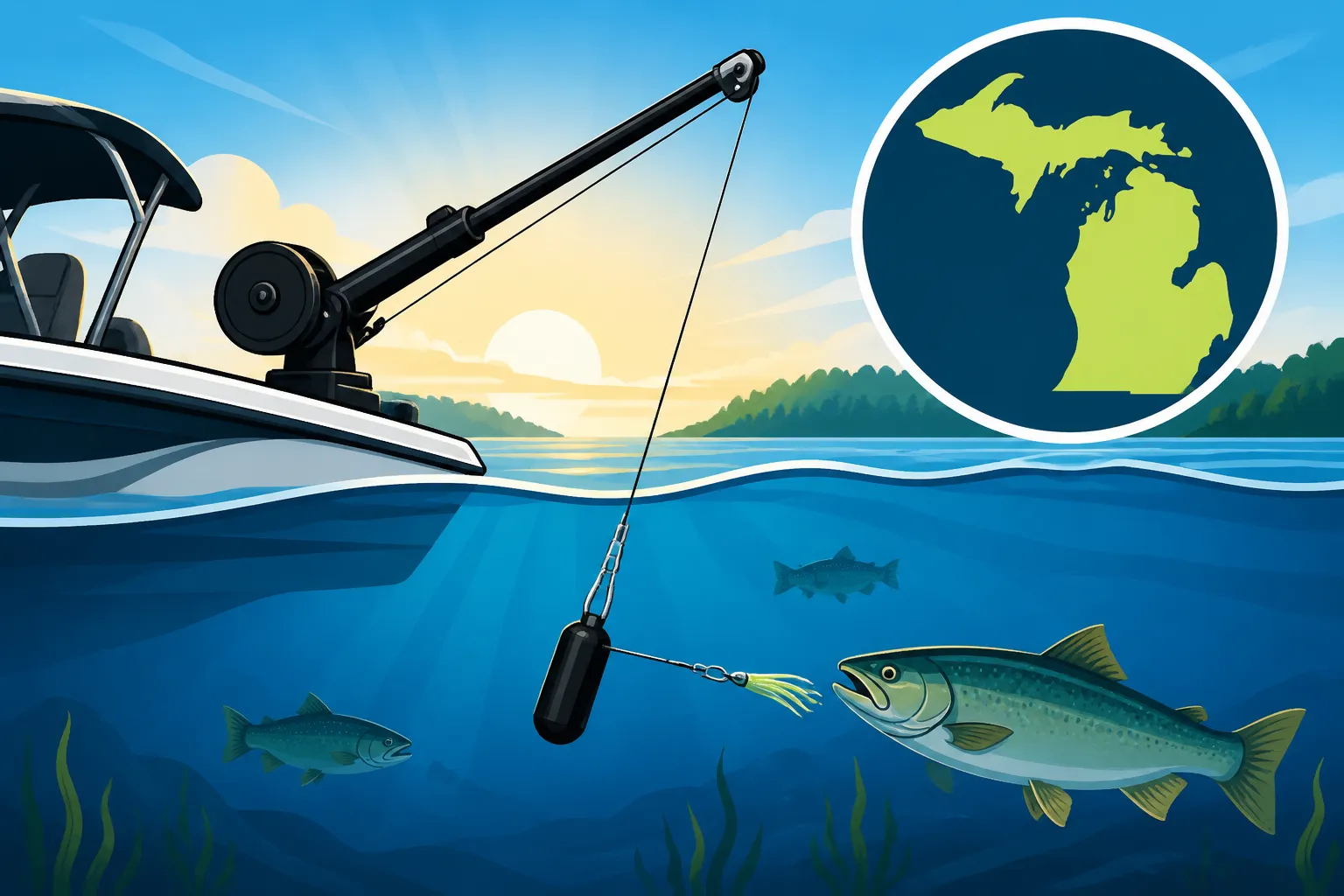
A downrigger is essentially a specialized winch system designed to get your fishing lure down to a precise, controlled depth and keep it there while your boat is moving. It uses a heavy cannonball-like weight (the downrigger ball) to pull your fishing line, which is attached to the ball with a release clip, straight down. When a fish strikes, the line pops free from the clip, allowing you to fight the fish directly without the weight of the downrigger ball.
Why is this so crucial in Michigan? Imagine trolling for salmon on Lake Michigan. These fish might be holding at 60 feet over 200 feet of water. Without a downrigger, trying to get a lure to stay consistently at that depth while trolling at several miles per hour is incredibly difficult, if not impossible. Conventional methods like lead core line or diving planers have their place, but they offer less precise depth control and often don't get as deep or keep the lure as consistently at depth as a downrigger. For anglers serious about targeting species like Chinook and Coho salmon, or the deep-dwelling lake trout, downriggers aren't just a luxury; they're a fundamental piece of Trolling Gear for Michigan's Great Lakes.
Factors Influencing Fish Depth in Michigan Waters
Fish aren't just randomly swimming around; they're constantly seeking optimal conditions for feeding, comfort, and safety. Several environmental factors heavily influence where they choose to hang out in the water column.
- Water Temperature (Thermocline): This is arguably the most significant factor, especially for cold-water species like salmon and trout. The Great Lakes stratify in summer, forming distinct layers of water with different temperatures. The thermocline is the boundary between the warmer surface water and the colder, deeper water. Baitfish often congregate along this cooler, oxygen-rich layer, and predatory fish follow them. Understanding where the thermocline is located is paramount for downrigger fishing.
- Light Penetration: Fish, like humans, are sensitive to light. On bright, sunny days, many species will move deeper to avoid the intense surface light. Conversely, on cloudy days or during low-light periods like dawn and dusk, they might come shallower. Water clarity also plays a role; in clearer waters, light penetrates deeper, potentially pushing fish down further.
- Baitfish Location: Find the bait, find the fish. This age-old adage holds true. If schools of alewives, smelt, or cisco are holding at a specific depth, you can bet the salmon, trout, and walleye won't be far behind. Your fish finder will be your most valuable tool for locating these baitfish schools.
- Time of Day/Season: Fish behavior changes throughout the day and with the seasons. Early morning and late evening often see fish moving shallower to feed. In mid-day, they might retreat to deeper, cooler water. Seasonal changes, such as spawning migrations in spring and fall, will also drastically alter their depth preferences. For instance, the Fall Steelhead Run in Michigan Rivers often sees fish staging in deeper lake waters before moving into tributaries.
Key Factors to Consider for Downrigger Depth Settings
Setting your downrigger depth isn't a "set it and forget it" operation. It requires a dynamic approach, constantly adjusting to conditions and the behavior of your target species. Success hinges on a combination of knowledge, observation, and technology.
Species-Specific Depth Preferences
Different fish species have distinct preferences for temperature, light, and food sources, which in turn dictate their usual depth ranges.
- Salmon (Chinook, Coho): These powerhouses are often found from the surface down to 100 feet or more, depending on the season, time of day, and baitfish location. In spring, especially for Coho, they might be quite shallow, sometimes even in the top 20 feet. As summer progresses, Chinook often go deeper, seeking cooler water and following bait. You might find them anywhere from 40 to 90 feet down. Mastering How to Troll for Chinook Salmon on Lake Michigan means understanding these seasonal shifts. For Coho, particularly earlier in the season, they can often be caught higher in the water column, sometimes even with planer boards rather than strictly downriggers, though downriggers are still critical for precise depth.
- Lake Trout: True deep-water dwellers, especially in the summer. Lake trout thrive in very cold water, so don't be surprised to find them well below the thermocline, often 70 to 150 feet deep, sometimes even deeper in the truly vast waters of Lake Superior or the deepest parts of Lake Michigan. In spring or fall, they might venture a bit shallower. If you're wondering How Deep to Troll for Lake Trout, think cold and deep!
- Walleye (Great Lakes): While many think of walleye as shallow-water, structure-oriented fish, the Great Lakes have massive populations that suspend in open water, often relating to submerged reefs, drop-offs, or the thermocline. In places like Saginaw Bay on Lake Huron or western Lake Erie, walleye can be found anywhere from 15 to 40 feet, sometimes deeper, especially during the day. Michigan Walleye Fishing Techniques often involve trolling cranks and stickbaits at these specific depths.
Reading Your Electronics: Fish Finders and Sonar
Your fish finder is your window into the underwater world. Without it, you're essentially fishing blind. It provides critical information that directly informs your downrigger depth settings.
- Interpreting Sonar: Learn to identify fish arches (or dots, depending on your unit's settings), bait balls, and the distinct line of the thermocline. Fish often appear as strong, bright arches. Baitfish show up as cloudy masses or dense schools. The thermocline typically appears as a fuzzy or broken line across your screen, indicating a change in water density. Many modern fish finders, especially those from brands like Humminbird or Lowrance, make it easier to discern these features.
- Marking Fish: Don't just look at the screen; actively use it. If you see consistent fish arches at, say, 70 feet, that's your starting point. If you mark a massive school of baitfish at 55 feet, deploy a downrigger right into that zone. Pay attention to how deep those fish are relative to the surface and the bottom, as this will determine whether you're targeting suspended fish or those holding tight to structure. Many advanced units also offer side imaging or 3D views, giving you an even broader picture of where the fish are holding, but basic 2D sonar is perfectly adequate for depth finding. For more detailed insights, check out Fish Finders for Michigan Boat Fishing.
Water Temperature and the Thermocline
As mentioned, the thermocline is a game-changer for Great Lakes trolling. It's not just a line on your screen; it's a dynamic zone where the water temperature changes rapidly, creating a comfortable habitat for many game fish and their prey.
- Locating the Thermocline: Your fish finder, especially if it has a temperature gauge built into the transducer, can give you a general idea of surface temperature. However, dedicated temperature probes are invaluable for finding the exact depth of the thermocline. These devices can be dropped down to various depths to get precise temperature readings. Once you find a significant temperature drop (often 5-10 degrees Fahrenheit over a few feet), you've found the thermocline. This is often where you'll want to place your downrigger balls, or just above or below it.
- Significance for Cold-Water Fish: Salmon and trout prefer colder water, typically in the 40-55 degree Fahrenheit range. In the summer, this means they're usually below the warmer surface waters, often right in or below the thermocline. Baitfish also gravitate to this zone, so matching your lure depth to the thermocline and bait presence is a winning strategy.
Practical Strategies for Setting Downrigger Depth
Now that you understand the "why," let's dive into the "how." Setting your downrigger depth effectively involves a mix of strategic deployment and continuous adjustment based on real-time feedback.
The "Search Pattern" Approach
It's rare that all the fish are at the exact same depth. A smart angler uses their downriggers to cover multiple depths, increasing their chances of finding active fish.
- Starting Shallow and Going Deeper: A common tactic, especially if you're new to a body of water or conditions have changed, is to start with your downriggers staggered at various depths. If you have two downriggers, you might set one at 40 feet and the other at 60 feet. If you have four, you might run them at 35, 50, 65, and 80 feet. The goal is to present lures across a wide slice of the water column. Once you get a strike, you can then adjust your other downriggers to that productive depth or slightly above/below it. This systematic exploration is key to discovering the fish's preferred depth zone for that particular day.
- Staggering Multiple Downriggers: When you're running multiple downriggers, avoid the temptation to just set them all at the same depth, even if you've already found fish there. Instead, keep one or two at the "hot" depth and move the others a bit shallower or deeper. Fish often move vertically, and what was hot 30 minutes ago might not be now. Plus, different species might be holding at different depths – you might catch a Chinook at 60 feet and a lake trout at 80 feet. This strategy is vital when fishing diverse areas of Michigan's Great Lakes Fishing Guide.
Adjusting for Conditions: Season, Time of Day, and Weather
Fish depth is not static. It shifts with the environment, so your downrigger settings must adapt.
- Spring Fishing: As the ice recedes and water temperatures slowly rise, many species will be found relatively shallow. Cold surface waters might concentrate baitfish closer to shore or in warmer bays. Coho salmon, in particular, are often found in the top 30 feet in spring. Lake trout might be shallower than their summer haunts. Pay close attention to surface temperature breaks.
- Summer Fishing: This is when the thermocline is strongest and most defined. Salmon and lake trout will seek refuge in the cooler waters below the thermocline, often ranging from 40 to over 100 feet deep. On bright, sunny days, they'll likely be deeper. On overcast days, they might push up a bit higher in the water column, but still typically below the warmer surface layer. Understanding Best Time to Catch Lake Trout on the Great Lakes often comes down to knowing their summer deep-water patterns.
- Fall Fishing: As waters cool again, the thermocline begins to break down, and fish may move shallower. Salmon, in particular, will begin their spawning migrations, staging in shallower lake waters before entering rivers. This can mean fishing downriggers in the 20-50 foot range, or even shallower if you're targeting staging fish near river mouths.
- Cloudy vs. Sunny Days: Light penetration is a big factor. On bright, sunny days, fish often dive deeper to escape the intense light. On dark, cloudy days, or during low-light conditions like dawn and dusk, they'll often come shallower to feed aggressively. Adjust your downriggers accordingly, perhaps running 10-20 feet shallower on a dreary day.
Integrating Lure Type and Action with Depth
It's not just about the downrigger ball's depth; it's about your lure's presentation. Different lures behave differently in the water, and understanding "blowback" is crucial.
- Lure Action and Speed: Some lures, like certain diving crankbaits, are designed to have optimal action at specific speeds. If your lure isn't running true or performing as intended, it might not entice strikes. Experiment with trolling speeds and observe your rod tips; a properly working lure will often impart a subtle wiggle or pulse to the rod. Large spoons or dodger-and-fly combinations might require slower speeds than small, fast-wobbling spoons.
- Considering Blowback: Blowback is the angle your fishing line takes from the downrigger release clip back to your lure due to water resistance. Even if your downrigger ball is at 70 feet, your lure might be only at 60 feet or even shallower, depending on your trolling speed, line diameter, lure type, and how much line you let out from the release clip. The faster you troll, the more blowback you'll experience. Using lighter line and larger downrigger balls can help minimize blowback, but it will always be a factor. When you're How to Set Up Downriggers for Salmon Trolling, always factor in a few feet of blowback, especially if you're running long leaders behind the ball.
| Factor | Typical Depth Range (Great Lakes) | Notes |
|---|---|---|
| Chinook Salmon | 30-90 feet | Often deeper in summer, shallower in spring/fall. Follows bait and thermocline. |
| Coho Salmon | 15-60 feet | Often shallower than Chinook, especially in spring. |
| Lake Trout | 70-150+ feet | Deepest of the common Great Lakes game fish, seeking cold water. |
| Walleye | 15-40 feet | Varies widely by location and structure; can suspend in open water. |
| Thermocline | 30-70 feet (Summer) | Key zone where bait and predatory fish often congregate. |
| Bright Sun | Deeper | Fish retreat from intense light. |
| Cloudy Day | Shallower | Fish more active and move up in water column. |
Common Mistakes and Troubleshooting Downrigger Depth
Even experienced anglers can fall into common traps when it comes to downrigger fishing. Being aware of these pitfalls and knowing how to troubleshoot them can significantly improve your success rate.
Ignoring Your Electronics
One of the biggest mistakes you can make is relying solely on past experience or "gut feelings" for downrigger depth. Michigan's waters are dynamic, and fish move.
- The Danger of Guessing: Just because you caught fish at 50 feet last week doesn't mean they'll be there today. Water temperature, baitfish presence, and even current can shift daily. Blindly dropping downriggers to a historical depth without confirming fish presence or the thermocline on your sonar is like driving with your eyes closed – you might get lucky, but it's risky.
- Your Fish Finder is Your Best Friend: Make it a habit to constantly monitor your fish finder. Look for arches, bait balls, and the thermocline. If you're not seeing anything where you're fishing, move! If you are seeing fish, adjust your downriggers to put your lures right in that strike zone. Invest in a good unit; there are excellent options available from retailers like Bass Pro Shops or online through Amazon that can give you a clear picture of what's below.
Setting All Lines at the Same Depth
It's tempting, once you get a strike, to put all your eggs in one basket and set every downrigger at the "hot" depth. While this can sometimes be effective, it often limits your potential.
- Missed Opportunity for Exploration: Fish, even within the same school, can be spread out vertically. Some might be actively feeding at 60 feet, while others are resting a bit deeper at 75 feet. By running all your lines at one depth, you're missing out on fish that might be just a few feet shallower or deeper.
- The Benefit of a Diversified Spread: Continue to stagger your depths even after finding fish. For example, if you get a strike at 60 feet, set one downrigger there, but perhaps keep another at 50 feet and a third at 70 feet. This diversified spread allows you to confirm the most productive depth while also exploring the edges of that zone. You might be surprised to find that the fish activity shifts or that a different species prefers a slightly different depth.
Not Accounting for Blowback
Many anglers forget that the depth shown on their downrigger counter is the depth of the cannonball, not necessarily the exact depth of their lure.
- Explaining Blowback: As mentioned earlier, water resistance on your line, leader, and lure causes the line to "blow back" behind the downrigger ball. This means your lure is shallower than the ball. The amount of blowback increases with trolling speed, thinner line diameter, and longer leaders. It's especially pronounced with lighter downrigger balls.
- Estimating Blowback: While there's no perfect formula without specialized equipment, you can roughly estimate blowback. A good rule of thumb for standard trolling speeds (2-3 mph) with monofilament line and a typical spoon or fly setup is that your lure might be 5-15 feet shallower than your downrigger ball. If you're running a longer leader, it could be more. Consider using heavier downrigger balls (10-12 lbs) to reduce blowback, or simply set your downrigger ball a bit deeper than your desired lure depth. For example, if you want your lure at 60 feet, you might set your downrigger ball at 65-70 feet, accounting for blowback. This fine-tuning often makes the difference between a slow day and a successful outing.
Ultimately, mastering downrigger depth in Michigan's Great Lakes is a continuous learning process. It requires observation, adaptation, and a keen understanding of both your gear and the fish you're targeting. Keep experimenting, keep learning, and most importantly, keep enjoying your time on the water!
Disclaimer
This article is for general informational purposes only and does not constitute professional advice. Laws, prices and regulations vary by location and change over time. Consult a qualified professional for guidance on your specific situation.