Boats Exempt From Michigan Registration
It can be incredibly confusing to figure out Michigan’s boat registration rules, especially when you’re just trying to enjoy a peaceful day on the water. Many anglers assume every watercraft needs to be registered, leading to unnecessary worry or even incorrect purchases. This guide is here to untangle the nuances of Michigan’s boat registration exemptions, helping you understand exactly which vessels are allowed to hit the lakes and rivers without a state registration sticker, and why.
Understanding the Foundation of Michigan Boat Registration
Before we dive into the exemptions, it's really helpful to understand the basic premise of Michigan's boat registration laws. Generally speaking, if you have a vessel on Michigan waters that uses any kind of motor, even an electric one, it likely needs to be registered. This isn't just about collecting fees; it's about safety, identification in case of an accident or theft, and funding for conservation and waterway maintenance. The Michigan Department of Natural Resources (DNR) oversees these regulations, and they apply to most public waters across the state, from the smallest inland lake to the vast expanse of the Great Lakes. For a more comprehensive overview, you can check out Michigan Boat Registration Requirements.
The underlying goal is to ensure a safe and managed environment for everyone enjoying Michigan's abundant waterways. When you see those registration numbers on the bow, they're not just random digits; they're a unique identifier for that specific vessel. This system helps emergency services, law enforcement, and even other boaters if there's an issue. It’s a good system, but it does leave people scratching their heads when they pull out their trusty rowboat or a brand-new stand-up paddleboard, wondering if they need to jump through the same hoops as someone with a large fishing cruiser.
Why Some Boats Are Exempt
The exemptions aren't random; they're usually based on the type of propulsion, the size of the vessel, or its primary purpose. The state recognizes that a small, non-motorized craft poses a different level of administrative and safety concern than a large powerboat. Think about it: a child's inflatable raft is hardly comparable to a 20-foot bass boat, and the regulations reflect that common sense. The exemptions aim to strike a balance between necessary oversight and not overburdening individuals who are simply enjoying a simpler, often quieter, form of water recreation.
These rules also consider practicality. Imagine if every single inflatable pool toy or child's paddleboat needed to be registered. The administrative burden would be immense, and it wouldn't serve any real safety or funding purpose. Instead, the focus is placed on vessels that are capable of higher speeds, carry more people, or have a greater impact on the waterways, either through propulsion or size. This is why understanding the "why" behind the exemptions helps to make the rules feel less arbitrary and more logical.
General Requirements for Registered Vessels
For those vessels that do require registration, there's a clear process. This typically involves submitting an application, proof of ownership, and paying a fee. Once registered, you'll receive a certificate of number and decals that must be displayed prominently on your vessel. The registration is usually valid for a set period, often three years, requiring renewal. You can learn more about this by checking Michigan Boat Registration Cost and Renewal. Beyond registration, all vessels, whether registered or exempt, must adhere to Michigan's basic boating safety laws, such as carrying enough life jackets for everyone on board and proper lighting after dark. These safety rules are non-negotiable for all watercraft users, regardless of registration status.
It’s crucial to remember that registration is just one piece of the puzzle. Safety regulations, like having the appropriate number and type of personal flotation devices (PFDs) for everyone onboard, are universal. So, even if your small kayak is exempt from registration, you still need to ensure you have a PFD for yourself and any passengers. The DNR's primary concern is always the safety of those on the water, and proper equipment is paramount, even for the smallest craft.
Non-Motorized Vessels: The Most Common Exemption
The biggest category of vessels that are typically exempt from registration in Michigan are those that are solely propelled by human power or wind. This makes a lot of sense when you think about it. These craft generally move slower, have a smaller environmental footprint, and don't require the same kind of oversight as a motorized vessel. It’s a welcome relief for many who enjoy a more serene experience on the water, relying on their own strength or the wind to get around.
This exemption is a boon for paddlers and sail enthusiasts alike. It encourages people to get out and enjoy Michigan's beautiful natural resources without the added administrative steps and costs associated with motorboats. For a lot of folks, the simplicity of launching a canoe or kayak is part of the appeal, and not having to worry about registration certainly adds to that carefree feeling.
Canoes and Kayaks
Good news for all you paddlers out there! Traditional canoes and kayaks, which are moved exclusively by paddles, are exempt from Michigan registration. This means you can pick up a new fishing kayak from a place like Bass Pro Shops, strap it to your roof, and head straight to the water without a second thought about paperwork. This applies whether you're leisurely paddling down the Au Sable River or heading out onto a quiet inland lake for some bass fishing. The same goes for larger, tandem kayaks or even those specialized fishing kayaks with pedal drives – as long as there's no motor involved, you're usually in the clear.
This exemption is one of the reasons kayaking and canoeing have exploded in popularity in Michigan. It lowers the barrier to entry, making these fantastic outdoor activities accessible to more people. Whether you're a seasoned paddler or just getting started, the ease of access is a huge plus. Just make sure you have your PFDs and any other essential safety gear for your trip. If you're wondering specifically about these types of vessels, we have more detailed information in Do Kayaks Need to Be Registered in Michigan? and Do Canoes Need to Be Registered in Michigan?.
Stand-Up Paddleboards (SUPs) and Rowboats
Just like canoes and kayaks, stand-up paddleboards (SUPs) are also exempt from registration, as they are solely propelled by human power. These increasingly popular watercraft offer a unique way to explore Michigan's calm waters and even some gentle rivers. The same principle applies to traditional rowboats – if you're pulling oars and there's no motor mounted on the transom (or anywhere else!), then registration isn't required. It's all about that human-powered propulsion.
Imagine a perfect summer day, gliding across a glassy lake on your SUP, or rowing a classic wooden boat with a tackle box and a friend. The beauty of these activities is their simplicity, and Michigan's registration exemptions help preserve that. They understand that these are not the vessels that create the same level of concern as a powerful motorboat, so they keep the regulations appropriately light. Just remember that even though they're exempt, you still need to follow navigation rules and safety guidelines, like having a whistle and a PFD.
The Motorized Nuance: Adding a Trolling Motor
Here's where it gets a little tricky and often causes confusion: what if you decide to add a small electric trolling motor to your canoe, kayak, or rowboat? This is a common scenario for anglers looking to cover more water or fight currents with less effort. Unfortunately, once you attach any motor, even a tiny electric one, to a previously exempt vessel, it generally becomes subject to registration requirements. The moment that motor touches the water, the game changes.
Michigan law looks at the potential for mechanical propulsion, not necessarily how often you use it. So, even if you only use your trolling motor intermittently, the fact that your vessel has mechanical propulsion means it typically needs to be registered. This is a common mistake people make, assuming their small vessel remains exempt because the motor is removable or only used occasionally. Be sure to understand Does a Boat With a Trolling Motor Need to Be Registered? before you head out with that new electric motor. The DNR wants all mechanically propelled vessels accounted for, regardless of their original design.
Vessels Used on Private Waters: Another Key Exemption
Another significant exemption revolves around where you use your boat. If your boat is exclusively operated on private waters, meaning waters that are entirely enclosed within private property and have no access to public waterways, then it generally does not need to be registered with the state of Michigan. This makes perfect sense; the state's jurisdiction primarily applies to public navigable waters.
This exemption is particularly relevant for those who own property with a pond, a small private lake, or are part of a private lake association where the water body is completely landlocked within private ownership. It's a clear distinction designed to respect property rights while focusing state resources on the waters where the public has access and where general regulations are most needed.
Fully Enclosed Private Lakes or Ponds
If you have a boat that only ever sees the water on your own private pond, or a lake that is completely landlocked within private property with no public access points (no public boat launches, no connections to public rivers or other lakes), then that boat is typically exempt from state registration. This is because the state's interest in regulating and identifying vessels is diminished when the waters are not accessible to the general public.
This exemption simplifies things for property owners who just want to putter around their own little slice of heaven. Whether it's a small jon boat for fishing in your backyard pond or a pontoon boat for leisurely cruises on a private, landlocked lake, you can often do so without state registration. However, you should always double-check with local ordinances or your private lake association, as they may have their own internal rules or restrictions that apply, even if state registration isn't required.
No Connection to Public Waterways
The key here is "no connection to public waterways." This means no streams, rivers, or canals leading in or out that would allow a boat to travel from the private water into public waters, or vice-versa. If there's any navigable access, even seasonal, to a public lake or river, then the exemption typically does not apply, and your vessel would need to be registered if it's motorized. This distinction is crucial and often misunderstood. Just because a lake feels "private" doesn't mean it lacks public access or connections.
A small stream or ditch that connects to a larger river can negate this exemption, even if you rarely or never use that connection. The potential for public access is what the law often considers. So, before assuming your boat on a "private" lake is exempt, ensure there truly are no public access points or navigable connections to broader waterways. When in doubt, it's always best to err on the side of caution and check with the DNR or local authorities.
Other Specific Exemptions and Considerations
While non-motorized and private water exemptions cover a lot of ground, there are a few other specific scenarios where a boat might not need to be registered. These are less common for the average recreational angler but are important to understand for completeness. It demonstrates that the Michigan DNR has thought through various use cases and tried to create a fair and comprehensive system.
Understanding these less common exemptions can prevent confusion and ensure you're always operating within the law. It also highlights the intricate details within boating regulations, which can sometimes feel overwhelming.
Lifeboats and Dinghies (Under Specific Conditions)
Lifeboats that are carried aboard a registered vessel and used solely for emergency purposes are typically exempt from registration. The same often applies to small dinghies or tenders that are used as auxiliary vessels for a larger, registered "mother ship." However, the exemption for dinghies usually comes with specific conditions, such as being clearly marked with the registration number of the main vessel and only being used for transport to and from the mother ship, or for short, auxiliary trips. If you start using that dinghy for extended recreational fishing trips away from the main vessel, it might lose its exempt status.
The rationale here is that these small auxiliary craft are an extension of the primary, registered vessel, and their primary purpose is supporting that main boat or providing emergency safety. They aren't generally considered independent recreational vessels in the same way. So, if your small tender has a tiny motor and you use it to run errands from your yacht to shore, you might be in the clear. But if you take that same tender out for a full day of fishing on its own, it’s worth checking if it crosses the line into needing its own registration.
Vessels Used for Commercial Purposes
Boats used solely for commercial purposes, like charter fishing vessels that carry paying passengers, or boats used for research, rescue, or law enforcement, often have different registration or licensing requirements. They are usually registered under specific commercial categories rather than general recreational boat registration, or they may be regulated by federal agencies like the Coast Guard. While not "exempt" in the sense of needing no identification, they fall under a different regulatory umbrella.
This distinction is important because the safety and operational standards for commercial vessels are often much stricter than for recreational boats. If you’re running a charter fishing operation on Lake Michigan, for instance, you'll be dealing with a host of federal and state regulations that go far beyond what a typical recreational angler needs to worry about. These commercial vessels still contribute to the system, but through different channels.
Vessels Temporarily in Michigan
If you're visiting Michigan from another state or country and your vessel is already validly registered in your home jurisdiction, it generally doesn't need to be registered in Michigan for a temporary period. There are usually time limits associated with this, so if you become a Michigan resident or stay for an extended period, you would eventually need to register your boat in Michigan. This reciprocity is common among states and helps facilitate tourism and ease of travel for boaters.
Always carry your home state's registration papers on board when visiting. This ensures that if you are stopped by the Michigan DNR or local law enforcement, you can easily prove your vessel's legal status. The exact duration for "temporary" can vary, so if you plan a lengthy stay, it’s always wise to consult the Michigan DNR’s guidelines to avoid any issues. This is similar to how your driver's license from another state is valid for a period when you're visiting.
Common Misconceptions and Clarifications
The world of boat registration can be a minefield of "what ifs" and "I heard that…" scenarios. It's easy to get confused, especially with so many different types of watercraft and ways to enjoy Michigan's waters. Let's clear up some of the most frequent misunderstandings to ensure you're well-informed and confident when you launch your vessel.
One of the biggest frustrations anglers face is getting conflicting information or misunderstanding a nuance that leads to a violation. Our goal is to cut through that noise and give you clear, actionable information.
"It's too small to need registration."
This is probably the most common misconception. Many people believe that if their boat is below a certain length, say 10 or 12 feet, it automatically doesn't need to be registered. This is largely untrue in Michigan if the vessel is motorized. The critical factor isn't necessarily the length; it's the presence of a motor. A small, 8-foot dinghy with a 2-horsepower outboard motor will still typically require registration, even though it's tiny.
The state doesn't have a minimum length requirement for motorized vessel registration. If it has an engine, whether gas or electric, it's usually on the hook for registration. So, before you buy that small fishing boat, even if it's compact enough to fit in the back of your truck, make sure you factor in the registration step if it comes with an engine. You can find many small fishing boats at a retailer like Bass Pro Shops that would need to be registered.
"My trolling motor is electric, so it's exempt."
As we touched on earlier, this is another major point of confusion. There's a persistent myth that electric trolling motors are treated differently than gasoline outboards when it comes to registration. Unfortunately, that's not the case for state registration purposes in Michigan. If your vessel is propelled by an electric motor, regardless of its size or power, it generally needs to be registered.
This rule exists because an electric motor still provides mechanical propulsion, which is the defining characteristic for registration. It still allows the vessel to cover distance without human power, and it still requires identification for safety and administrative reasons. So, whether you're running a silent electric motor for sneaking up on fish or a roaring gas engine, the registration obligation remains. Many anglers buy excellent trolling motors from retailers like Amazon, but the motor itself, once installed on a boat, triggers the registration requirement for the vessel.
"I only use it on private property."
While the "private water" exemption is real, its scope is often misunderstood. The critical detail is that the water body must be entirely enclosed within private property and have no navigable outlet or inlet to public waters. If your private lake has even a seasonal creek that connects to a public river, or if there's a public access point that even a small rowboat could use, then the water is no longer considered solely private in the eyes of the law, and your motorized boat would likely require registration.
It's tempting to think of any non-public access lake as "private," but the legal definition is much stricter. Always confirm the actual legal status of the water body. This is a situation where a quick call to the local DNR office or township clerk can save you a lot of headache down the road. If you’re fishing on a body of water that might have public access, even if you’re launching from your own dock, you’ll need to comply with standard regulations. You can check Do You Need a License to Fish on Private Water in Michigan? for related information.
Consequences of Non-Registration
Operating a motorized vessel that requires registration without one can lead to a few unpleasant outcomes. First and foremost, you could face fines. These fines can vary depending on the severity of the violation and whether it's a first offense, but they are certainly not a pleasant surprise. Beyond the financial penalty, law enforcement or DNR officers could order you off the water until the issue is resolved, disrupting your day. In some cases, repeated offenses could lead to more serious legal consequences.
It's simply not worth the risk. The registration fees are generally quite reasonable when considering the benefits they provide to Michigan's waterways and the avoidance of potential legal trouble. Taking a few minutes to ensure your vessel is properly registered is a small price to pay for peace of mind and full compliance. For more details on the repercussions, consider reading What Is the Penalty for an Unregistered Boat in Michigan and Can You Fish From an Unregistered Boat in Michigan?.
Deciding if Your Boat Needs Registration
When in doubt, the best approach is always to check. Michigan's boating laws are designed to be clear, but the nuances can be confusing for even experienced boaters. Taking the time to understand the rules upfront will save you time, money, and potential frustration in the long run.
Here's a simple way to think about it and a table to help you quickly assess your situation.
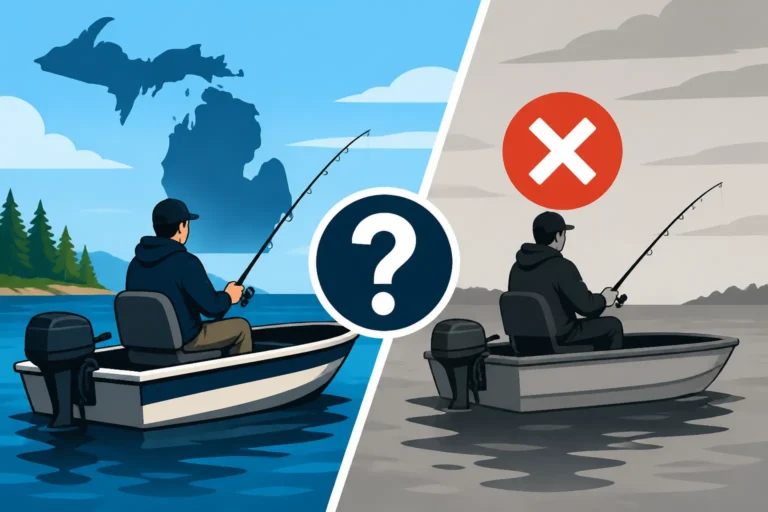
Ask These Key Questions
To simplify the decision, ask yourself these two primary questions:
-
Does my vessel have any form of mechanical propulsion (gas, electric, or other)?
- If YES, it likely needs to be registered.
- If NO (it's purely human-powered or wind-powered), proceed to question 2.
-
Is my purely human-powered/wind-powered vessel being operated exclusively on a completely landlocked, privately owned body of water with no public access or connections to public waterways?
- If YES, it is likely exempt.
- If NO (it's on public water, or private water with public access/connections), it is likely exempt as long as it remains purely human-powered/wind-powered.
These questions cover the vast majority of situations. Remember, the moment you add even a tiny electric motor, the "human-powered" exemption typically disappears, and your vessel becomes a "motorized vessel" in the eyes of the law.
Summary of Common Exemptions
Here's a quick reference table to help clarify the status of some common boat types in Michigan:
| Boat Type | Propulsion Method | Used on Public Water | Generally Requires Registration? |
|---|---|---|---|
| Canoe | Paddles (Human Power) | Yes | No |
| Kayak | Paddles (Human Power) | Yes | No |
| Stand-Up Paddleboard | Paddles (Human Power) | Yes | No |
| Rowboat | Oars (Human Power) | Yes | No |
| Sailboat | Wind (Sails) | Yes | No |
| Canoe with Trolling Motor | Paddles + Electric Motor | Yes | Yes |
| Kayak with Trolling Motor | Paddles + Electric Motor | Yes | Yes |
| Jon Boat with Outboard | Gas Motor | Yes | Yes |
| Bass Boat | Gas Motor | Yes | Yes |
| Pontoon Boat | Gas Motor | Yes | Yes |
| Any Motorized Vessel | Gas or Electric Motor | Public or Connected Private | Yes |
| Any Vessel | Any (Motorized or Not) | Fully Enclosed Private Water | No (if truly private, no public access) |
This table provides a handy snapshot, but remember to consider the specific details of your situation, especially regarding the definition of "fully enclosed private water." When in doubt, it’s always better to over-comply or seek clarification from official Michigan DNR sources. It's much easier to register a boat you didn't strictly need to than to deal with a fine for not registering one you did. To understand the broader context of which boats need to be registered, you can also read Which Boats Need to Be Registered in Michigan.
Conclusion
Navigating Michigan's boat registration rules doesn't have to be a source of stress. The core principle is straightforward: most motorized vessels on public waterways need to be registered. However, the state offers clear exemptions for truly human-powered craft like canoes, kayaks, paddleboards, and rowboats, as well as for any vessels used exclusively on genuinely private, landlocked bodies of water. These exemptions are there to make it easier for many to enjoy the natural beauty and fantastic fishing Michigan offers without unnecessary red tape.
By understanding these distinctions, you can confidently launch your chosen watercraft, knowing you're in compliance with the law. Always double-check if you decide to add a motor to a previously exempt vessel, or if you're unsure about the "private" status of a particular water body. A little bit of knowledge goes a long way in ensuring a smooth, enjoyable, and regulation-free day on Michigan's magnificent waters.
Disclaimer
This article is for general informational purposes only and does not constitute professional advice. Laws, prices and regulations vary by location and change over time. Consult a qualified professional for guidance on your specific situation.