How Far Apart Are the Registration Numbers on a Boat
It’s a scenario many Michigan boaters have faced: you’ve finally got your new boat, the registration is handled, and you’re ready to hit the water, but then you stare at those registration numbers and decals, wondering exactly where they're supposed to go and, more importantly, how far apart they need to be. It’s not just about aesthetics; getting this wrong can lead to frustrating fines and a ruined day on the lake. This guide will walk you through Michigan's specific requirements for boat registration numbers, ensuring your vessel is compliant and ready for adventure.
Understanding Michigan's Boat Registration Number Requirements
Before we even get to the spacing, it’s crucial to understand the foundational rules for displaying your boat's registration numbers in Michigan. These aren't arbitrary guidelines; they're designed for easy identification by law enforcement and to ensure safety on our beautiful waterways. Ignoring these rules, even with the best intentions, can quickly turn a fun outing into a headache. Many boaters, especially new ones, often overlook these details until it's too late, leading to unnecessary stress and potential violations.
Why Proper Display Matters
Think of your boat's registration numbers like your car's license plate. They serve as a unique identifier for your vessel, crucial for everything from emergency response to routine checks by the Department of Natural Resources (DNR). Without clearly displayed and correctly formatted numbers, it's incredibly difficult for authorities to identify your boat if it's involved in an accident, if it's reported stolen, or if there's a safety concern. This isn't just about avoiding a ticket; it's about contributing to the overall safety and accountability on Michigan's vast network of lakes and rivers. A properly registered and marked boat signifies that you're a responsible boater, adhering to the collective efforts to keep our waters safe and enjoyable for everyone. It also helps in situations where you might need assistance; imagine trying to describe a boat to the Coast Guard without accurate identifiers. For a deeper dive into the legalities, check out our guide on Michigan Boating Laws for Anglers.
Key Specifications for Numbers and Letters
Michigan, like most states, has clear-cut rules about the appearance of your boat's registration numbers and letters. It’s not enough to just stick them on; they need to be visible, legible, and durable.
- Height Requirement: Each character – letter or number – must be at least three inches high. This isn't a suggestion; it's a hard rule. Anything smaller makes them difficult to read from a distance, especially at speed or in choppy conditions.
- Block Style: The numbers and letters must be in a simple, block font. Fancy scripts or highly decorative fonts are a no-go. The goal is clarity, not artistic expression. Think basic Arial or Helvetica.
- Color Contrast: The characters need to be a color that strongly contrasts with the color of your boat's hull. If you have a white boat, black numbers are perfect. If your boat is dark blue, white or bright yellow numbers would be appropriate. This ensures maximum visibility, even in low light or glare.
- Permanently Attached: The numbers and letters must be "permanently attached" to the boat. This generally means painted on, or applied with durable, marine-grade decals that will withstand water, sun, and weather without peeling or fading. Using tape or temporary stick-on letters that might fall off isn't going to cut it. You can find robust decal kits at marine supply stores or even on Amazon.
These basic requirements form the foundation of compliance. Getting these right is the first step before worrying about placement and spacing.
Michigan's Specific Rules for Number Placement and Spacing
Now, let's get to the heart of the matter: where do these numbers go, and how much space should be between them? Michigan's regulations are quite precise, leaving little room for guesswork. This section will break down the exact placement, the required spacing, and how to integrate your annual registration decal.
Placement on the Hull
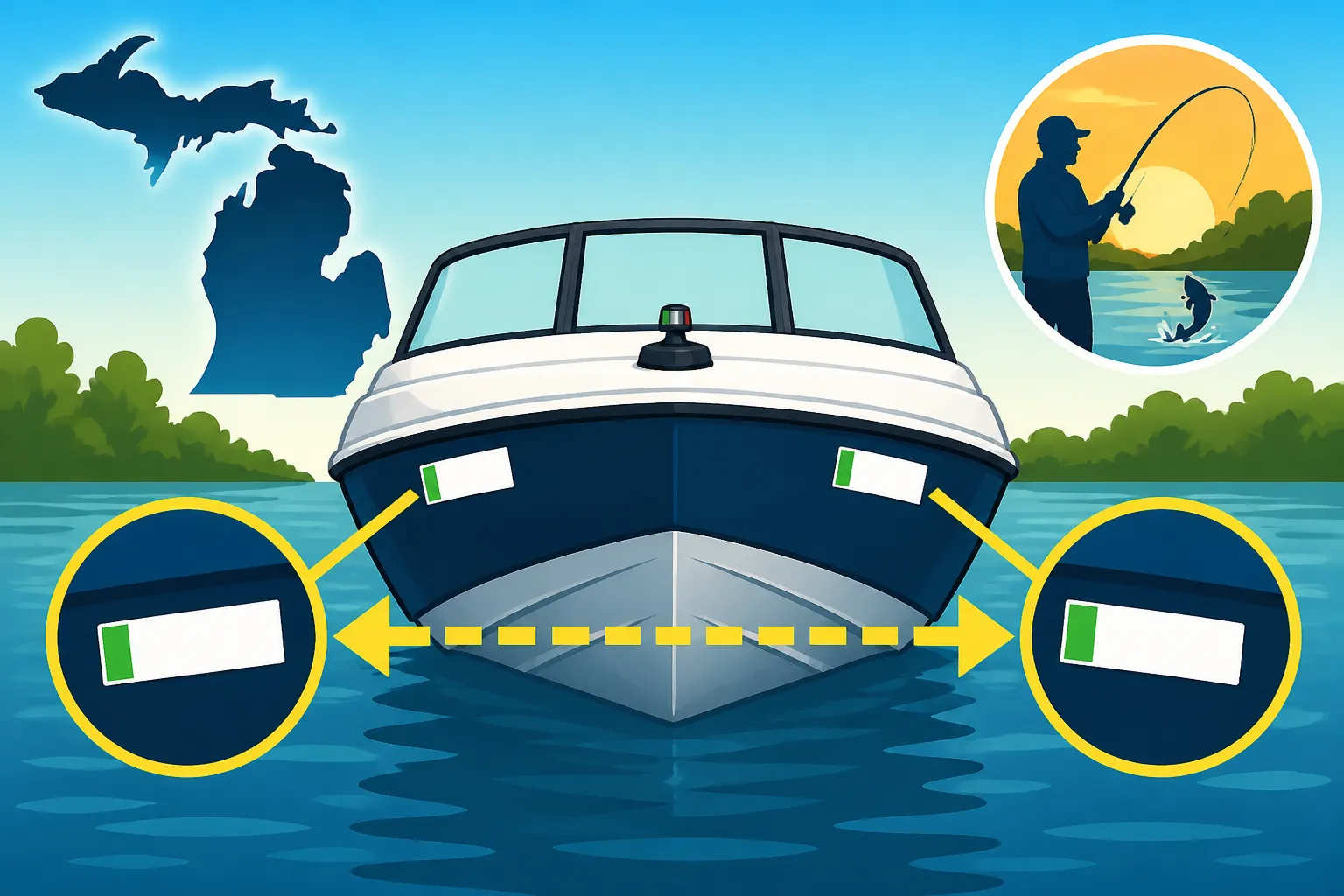
Your Michigan boat registration numbers have a designated spot on your vessel. They must be displayed on both the port (left) and starboard (right) sides of the forward half of the hull.
- Forward Half: This means somewhere between the bow (front) of the boat and the middle. You can't put them on the stern (back) or tucked away near the motor. They need to be prominently featured where they are easily seen from either side of the boat as it moves through the water.
- Visible from Afar: The idea here is that another boater, or a DNR officer, should be able to clearly see your registration numbers as your boat approaches or passes. This typically means placing them high enough above the waterline so they aren't obscured by waves or spray, but not so high that they're on the deck or cabin structure, which can make them hard to read from the side.
Many boaters choose to put them just below the gunwale (the top edge of the hull) or along a natural "stripe" or line on their boat for a clean look. The exact position might vary slightly based on your boat's design, but always prioritize visibility on the forward half of both sides.
The All-Important Spacing Rule
This is where many boaters get tripped up, thinking "close enough" is good enough. But Michigan's rule is crystal clear: there must be a space or a hyphen between the letter group and the number group, and another space or hyphen between the number group and the final letter group.
Let’s say your registration number is "MI-1234-AB".
- Example 1 (Spaces): You would display it as "MI 1234 AB". There's a distinct, visible gap between "MI" and "1234", and another between "1234" and "AB".
- Example 2 (Hyphens): Alternatively, you could display it as "MI-1234-AB". The hyphens act as separators, fulfilling the spacing requirement.
The crucial part is that these separators (space or hyphen) must be approximately equal to the width of a letter or number. You can't just barely separate them; it needs to be a noticeable, consistent gap. This prevents the entire registration number from looking like one long, jumbled string of characters, making it much easier to read quickly and accurately. Misinterpreting this can lead to officers questioning your compliance, even if the characters themselves are correct.
Incorporating the Annual Decal
Michigan requires you to display an annual validation decal alongside your registration numbers. This decal confirms that your registration is current for the given year.
- Placement: The decal must be placed within six inches of the last letter of the registration number on both the port and starboard sides. It needs to be easily visible and not obscured by anything. It’s usually placed just behind the final letter grouping, but can be above or below, as long as it's within that six-inch radius.
- Current Year: Ensure you're always displaying the most current decal. When you renew your registration, you'll receive a new decal, and you should remove the old one before applying the new one. Old decals can cause confusion and might even lead to a citation for improper display. Remember, Michigan's Fishing License Year Runs April to March, so your boat registration decal typically follows a similar annual cycle, requiring renewal each spring.
Here’s a quick summary table for clarity:
| Requirement | Specification |
|---|---|
| Character Height | Minimum 3 inches high |
| Font Style | Block letters and numbers |
| Color Contrast | Must sharply contrast with hull color |
| Attachment | Permanently attached (paint or marine-grade decals) |
| Placement | On both port and starboard sides of the forward half of the hull |
| Spacing | Space or hyphen between letter groups and number groups |
| Spacing Width | Approximately equal to the width of a letter or number |
| Decal Placement | Within 6 inches of the last letter of the registration number on both sides |
Following these guidelines ensures your boat is legally marked and ready for all your Michigan fishing adventures. If you need more details on securing your vessel's legal status, consider reading our Michigan Boat Registration Requirements article.
Practical Tips for Applying Your Registration Numbers
Now that you know the rules, let's talk about the actual application process. It might seem straightforward, but a little preparation and care can make a huge difference in how professional your numbers look and how long they last. Nobody wants crooked, peeling numbers on their prize possession!
Choosing Your Application Method
There are generally two main ways to apply your registration numbers: painting them on or using adhesive decals. Each has its pros and cons.
- Painted Numbers: If you have a steady hand and some painting experience, you can paint the numbers directly onto your hull using stencils and marine-grade paint. This offers a very permanent solution and can seamlessly match your boat's finish. However, it requires precision, patience, and the right kind of paint that will adhere well to fiberglass or aluminum and withstand the elements. Mistakes can be tricky to fix.
- Adhesive Decals: This is by far the most popular and easiest method for most boaters. You can buy pre-cut vinyl letters and numbers, often in kits, specifically designed for marine use. These decals are durable, resistant to UV rays and saltwater (or freshwater, in our case!), and come with adhesive backings for easy application. Many online retailers and marine stores, like Bass Pro Shops, offer custom decal services where you can order your exact registration number in the correct size and font. The key here is to choose high-quality, marine-grade vinyl that won't fade or peel prematurely. Cheaper options from general craft stores often aren't up to the task.
Whichever method you choose, remember the requirement for them to be "permanently attached." This rules out temporary solutions that might fall off.
Step-by-Step Application Process
Let’s walk through applying those decals, as it’s the most common approach.
- Gather Your Supplies: You’ll need your decal kit (with the correct numbers and letters), a tape measure or ruler, painter's tape, a marker (preferably fine-tipped and erasable), a squeegee or credit card, and a cleaning solution (rubbing alcohol works well) with clean cloths.
- Clean the Surface: This is critical! The area where your numbers will go must be absolutely spotless, free of dirt, wax, grease, or old adhesive residue. Use rubbing alcohol and a clean cloth to thoroughly clean the area, then let it dry completely. A clean surface ensures maximum adhesion for your decals.
- Measure and Mark: Using your tape measure and painter's tape, mark out the exact spot for your numbers on the forward half of the hull. Remember to do this on both sides of the boat! Measure carefully to ensure the numbers will be level and positioned correctly.
- Practice Layout: Before peeling any backing, arrange your letters and numbers on the hull using painter's tape to hold them in place. This allows you to check the alignment, the 3-inch height, the block style, and crucially, the spacing between the groups. Adjust until it looks perfect and meets the "width of a letter or number" spacing rule. Don't rush this step!
- Apply Decals Carefully: Once you're happy with the layout, apply one character at a time. Peel a small section of the backing, align the character, and slowly press it onto the hull, using your squeegee or credit card to smooth out any air bubbles as you go. Work from one end of the character to the other. Take your time to ensure each character is straight and firmly adhered.
- Final Press and Cure: Once all characters are applied, go over them again with the squeegee to ensure a strong bond and remove any remaining air bubbles. Avoid washing the boat or exposing the numbers to heavy water pressure for at least 24-48 hours to allow the adhesive to fully cure.
For many, a trip to a local marine outfitter or even browsing marine decal options on Amazon can make this process a lot smoother, as they often come with clear instructions and are designed specifically for this purpose.
Common Mistakes and How to Avoid Them
Even with the best intentions, it's easy to make small errors when applying boat registration numbers. These mistakes, while seemingly minor, can lead to compliance issues and frustrations. Let's look at some common pitfalls and how you can steer clear of them.
Incorrect Spacing Between Character Groups
This is perhaps the most common mistake. People know they need a space or hyphen, but they don't get the amount of space right. They might put a tiny gap, or sometimes a huge gap, thinking "more space is better." Michigan's rule specifies that the space or hyphen should be approximately the width of a character.
- How to Avoid: When you're doing your practice layout with painter's tape, grab one of your actual letters (like an 'M' or 'W') or a number (like an '8') and use it as a measuring guide for the space. If your registration is "MI 1234 AB", once "MI" is placed, hold an 'I' or a '1' sideways next to it to gauge the appropriate gap before placing the "1234". This ensures consistency and compliance.
Not Enough Contrast in Color
Another frequent oversight is choosing numbers that blend too much with the hull color. A light grey hull with slightly darker grey numbers might look subtle and stylish from up close, but from a distance, it becomes illegible.
- How to Avoid: Always opt for a high-contrast color. Black on white, white on dark blue, red on silver – these combinations are easily readable. When in doubt, go for maximum contrast. Imagine a DNR officer on a patrol boat trying to read your numbers in dim light or harsh sun. If it's hard for you to read your own numbers from 20 feet away, it's definitely not compliant.
Improper Decal Placement or Missing Decals
Sometimes boaters forget about the annual decal, or place it incorrectly, thinking it’s just a minor sticker. But it’s an essential part of your boat’s legal identification.
- How to Avoid: Make it a habit to check your decal every spring when you get your new one. Ensure it’s within six inches of the last letter of your registration number and visible on both sides of the boat. Always remove expired decals to prevent confusion. This is also a good time to review your Michigan Fishing License Renewal Each Spring, as keeping all your licenses and registrations current is key to hassle-free enjoyment of our waters.
Crooked or Uneven Application
While not a direct legal violation, crooked or uneven numbers look sloppy and can actually make them harder to read quickly. It detracts from the overall appearance of your boat.
- How to Avoid: The painter's tape and pre-layout steps are your best friends here. Use a long piece of painter's tape as a straight edge along the bottom of where your numbers will sit. This creates a guideline to keep everything perfectly level. Step back multiple times during the process to eyeball the alignment from a distance. If you’re really struggling, remember that professional decal shops can often apply them for you.
By being mindful of these common mistakes and taking a little extra time during the application process, you can ensure your Michigan boat registration numbers are perfectly compliant, clear, and durable, letting you focus on the joy of fishing and boating without any legal worries. It's an investment in peace of mind, allowing you to enjoy all that Michigan's diverse waters have to offer. For instance, if you're planning a trip to a larger body of water, you might want to look into Michigan's Great Lakes Fishing Regulations Guide to be fully prepared.
Maintaining Your Boat Registration Numbers for Long-Term Compliance
Once your boat registration numbers are perfectly applied, your job isn't quite over. Like anything exposed to the harsh elements of sun, water, and weather, they require a bit of ongoing care to ensure they remain compliant and clearly visible for years to come. Neglecting them can lead to fading, peeling, and eventually, a non-compliant display, forcing you to reapply them sooner than necessary.
Protecting Against Fading and Wear
The sun's UV rays are perhaps the biggest enemy of boat decals and paint. Over time, constant exposure can cause colors to fade, especially reds and blues, making your numbers dull and harder to distinguish. Freshwater or saltwater exposure can also contribute to wear and tear.
- Regular Cleaning: Just like the rest of your boat, the areas with your registration numbers need regular cleaning. Use mild boat soap and water, avoiding harsh abrasive cleaners or scrubbing pads that could scratch or damage the decals or paint. Gentle washing helps remove grime, salt residue, and pollutants that can accelerate wear.
- UV Protection: Consider applying a UV protectant specifically designed for marine vinyl or painted surfaces. Products that offer UV inhibitors can create an invisible barrier that shields your numbers from the sun's damaging rays, extending their vibrancy and lifespan. Many boat waxes or ceramic coatings also offer some level of UV protection.
- Storage: If possible, store your boat in a covered area, a garage, or under a boat cover when not in use. This provides the ultimate protection from sun, rain, and other environmental factors, significantly preserving the integrity of your registration numbers and the rest of your boat's finish.
Addressing Peeling or Damage
Even with the best care, sometimes decals might start to peel at the edges, or paint might chip. This needs to be addressed promptly, as any compromise to the clarity or permanence of your numbers can lead to a compliance issue.
- Minor Peeling: If a small edge of a decal starts to lift, you might be able to re-adhere it with a specialized vinyl adhesive, following the product instructions carefully. Trim away any frayed edges with a sharp blade for a cleaner look.
- Significant Damage: If numbers are significantly peeling, torn, or badly faded, it's best to replace them entirely. Trying to patch up heavily damaged decals often looks worse than a fresh application. If you originally painted them and they're chipping, you might need to sand and repaint, or consider switching to high-quality decals for easier replacement in the future.
- Annual Check: Make it a part of your annual boat maintenance routine to inspect your registration numbers closely. Check for fading, peeling, bubbling, or any damage. This proactive approach allows you to fix small issues before they become big problems, ensuring you’re always in compliance and ready to hit the Best Places to Fish in Michigan or wherever your adventures take you.
Maintaining your boat's registration numbers is a small but essential part of responsible boat ownership. A little attention goes a long way in keeping your vessel legal, safe, and looking its best on Michigan's waters.
Disclaimer
This article is for general informational purposes only and does not constitute professional advice. Laws, prices and regulations vary by location and change over time. Consult a qualified professional for guidance on your specific situation.