What Color Are Michigan Boat Registration Decals
One common point of confusion for Michigan boat owners is understanding the ever-changing array of colors on their boat registration decals. It can feel like a game of deciphering hieroglyphs when all you want to do is get out on the water. This guide will help demystify the Michigan boat registration decal system, explaining what each color signifies and why these little stickers are so important for every boater, from seasoned Great Lakes captains to casual inland lake kayakers.
Understanding Michigan Boat Registration Decals
When you're out enjoying Michigan's beautiful waterways, whether it's cruising Lake St. Clair or paddling a quiet inland lake, you'll notice that every motorized vessel, and even some non-motorized ones over a certain length, proudly displays a set of registration numbers and a small decal. These aren't just for decoration; they're a critical part of ensuring your boat is legally recognized and that you're contributing to the upkeep and safety of our aquatic resources. But why do those decals keep changing color every few years? It's a question many boaters ponder, often when they're staring at an envelope from the Michigan Secretary of State.
The Purpose of Registration Decals
At its core, the registration decal serves as a visual confirmation that your boat's registration is current and valid. Think of it like the license plate sticker on your car. Law enforcement, like the Michigan Department of Natural Resources (DNR) conservation officers, can quickly glance at the decal to determine if a vessel is properly registered without needing to stop every single boat on the water. This efficiency is crucial, especially on busy summer weekends.
Beyond enforcement, the funds generated from boat registrations, including the decals, play a vital role in Michigan's boating infrastructure. They contribute to things like public boat launches, navigational aids, and programs that promote boating safety and education. So, while it might seem like a small sticker, it represents a much larger commitment to maintaining Michigan's incredible boating opportunities. You can learn more about the broader requirements in our Michigan Boat Registration Requirements guide.
Components of Michigan Boat Registration
Your boat's registration isn't just about that little decal. It's a multi-faceted system designed to keep things organized and safe. Every registered vessel will have:
- Registration Numbers: These are the large, block letters and numbers that appear on both sides of the forward half of your boat. They're unique to your vessel and are assigned by the state. There are specific rules about their size, color contrast, and placement, which are essential for readability.
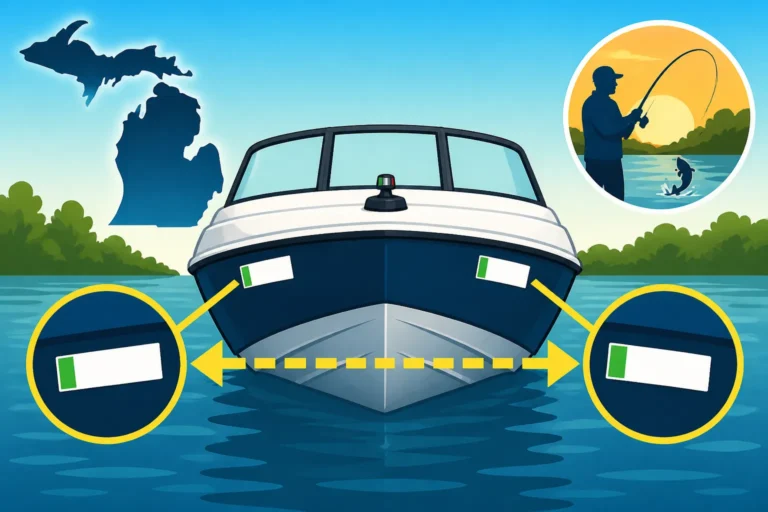
- The Decal: This is the small, colored sticker that indicates the current registration period. It's usually placed near the registration numbers, typically on the bow. The color changes each registration cycle, which is the main topic we're diving into here.
- Certificate of Number (Registration Card): This is the physical paper document that you should always carry with you when operating the boat. It lists all the pertinent information about your vessel and its owner. It's your proof of ownership and registration, much like your car's registration in your glove box.
Understanding these components together ensures you're fully compliant. Many experienced boaters will tell you stories of forgotten registration cards leading to minor headaches, so always double-check your essentials before heading out.
Decoding the Decal Color System
The Michigan boat registration decal color system is designed to quickly show conservation officers whether a boat's registration is current without requiring a full database check. It's a cyclical system, meaning the colors repeat over time, but always in a predictable pattern tied to the registration period.
The Triennial Registration Cycle
Michigan boat registrations are valid for a three-year period. This means you're not renewing your boat registration every single year like you might with a car. Instead, you renew it every three years. This triennial cycle is why the decal colors change. Each color corresponds to a specific three-year registration period. This helps identify quickly if a boat is operating on an expired registration.
For example, if you see a boat with a certain color decal, and you know that color was for the last registration cycle, it's immediately obvious that the boat is likely overdue for renewal. This system is effective because it creates a clear visual cue that's easy to spot even from a distance. The registration period for all recreational boats runs from April 1st of the renewal year through March 31st of the third year. This consistent timing helps everyone know when to expect new decals.
The Decal Color Rotation Explained
The Michigan Secretary of State employs a rotating color system for boat registration decals. While the specific sequence can feel a bit arbitrary, it's consistent. Here's how it generally works:
Imagine a three-year rotation:
- Year 1 (or the start of a new cycle): The decal will be a distinct color, let's say "Red" for illustrative purposes. This decal is valid for three years.
- Year 2 (during the same cycle): No new decal color is issued for boats already registered, as their "Red" decal is still valid.
- Year 3 (during the same cycle): Still no new decal color, the "Red" decal remains valid.
- Year 4 (start of the next cycle): A brand new color is introduced, for instance, "Green." Everyone whose three-year registration is expiring will receive this new "Green" decal upon renewal.
This means that for any given year, you might see a couple of different valid decal colors on the water, representing boats that are in different stages of their three-year registration period. The new color signifies the start of a new three-year cycle.
| Registration Cycle Start Year | Decal Color (Example) | Valid Through (Example) |
|---|---|---|
| 202X | Red | March 31, 202(X+3) |
| 202(X+3) | Green | March 31, 202(X+6) |
| 202(X+6) | Blue | March 31, 202(X+9) |
| 202(X+9) | Orange | March 31, 202(X+12) |
Note: These colors are illustrative. Always refer to current Michigan Secretary of State information for the exact color of the current registration period.
It's common for new boaters, or even experienced ones who've taken a break, to wonder what color they should be looking for. The simplest way is to check the official Michigan Secretary of State website or the materials they send you when it's time to renew. If you're buying a used boat, verifying the decal color and registration status is a good step to take. You can find out more about the financial side in Michigan Boat Registration Cost and Renewal.
When to Expect a New Decal
You'll receive a new decal color when you renew your boat registration, which happens every three years. The Secretary of State typically sends out renewal notices well in advance of your expiration date, usually by mail or email, depending on your preferences. These notices will clearly state the new decal color and provide instructions on how to renew.
If you purchase a brand-new boat or a used boat that has not been registered in Michigan before, you will receive the current cycle's decal color when you initially register it. It's a straightforward process, and whether you're buying online from a retailer like Bass Pro Shops or browsing local marinas, making sure your registration is current is always the final step before hitting the water.
Proper Decal Placement and Maintenance
Once you've got your hands on that shiny new decal, the next step is applying it correctly. This isn't just about aesthetics; proper placement ensures that your registration is clearly visible to law enforcement and complies with Michigan's boating regulations. A misplaced or obscured decal can lead to unnecessary interactions with conservation officers.
Where to Display Your Decals
Michigan boating law is pretty clear on where these little guys need to go. Your registration decal must be displayed on the forward half of your boat, on the port (left) side. It should be placed within six inches of the last character of the registration number. This ensures it's easily visible and associated with your unique boat identifier.
For instance, if your boat's registration numbers are "MI 1234 AB," the decal should be placed on the port side, near the "B." It needs to be above the waterline so it's visible when the boat is operating. A good rule of thumb is to put it in a spot that's flat and clean, away from cleats or other hardware that might obscure it. For more details on this, check out Michigan Boat Registration Decal Placement.
Common mistakes to avoid:
- Placing it too far away: Don't put it near the transom or under a railing where it's hard to see.
- Obscuring it: Make sure it's not covered by dock lines, fenders, or fishing rod holders.
- Wrong side: Always the port side! While it might seem minor, adherence to this rule is important.
Taking a moment to apply it correctly saves you hassle down the line. Many boaters apply these decals themselves, but if you're unsure, a local marina or even a knowledgeable friend can help.
Tips for Application and Longevity
Applying your decal correctly helps it last the full three-year cycle without peeling or fading. Here are some tips:
- Clean the Surface: Before applying, make sure the area where the decal will go is thoroughly clean and dry. Use an all-purpose cleaner and then wipe it down with rubbing alcohol to remove any wax, grease, or residue. This is crucial for adhesion.
- Temperature Matters: Apply the decal when the temperature is moderate, ideally between 50-80°F (10-27°C). Applying it in direct, blazing sun or freezing cold can affect how well it sticks.
- Smooth Application: Peel the backing slowly and apply the decal smoothly, pressing out any air bubbles from the center outwards. A squeegee or even a credit card wrapped in a soft cloth can help with this.
- Avoid Immediate Exposure: If possible, let the decal set for a few hours before getting it wet or exposing it to harsh weather.
Over time, decals can start to fade or peel due to sun exposure, saltwater (if you're on the Great Lakes), or even boat cleaning chemicals. If your decal becomes unreadable or falls off, you should request a replacement from the Secretary of State. You don't want to be caught with a decal that can't be read, as it defeats the purpose of the registration. When shopping for cleaning supplies, reputable sources like Bass Pro Shops or Amazon often have marine-specific cleaners that are safe for decals and boat finishes.
Beyond the Decal: Other Registration Essentials
While the colorful decal is an important visual, it's part of a larger picture of responsible boat ownership in Michigan. There are other aspects of boat registration and operation that every boater needs to be aware of to ensure smooth sailing and avoid any unexpected issues on the water.
What if You Don't Have a Decal or It's Expired?
Fishing or boating with an expired or missing registration decal is akin to driving with an expired license plate sticker. It's a violation of Michigan law. If a conservation officer or marine patrol stops you and finds your registration is expired or your decal is missing, you could face fines and penalties. It's not usually a severe offense for a first-time oversight, but it's easily avoidable by simply keeping track of your renewal date.
Imagine you've planned a fantastic weekend fishing trip on the Manistee River, gear all packed, excited for some steelhead action. The last thing you want is to be pulled over and delayed because of an expired decal you forgot about. Always double-check your Michigan Fishing Regulations Every Angler Should Know and your boat's documents before launching.
Titling vs. Registering Your Boat
It's important to understand that in Michigan, there's a distinction between titling and registering your boat.
- Registration is what we've been discussing – the process of obtaining unique numbers and a decal that allows you to operate your boat legally on the water. This applies to all motorized boats and non-motorized boats 16 feet or longer.
- Titling is about proving ownership of your vessel, similar to how you have a title for your car. In Michigan, boats 20 feet or longer, and all boats with a permanently affixed engine (inboard), must also be titled. This document is crucial for buying, selling, or proving ownership.
So, you could have a titled boat that isn't currently registered for use on the water if you haven't renewed it. Or, for smaller boats, you might register it without needing a title at all. It can be a bit confusing, but knowing the difference is key to being fully compliant. Our guide on Michigan Boat Titling Rules offers a deeper dive into these requirements.
Carrying Your Registration and Other Documents
Just like you carry your driver's license when driving, you are required to have your boat's Certificate of Number (registration card) on board whenever the vessel is in operation. This isn't just a suggestion; it's a legal requirement.
Along with your registration card, it's also a good idea to have any required safety certificates (like a boating safety certificate if you're under a certain age and operating a motorized vessel) and proof of insurance, though insurance isn't always mandatory, it's highly recommended. These documents prove you are legally entitled to operate the boat and are prepared for safe navigation. Many boaters keep these essential documents in a waterproof bag or container that stays on the boat, ensuring they're always accessible. Whether you're fishing a quiet lake or navigating Michigan's Great Lakes, proper documentation is a must.
Disclaimer
This article is for general informational purposes only and does not constitute professional advice. Laws, prices and regulations vary by location and change over time. Consult a qualified professional for guidance on your specific situation.