Best Time to Target Lake Trout in Spring
Trying to figure out the absolute best time to hit Michigan's vast waters for lake trout in the spring can feel like chasing a ghost. Conditions can change daily, and those lakers, well, they're notorious for being elusive. This guide is all about helping you decode the mysteries of spring lake trout fishing, pinpointing those prime windows, and giving you the know-how to increase your chances of a successful outing.
Understanding Lake Trout Behavior in Spring
Spring in Michigan is a time of major transition, and for lake trout, it means a shift from their winter patterns. Many anglers get frustrated because what worked through the ice doesn't necessarily cut it once the thaw begins. The key is understanding how these cold-water predators react to warming temperatures and increased light penetration.
Post-Spawn Recovery and Foraging Patterns
Lake trout typically spawn in the fall, which means by the time spring rolls around, they're often in a post-spawn recovery mode. They've expended a lot of energy during the spawning ritual and the long winter, so their primary focus turns to replenishing their fat reserves. This makes them active feeders, though not always aggressive in the way you might think. They're looking for easy meals, and their metabolism is still relatively slow in the colder early spring waters.
You'll often find them lurking near areas where baitfish are congregating, such as shallow flats adjacent to deep water, points, and structural elements. These fish are trying to maximize their caloric intake with minimal effort. Think of them like someone who just ran a marathon; they're hungry, but they're not going to sprint for food if they can help it. They'll position themselves strategically to ambush unsuspecting schools of ciscoes, alewives, or smelt.
Depth Migration and Preferred Habitats
As spring progresses, lake trout will undertake subtle migrations in the water column and across different habitats. Immediately after ice-out, especially in inland lakes, they might be found relatively shallow, sometimes as shallow as 10-30 feet, as the entire water column is uniformly cold and baitfish are often pushed towards the surface by predators or seeking warmer surface layers near shore. This is a fantastic, but often brief, window for shore anglers or those without extensive deep-water gear.
However, once surface temperatures start to warm noticeably and the water column begins to stratify, lake trout will start their slow descent, seeking their preferred cold-water refuge. In the Great Lakes, this movement might be less dramatic early on due to the sheer volume of cold water, but they will still relate to deeper structures, current breaks, and underwater points where they can ambush prey and maintain comfort. Knowing the general layout of the lake bottom and looking at bathymetric charts can be incredibly helpful for identifying these transition zones. For a broader understanding of where these fish thrive, check out our guide on Michigan's Great Lakes Fishing Guide.
Optimal Spring Timing and Water Temperatures
Michigan's spring weather can be fickle, but water temperature is the single most critical factor in determining lake trout location and activity. Forget the calendar; pay attention to the thermometer.
Early Spring Ice-Out Period
The absolute earliest part of spring, immediately following ice-out, can be one of the best times to target lake trout, especially in inland lakes and shallower Great Lakes bays. The entire water column is still very cold, often in the mid-30s to low 40s Fahrenheit. At this time, lake trout are often found shallower than any other time of year. This uniform temperature means they don't have to expend much energy to find their preferred cold-water environment.
This shallow-water window is golden because it makes them more accessible to a wider range of anglers, even those without specialized deep-water trolling gear. You might find them in depths of 15 to 40 feet, cruising along drop-offs or over humps. The challenge is that this period can be short-lived, sometimes only lasting a couple of weeks, depending on how quickly the air temperatures warm up. Anglers who are ready to hit the water the moment the ice melts often find the most success during this brief window.
Mid-Spring Turnover and Thermocline Formation
As spring progresses and the surface water warms, inland lakes often experience what's known as "turnover." This is when the warmer surface water sinks, and the colder bottom water rises, mixing the entire lake. While turnover itself isn't directly related to lake trout actively biting, the period after turnover, as the lake begins to stratify and a thermocline starts to form, is crucial. For the Great Lakes, due to their immense size, a full turnover might be less dramatic or occur much later in the season, but the principle of temperature stratification still applies.
Once the thermocline (a distinct layer of rapid temperature change) starts to set up, lake trout will primarily hold above, within, or just below it, always seeking that ideal temperature range, typically between 40-55 degrees Fahrenheit. This usually means they'll start moving deeper, tracking their preferred temperatures and the baitfish that also relate to those zones. This mid-spring period often means transitioning to more traditional deep-water techniques as the fish become less accessible in shallow areas.
How Water Temperature Dictates Location
Lake trout are extremely temperature-sensitive. They are a cold-water species, and their activity levels and preferred depths are almost entirely dictated by finding water within their comfort zone. In early spring, when the water is uniformly cold, they might be spread out more horizontally. But as the surface warms, they will condense into layers or pockets of cold water.
For example, if you find surface temperatures hitting 55 degrees, you can be almost certain the lake trout aren't far from that 45-degree thermocline, which might be 60 or 80 feet down. Using a good fish finder with temperature readouts can be invaluable for identifying these thermal breaks. Many high-quality fish finders, readily available on Amazon, can give you a significant advantage in locating these fish. Always consult resources like How Deep to Troll for Lake Trout to fine-tune your approach based on current conditions.
Best Spring Techniques for Lake Trout
The tactics you employ for spring lake trout will heavily depend on whether you're fishing early, mid, or late spring, and whether you're on a vast Great Lake or a smaller inland body of water. Adaptability is your best friend.
Trolling with Downriggers and Planer Boards
Trolling is undeniably one of the most effective methods for covering vast amounts of water and presenting lures at precise depths for lake trout, especially as they move deeper later in spring. Downriggers become essential tools for getting your lures down to where the fish are holding, often 50 to 100+ feet deep. They allow you to run multiple lines at different depths, mimicking schools of baitfish. When running downriggers, keep your lures fairly close to the release clip, typically 10-20 feet back, to ensure they're tracking true at the desired depth.
Planer boards, while more commonly associated with salmon fishing or covering shallower spreads, can still be useful in spring. In early spring, if lake trout are still relatively shallow, planer boards allow you to spread your lines horizontally, away from the boat, covering a wider swath of water without spooking fish in clearer, shallower conditions. You might use them to target fish holding closer to shore or over structure that the boat itself might otherwise pass directly over. Our guide on Downriggers for Michigan Great Lakes Trolling offers more in-depth information on these crucial tools.
Jigging and Vertical Presentation
Jigging is an incredibly effective technique, particularly in early spring when lake trout might be shallower, or later, when you've located a suspended school over deeper water. Heavy spoons, tube jigs, and vertical jigs are excellent choices. The key is to present these lures directly to the fish you're marking on your electronics. A common retrieve involves lifting the rod sharply, letting the lure fall on a semi-slack line to mimic a wounded baitfish, and then repeating. The strike often comes on the fall, so pay close attention to your line.
This technique is especially productive when fishing near prominent underwater features like humps, reefs, or sudden drop-offs. Imagine you're marking fish at 40 feet over a 100-foot bottom. You drop your jig right down to that depth, give it a few aggressive lifts, and watch your fish finder for a reaction. Sometimes a subtle "dead stick" method, where you just let the jig hang motionless for a few seconds, can trigger a bite from a wary laker. Consider looking at techniques described in How to Jig for Walleye in Michigan as some principles can be adapted for lake trout.
Shore and Pier Opportunities
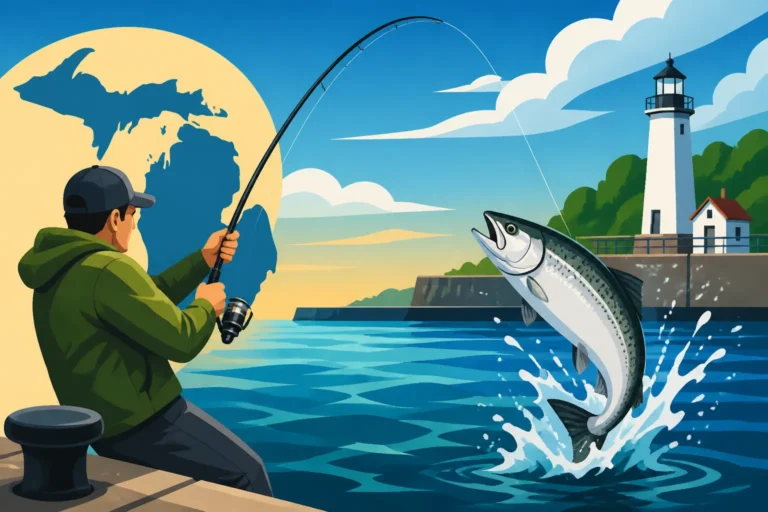
While typically thought of as a deep-water species, the early spring window presents fantastic opportunities for shore and pier anglers, particularly for smaller to medium-sized lake trout, but sometimes even larger ones will venture in. As mentioned earlier, during ice-out, the uniformly cold water allows them to cruise shallower depths, making them accessible from accessible points. Look for piers, rocky points, and shorelines that drop off quickly into deeper water.
Casting heavy spoons, like a ¼ to ¾ ounce silver or blue/silver spoon, can be very effective. Work these lures with a retrieve that mimics a wounded baitfish – a few cranks, then a pause, letting the lure flutter. Some anglers even have success casting larger stickbaits or swimbaits. Remember, persistence is key, and the best times often coincide with dawn and dusk, or overcast days when the light penetration is lower. Always be aware of Michigan Fishing Regulations Every Angler Should Know regardless of where you're fishing.
Essential Gear for Spring Lake Trout Fishing
Having the right gear makes a huge difference, not just in catching fish, but in enjoying the experience and being prepared for Michigan's unpredictable spring conditions.
Rods, Reels, and Line Selection
For trolling for lake trout, you'll want sturdy gear that can handle the pull of a large fish and the resistance of deep-diving lures or downrigger weights. Medium-heavy to heavy action rods, around 7 to 9 feet in length, are ideal. These rods need enough backbone to fight strong fish but also enough flexibility in the tip to telegraph subtle bites or to work with downrigger releases. Look for specialized trolling rods or salmon/steelhead rods.
Pair these with baitcasting reels, preferably level-wind models, spooled with 20 to 30-pound test monofilament or fluorocarbon line. Braided line in the 30 to 50-pound range is also an excellent choice, especially for its no-stretch properties, which enhance sensitivity when jigging. When using braid, a fluorocarbon leader of 15-20 pounds is highly recommended for abrasion resistance and invisibility underwater. For those specifically trolling, exploring options in Best Trolling Rods for Michigan Salmon will give you an idea of what works for similar Great Lakes species.
Lures, Baits, and Electronics
Your tackle box for spring lake trout should be well-stocked with a variety of lures. Spoons are legendary for lake trout; classic colors like silver, copper, blue/silver, and chartreuse/silver are always good bets. Sizes typically range from 3 to 6 inches. Stickbaits and minnow-imitating crankbaits are also highly effective, especially in early spring or when fish are suspended. Consider patterns that mimic local baitfish such as alewives, ciscoes, or smelt. For jigging, heavy tube jigs (3-6 inches), bucktail jigs, and vertical flutter spoons are excellent.
Electronics are non-negotiable for serious lake trout anglers. A reliable fish finder with good sonar capabilities is crucial for marking fish, identifying baitballs, and locating underwater structure. GPS functionality is also incredibly helpful for marking productive spots and navigating large bodies of water. Many reputable brands offer excellent units, and you'll find a wide array of choices on Amazon, from basic models to advanced units with side imaging and real-time sonar. Finally, don't forget a sturdy landing net with a wide hoop and deep basket – a trophy lake trout can be a handful!
| Spring Phase | Typical Water Depth | Recommended Lure Types | Example Colors | Retrieve Style |
|---|---|---|---|---|
| Early Spring (Ice-Out) | 10-40 feet | Spoons, Tube Jigs, Stickbaits | Silver, Blue/Silver, White, Chartreuse | Cast & Retrieve, Vertical Jigging |
| Mid-Spring | 30-70 feet | Trolling Spoons, Diving Plugs, Jigging Spoons | Green/Silver, Orange/Gold, Pearl, Frog | Trolling (Downriggers), Vertical Jigging |
| Late Spring | 60-120+ feet | Large Trolling Spoons, Flashers & Flies, Deep Crankbaits | Green/Chartreuse, Purple, Black/Silver, Glow | Deep Trolling (Downriggers) |
Important Considerations: Weather and Safety
Michigan spring weather is notoriously unpredictable. One day it can be sunny and mild, the next can bring heavy rain, strong winds, or even snow. Always check the marine forecast before heading out, especially on the Great Lakes. Dress in layers, wear waterproof outerwear, and always have appropriate safety gear like life jackets, even if you're not required to wear one at all times. Cold water immersion is a serious risk in early spring.
Furthermore, consider the larger picture of Michigan Fishing Seasons Explained. Understanding how lake trout fit into the broader seasonal patterns will give you an even deeper appreciation and increase your overall success. Being prepared for rapidly changing conditions ensures a safer and more enjoyable trip, allowing you to focus on the fishing rather than battling the elements or worrying about safety.
Disclaimer
This article is for general informational purposes only and does not constitute professional advice. Laws, prices and regulations vary by location and change over time. Consult a qualified professional for guidance on your specific situation.