Best Kayak for Michigan Lake Fishing
There's nothing quite like the freedom of launching a kayak onto a quiet Michigan lake, paddling silently into a secluded cove, and dropping a line where bigger boats can't go. But if you've ever tried to fish from a flimsy recreational kayak or felt overwhelmed by the sheer number of specialized fishing kayaks on the market, you know the frustration of trying to find the right vessel for our diverse inland waters. This guide is here to cut through the confusion and help you discover the best kayak for chasing bass, walleye, or panfish on Michigan's beautiful lakes, ensuring your time on the water is more catch and less stress.
Why Kayak Fishing is a Game-Changer for Michigan Lakes
Kayak fishing has exploded in popularity, and for good reason, especially here in Michigan. It offers a unique blend of accessibility, stealth, and a connection to nature that's hard to beat. If you're tired of battling crowded boat launches or yearn to explore those hidden honey holes, a fishing kayak might just be your new best friend.
The Undeniable Advantages of a Kayak on Inland Waters
Let's be real, traditional bass boats or even larger aluminum fishing boats have their place, but they come with limitations. Kayaks, on the other hand, open up a whole new world on Michigan's lakes. One of the biggest perks is stealth. Imagine slowly gliding across the glassy surface of a small, undisturbed lake like Lake Leelanau, your paddle barely breaking the water. You can approach wary fish in shallow weed beds or along rocky drop-offs without the noisy rumble of an outboard motor. This quiet approach often leads to more bites, especially from pressured fish.
Then there's the unparalleled access. Michigan is dotted with thousands of inland lakes, many of which have limited public access, shallow sections, or no-wake zones that larger boats simply can't navigate. A kayak allows you to launch from almost any shoreline, slide over submerged logs, and explore those tight, snaggy areas that are often overlooked. Think about fishing for bluegill or crappie in the lily pads of a small, unnamed lake, or pursuing northern pike in the thick reeds of a bay on Houghton Lake – places where a conventional boat would get stuck or spook every fish for miles. The portability of a kayak means you can easily transport it on top of your car or in the back of a truck, bypassing the need for a huge tow vehicle and boat trailer. This means less time fussing at the ramp and more time fishing.
Overcoming the Challenges of Kayak Fishing
Now, it wouldn't be realistic if we didn't acknowledge some of the hurdles that come with kayak fishing. It's not always sunshine and calm waters, especially in Michigan. Stability is often the number one concern for new kayak anglers. Nobody wants to end up in the drink, especially when you're loaded with expensive gear and trying to land a feisty smallmouth. Recreational kayaks, while great for leisurely paddles, often lack the width and specialized hull design needed for comfortable, secure fishing, particularly if you plan to stand up to cast.
Storage can also be a puzzle. You need a place for rods, tackle boxes, a cooler, safety gear, and maybe even a fish finder battery. Traditional kayaks aren't always designed with this in mind, leading to gear piled precariously in your lap or lashed down clumsily. Moreover, weather concerns are amplified in a kayak. A strong gust of wind can quickly turn a pleasant paddle on Lake Huron into a grueling workout, and sudden thunderstorms demand a quick exit strategy. Understanding these challenges upfront helps you choose a kayak and outfit it properly, turning potential frustrations into manageable considerations. You'll want to review Michigan Boating Laws for Anglers to ensure you're compliant with all regulations, especially regarding safety gear.
Key Features to Look For in a Michigan Lake Fishing Kayak
Choosing the best kayak for Michigan lake fishing isn't just about picking the prettiest color. It's about matching the features of the kayak to your fishing style, the types of lakes you'll frequent, and your personal comfort needs. Let's break down the most critical aspects.
Stability vs. Speed: Finding Your Balance
This is perhaps the biggest trade-off you'll encounter. Stability is paramount for fishing. A stable kayak allows you to cast confidently, stand up to sight fish in shallow water, move around to access tackle, and, most importantly, safely land a thrashing fish. Fishing kayaks achieve stability through wider hulls, flatter bottoms (often pontoon or tunnel hull designs), and sometimes additional outriggers. The downside? These designs are typically slower and harder to paddle, especially over long distances or in windy conditions. If you're primarily fishing small, calm inland lakes like those found in the Irish Hills or near Traverse City, extreme speed might not be a top priority. However, if you plan to cross larger expanses on lakes like Higgins Lake or Burt Lake, a slightly more hydrodynamic hull might be beneficial.
On the other hand, speed comes from narrower, longer, and V-shaped hulls. These cut through the water efficiently, requiring less effort to cover ground. While great for touring or covering vast distances, they often sacrifice secondary stability, making it feel tippier when you lean or stand. For a dedicated fishing kayak on Michigan lakes, most anglers prioritize stability, accepting a trade-off in speed. You want to feel secure enough to focus on fishing, not on staying upright. Think about your personal comfort level and how you plan to fish. Do you need to stand to cast effectively, or are you content fishing from a seated position? This will heavily influence your stability requirements.
Storage Solutions for Your Gear
Kayak fishing involves gear, and lots of it. A good fishing kayak will have integrated, thoughtful storage solutions. Look for:
- Rod Holders: These are essential. Many fishing kayaks come with flush-mount rod holders behind the seat for trolling or storage, and often adjustable rod holders in front for quick access or varying angles.
- Tankwells: These are open storage areas, typically in the stern, with bungee cords or straps to secure crates, coolers, or dry bags. A milk crate rigged with PVC rod holders is a classic, cost-effective solution here.
- Hatches: Watertight compartments with covers (often bow and stern) are perfect for storing extra layers, snacks, wallets, keys, and other valuables that absolutely must stay dry.
- Gear Tracks: These versatile rails, often found on the gunwales, allow you to easily mount accessories like extra rod holders, fish finders, camera mounts, or even cup holders. They offer incredible customization without having to drill into your kayak. Many popular brands like Wilderness Systems or Hobie offer excellent gear track systems.
- Cup Holders and Tackle Trays: While seemingly minor, having easily accessible spots for your drink and frequently used lures can make a big difference in comfort and efficiency.
When you're out on a Michigan lake, whether it's the peaceful waters of Torch Lake or a smaller impoundment, having your tackle organized and readily available, yet secure, will greatly enhance your experience. Imagine needing to re-tie quickly after a snag, and your tackle box is buried under a cooler – not ideal! Many anglers find great deals on storage accessories and tackle management systems on platforms like Amazon.
Propulsion Options: Paddle, Pedal, or Motor
How you move your kayak across the water is another critical decision, especially for lake fishing.
- Paddle Kayaks: This is the traditional method. Paddle kayaks are generally the most affordable and often the lightest. They offer simplicity and excellent upper-body exercise. However, paddling constantly, especially against wind or current, can be tiring, and it means one hand is always occupied with the paddle, which isn't ideal when you're trying to fish. For smaller lakes or short trips, a paddle kayak is perfectly fine and provides a direct connection to the water.
- Pedal-Drive Kayaks: These are a game-changer for many kayak anglers, particularly on lakes. Instead of a paddle, you use your legs to turn a propeller or flippers beneath the hull. This keeps your hands free for casting, re-tying, or even eating a sandwich. The leg muscles are also typically stronger and have more endurance than arm muscles, allowing you to cover more water with less fatigue. This is especially advantageous when fighting wind on larger Michigan lakes or when trying to stay on a school of fish. Brands like Hobie pioneered pedal drives with their MirageDrive system, but many other manufacturers now offer excellent alternatives. The downside? Pedal kayaks are significantly heavier, more expensive, and require a bit more maintenance.
- Motorized Kayaks: Some kayaks are designed with transom mounts or scupper holes that allow for the addition of a small electric trolling motor. This gives you ultimate hands-free propulsion and speed, especially useful for covering large lakes or dealing with strong winds. However, adding a motor increases weight, complexity, and requires battery management. You'll also need to be aware of Michigan Boat Registration Requirements for any motorized vessel, even a kayak. This option bridges the gap between a pure kayak and a small boat, offering maximum versatility for those who want it.
Consider the typical size of the lakes you fish, how much ground you want to cover, and your budget when deciding on propulsion. For many Michigan lake anglers, a pedal-drive system offers the best balance of hands-free fishing and efficient travel.
Top Kayak Types for Michigan Lake Anglers
With the core features in mind, let's look at the popular categories of fishing kayaks and how they fit into the Michigan lake fishing scene. Each type has its devoted followers and its own set of pros and cons.
Sit-on-Top (SOT) Kayaks: Why They're Popular for Fishing
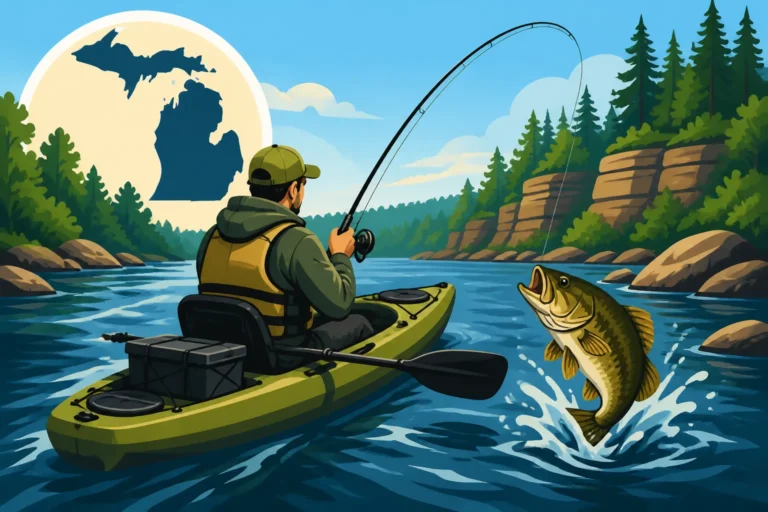
Sit-on-top kayaks are arguably the most popular style for fishing, and for good reason. You sit on top of the kayak, not inside it, meaning the cockpit is open. This design has several benefits for anglers on Michigan lakes:
- Ease of Entry and Exit: Getting on and off a SOT is much simpler than a sit-in kayak, which is a huge plus if you're launching from a bank or need to quickly jump out to wade a shallow area.
- Superior Stability: SOT kayaks are generally wider and have flatter hulls, making them incredibly stable. Many modern SOT fishing kayaks are stable enough to allow anglers to stand and cast, which is a massive advantage for sight fishing for bass in clear waters like those found in the Grand Traverse Bay area.
- Self-Bailing: Scupper holes allow water that splashes onto the deck to drain out, keeping your seating area relatively dry. This is a blessing when fishing in choppy conditions or after a sudden rain shower.
- Open Storage: The open deck design often means more accessible storage space for tackle crates, coolers, and gear, especially in the stern tankwell.
The main drawbacks are that you're more exposed to the elements (though this is less of an issue in the summer), and they can be slower than sit-in kayaks. For pure fishing on Michigan's vast network of inland lakes, a well-designed sit-on-top kayak offers an excellent blend of comfort, stability, and fishability. Many anglers start with a basic SOT kayak, then upgrade as their skills and preferences evolve, perhaps checking out options at Bass Pro Shops.
Pedal-Drive Kayaks: The Hands-Free Advantage
As mentioned earlier, pedal-drive kayaks take the sit-on-top concept and elevate it with hands-free propulsion. If your budget allows, and you plan to spend a lot of time on the water, a pedal-drive kayak is often considered the ultimate fishing platform for Michigan lakes.
- Hands-Free Fishing: This is the main draw. Imagine trolling a lure for walleye on Saginaw Bay, or jigging for perch on Lake St. Clair, all while effortlessly maintaining your position or slowly cruising along a contour line with your feet. Your hands are free to manage your rod, net a fish, or adjust your electronics.
- Efficiency and Endurance: Pedaling uses stronger leg muscles, allowing you to cover greater distances, fight wind, or hold your position against currents with less fatigue than paddling. This means longer, more productive days on the water.
- Precise Boat Control: Many pedal drives allow for instant forward and reverse, offering incredible maneuverability to navigate tight spots or quickly turn to face a hooked fish.
The downsides are their higher cost, increased weight (making car-topping more challenging for some), and more complex maintenance due to the mechanical drive system. However, for serious lake anglers, the benefits often outweigh these drawbacks. For those targeting species like muskellunge where precise boat control and strong retrieval are critical, a pedal drive is almost essential. You might even find dedicated Michigan Muskellunge Fishing Techniques articles recommending pedal kayaks.
Inflatable Kayaks: Portability and Specific Use Cases
When space and portability are your biggest concerns, inflatable kayaks can be a surprisingly viable option for Michigan lake fishing, especially on smaller, calmer bodies of water.
- Unmatched Portability: Inflatables pack down into a duffel bag or backpack, making them ideal for apartment dwellers, RV owners, or anyone with limited storage space. You can easily throw one in the trunk of your car.
- Easy Transport: No roof rack or trailer needed! You can hike into remote ponds or lakes where traditional kayaks are impossible to launch.
- Stability: Modern inflatable fishing kayaks, particularly those with high-pressure drop-stitch floors, can be surprisingly rigid and stable, often rivaling hardshell kayaks. Their wide profile contributes to this stability.
- Durability: Made from rugged PVC or Hypalon, quality inflatables are more puncture-resistant than many people imagine.
However, they do have some notable drawbacks. They require inflation and deflation time, they are generally slower and more susceptible to wind, and sharp hooks or fish spines can still pose a risk (though repair kits are usually included). While not typically the first choice for open Great Lakes fishing, for accessing hidden inland lakes or if storage is your absolute priority, a good inflatable fishing kayak found on sites like Amazon can be a fantastic entry point into Michigan kayak fishing.
| Kayak Type | Primary Propulsion | Key Advantages for Michigan Lakes | Key Disadvantages | Best For |
|---|---|---|---|---|
| Sit-on-Top | Paddle | Excellent stability, easy entry/exit, self-bailing, open storage. | Slower than sit-ins, exposed to elements, hands occupied with paddle. | General lake fishing, standing to cast, ease of use. |
| Pedal-Drive | Pedal | Hands-free fishing, efficient travel, precise boat control, covers more water. | Higher cost, heavier, more complex maintenance. | Serious anglers, covering large lakes, battling wind, long days. |
| Inflatable | Paddle | Extreme portability, easy storage/transport, surprisingly stable (modern). | Requires setup/teardown, generally slower, susceptible to punctures. | Small, calm lakes, remote access, limited storage space. |
Understanding Michigan Lake Conditions for Kayak Fishing
Michigan's lakes offer incredible diversity, from sprawling Great Lakes bays to tiny, spring-fed ponds. Your choice of kayak should absolutely reflect the conditions you'll most frequently encounter. A kayak that's perfect for a calm summer day on a small, protected lake might be a nightmare on a blustery day on Lake Michigan.
Calm Inland Lakes vs. Larger Water Bodies
Michigan is blessed with over 11,000 inland lakes, many of which are relatively small, shallow, and protected from the strongest winds. These are often ideal for paddle-powered sit-on-top kayaks or even robust inflatables. On a calm morning on Higgins Lake, you can easily paddle along the shoreline, exploring coves and structure without much concern for challenging conditions. Here, a kayak with excellent maneuverability for tight spaces and solid primary stability (the initial feeling of steadiness) is a huge asset. These lakes are perfect for targeting panfish, smallmouth bass, and even northern pike. You can find many Michigan Inland Lakes Worth Fishing that are perfectly suited for kayak adventures.
However, Michigan also boasts massive inland lakes like Houghton Lake, Torch Lake, and Burt Lake, not to mention the Great Lakes themselves. These larger bodies of water can generate significant waves and chop, even on seemingly calm days. For these conditions, secondary stability (how well the kayak resists tipping once it's already leaning) becomes incredibly important. A longer, wider, more robust kayak, often with a pedal-drive system, is usually preferred. These kayaks track better in waves, allow you to cover more distance, and crucially, keep your hands free to brace yourself or manage your gear when the water gets rough. Imagine trying to paddle against a stiff headwind on a choppy Grand Traverse Bay; a pedal drive would be a lifesaver.
Weather Considerations: Wind, Waves, and Safety
Michigan weather is notoriously unpredictable. What starts as a glassy morning can quickly turn into a windy, white-capped afternoon. As a kayak angler, you are much more exposed and vulnerable to these changes than someone in a larger boat.
- Wind: Wind is the kayak angler's nemesis. It pushes you around, makes paddling strenuous, and can create chop. On open lakes, a strong headwind can make forward progress almost impossible. If you plan to fish larger lakes, a pedal-drive kayak offers a significant advantage as you can use your stronger leg muscles to power through the wind while keeping your hands free to fish or brace. An anchor system, whether it's a small grapnel anchor or a stake-out pole, is also crucial for holding your position in windy conditions.
- Waves and Chop: Even on inland lakes, boat traffic or sustained winds can create uncomfortable waves and chop. A kayak with a good amount of rocker (the curve of the hull from bow to stern) can handle waves better, riding over them rather than plowing through. A scuppered sit-on-top design helps drain any water that comes over the bow. Always check the weather forecast before heading out, and be prepared to cut your trip short if conditions deteriorate. It's not just about comfort; it's about safety. Make sure you know about Life Jackets and Michigan Boating Safety Rules before you ever launch.
Understanding these environmental factors and matching them to your kayak's capabilities will help you make a safe and enjoyable choice for fishing Michigan's diverse lake landscapes.
Essential Accessories for Your Michigan Fishing Kayak
Once you've picked the perfect kayak, the journey isn't over! Outfitting it with the right accessories is just as important as the kayak itself. These additions enhance safety, comfort, and your overall fishing success.
Safety Gear You Can't Afford to Skip
This isn't optional; it's absolutely critical. Michigan waters can be cold, and accidents happen.
- Personal Flotation Device (PFD): You must wear a Coast Guard-approved PFD. Don't just have it in the kayak; wear it. Modern fishing PFDs are designed with mesh backs, extra pockets for tackle, and tool attachments, making them comfortable and functional for angling.
- Whistle or Air Horn: Required by law on many waters, a sound-producing device is essential for signaling other boaters or attracting attention in an emergency.
- Lights (for low light/night): If you plan to be on the water during dawn, dusk, or at night (think walleye fishing!), you need proper navigation lights. A 360-degree white light is typically required, making you visible to others.
- First-Aid Kit: A compact, waterproof kit should be a staple for any outing. Hooks, cuts, and scrapes are common when fishing.
- Paddle (even with pedal drive): Always carry a spare paddle, even if you have a pedal drive or motor. Mechanical failures happen, and a paddle is your reliable backup to get you back to shore.
Comfort and Convenience Add-ons
These items make your time on the water much more enjoyable and productive.
- Comfortable Seat: Many stock kayak seats are adequate, but an upgraded, elevated frame seat can dramatically improve comfort, especially on long fishing days. Better posture means less back pain and more focus on fishing. Some seats even allow for standing room underneath.
- Paddle Leash/Rod Leash: Dropping a paddle or a favorite fishing rod into the depths of Lake Charlevoix is a quick way to ruin a trip. Leashes keep your gear attached to the kayak.
- Anchor System: For holding your position in wind or current, an anchor is invaluable. Small grapnel anchors (1.5-3 lbs) with about 50 feet of line are perfect for kayaks. A stake-out pole is also great for shallow water, allowing for silent, secure positioning.
- Dry Bag: For items like your phone, car keys, wallet, and extra layers, a dry bag offers waterproof protection. Even if your kayak has hatches, an extra dry bag is good insurance.
- Cooler/Livewell: Depending on whether you plan to keep your catch or just bring snacks and drinks, a small cooler that fits in your tankwell is ideal. Some anglers even rig a small aerated livewell for keeping panfish alive. You'll find many suitable options for coolers at Bass Pro Shops.
Electronics and Navigation
These tools can give you a serious edge in finding fish.
- Fish Finder/Depth Finder: Modern portable fish finders, often with GPS capabilities, are incredibly useful for identifying structure, depth changes, and, of course, fish. They can be mounted on gear tracks or transducer mounts designed for kayaks. Learning how to use a Fish Finders for Michigan Boat Fishing unit effectively will drastically improve your success.
- GPS Unit/Smartphone with Maps: Even if your fish finder has GPS, a dedicated unit or a ruggedized smartphone with offline maps can help you navigate back to launch, mark hot spots, and track your movements, especially on larger lakes or unfamiliar waters.
- Battery Power: If you're running a fish finder or a motor, you'll need a reliable, waterproof battery (typically a small 12V lithium or sealed lead-acid battery) and a system to charge it.
Equipping your kayak properly ensures you're prepared for whatever Michigan's lakes throw at you, making every outing safer and more rewarding.
Disclaimer
This article is for general informational purposes only and does not constitute professional advice. Laws, prices and regulations vary by location and change over time. Consult a qualified professional for guidance on your specific situation.