Best Depth to Fish for Lake Trout in Summer
Oh, the sheer joy of a beautiful Michigan summer day on the water! The sun is shining, the birds are singing, and you're out there, ready to land a trophy lake trout. But then reality hits: the fish aren't biting where you expect them to be. It's a common frustration, isn't it? Summer heat sends these deep-water dwelling fish to their cool, comfortable zones, making them elusive if you don't know where to look. This guide is going to cut through the guesswork and help you pinpoint the best depths to target lake trout in Michigan during those warmer months, turning your summer fishing trips into successful adventures.
Understanding Lake Trout Behavior in Summer
Lake trout are fascinating creatures, perfectly adapted to cold, oxygen-rich waters. Unlike many other species that become more active and spread out as water temperatures rise, lake trout retreat. They're constantly seeking that sweet spot where the water is just right for their metabolism and they can find their preferred forage. If you think of summer as a giant oven, these fish are trying to find the coolest pantry, and in Michigan's deep lakes, that pantry is often hundreds of feet down.
Their behavior is primarily driven by two critical factors: water temperature and dissolved oxygen. As surface waters warm up, usually hitting the 60s Fahrenheit and beyond, the thermal stratification process begins. This means the lake water separates into distinct layers, much like oil and water, with different temperatures. The lake trout are specialists; they thrive in water typically below 55 degrees Fahrenheit, and ideally closer to the low 40s. Understanding this fundamental need is the first step to unlocking their summer hideouts.
The Role of Thermal Stratification and the Thermocline
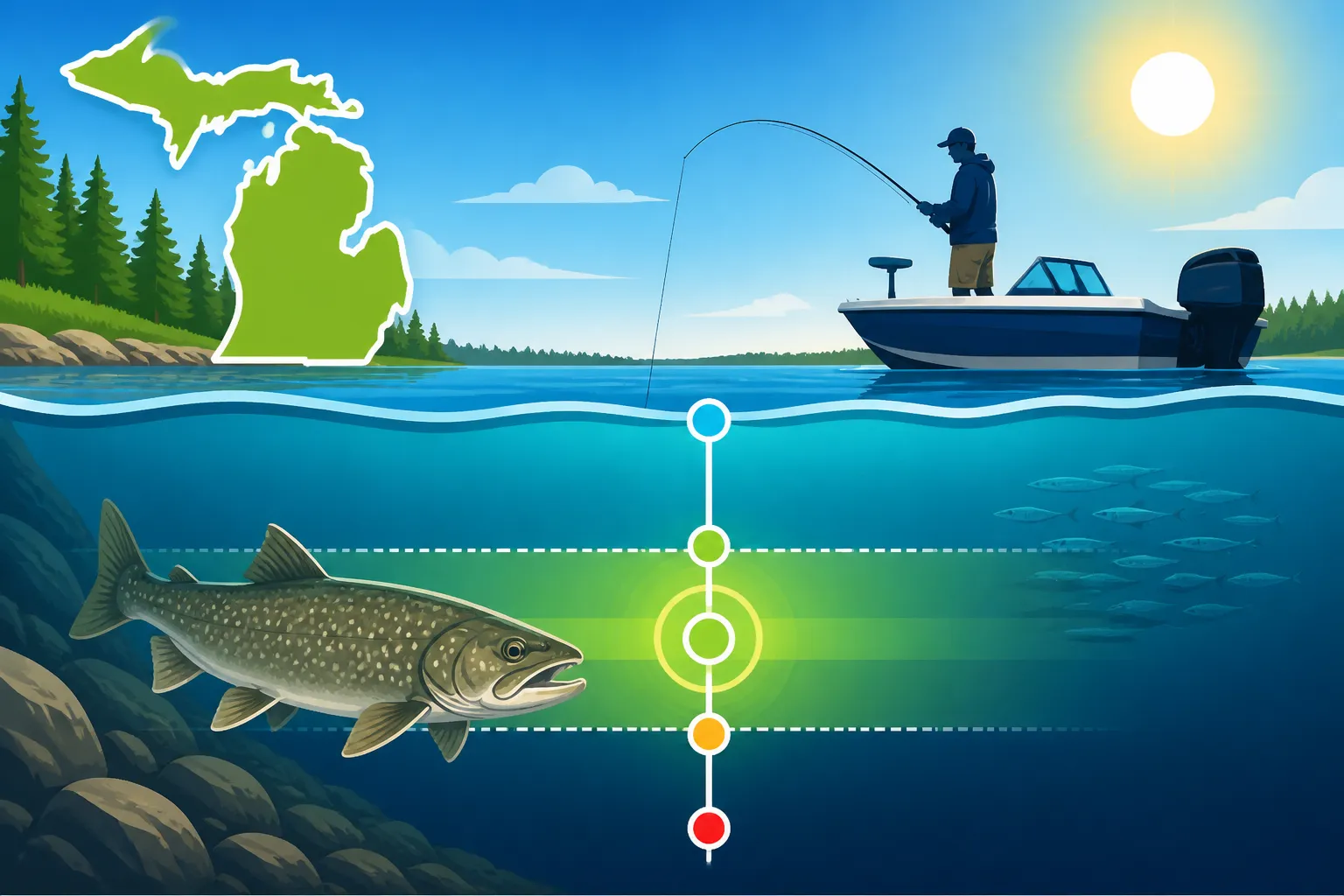
Thermal stratification is the single most important concept to grasp when pursuing lake trout in summer. Picture a deep lake: in spring and fall, the water mixes fairly well, maintaining a more uniform temperature. But come summer, the sun heats the surface, creating a warm upper layer called the "epilimnion." Below this, there's a distinct transitional layer where the temperature drops rapidly – this is the "thermocline." Finally, beneath the thermocline lies the "hypolimnion," a deep, cold, and typically stable layer.
The thermocline isn't just a temperature boundary; it's often an oxygen boundary too. Deeper layers, cut off from the surface, can sometimes experience oxygen depletion, especially in highly productive lakes. Lake trout need both cold water and enough oxygen to survive and thrive. This means they won't just go to the coldest water if it lacks oxygen. They'll position themselves at the intersection of their ideal temperature range and adequate oxygen levels, which often puts them right in or just below the thermocline, or sometimes much deeper in the hypolimnion if oxygen remains plentiful there. Learning to read your sonar to identify this layer is absolutely crucial for success.
Where Lake Trout Find Their Food in Summer
Another key piece of the puzzle is food. Lake trout are opportunistic predators, and their diet can vary depending on the lake and the available forage. In many of Michigan's Great Lakes, their primary food sources include baitfish like alewives, ciscoes (also known as lake herring), and smelt. These baitfish also have preferred temperature ranges and tend to congregate around the thermocline or in deep, structured areas.
So, when you're looking for lake trout, you're not just looking for cold water; you're looking for cold water with food. This often means finding schools of baitfish, which your fish finder can certainly help with. If you locate a dense school of baitfish suspended at a certain depth, you can bet that hungry lake trout won't be far behind. They'll cruise the edges of these schools, ambushing their prey. Understanding the behavior of their forage is just as important as understanding the lake trout themselves.
Identifying Key Depths for Summer Lake Trout
Pinpointing the exact depth for lake trout in summer isn't a one-size-fits-all answer. It's an art that combines science, technology, and a good dose of local knowledge. However, there are general guidelines that can get you started, and then you'll fine-tune based on the specific body of water you're fishing and the conditions of that particular day.
In Michigan's vast waters, from the deep inland lakes like Higgins and Torch to the immense expanse of the Great Lakes, the depth can vary. Generally, you're looking for depths anywhere from 50 feet down to over 200 feet, or even deeper in places like Lake Superior. The key is to find that stable, cold water that still holds plenty of oxygen.
The 50-100 Foot Range: Often a Starting Point
Many anglers targeting lake trout in Michigan's deeper inland lakes and even the Great Lakes start their search in the 50-100 foot depth range. This is often where the thermocline really begins to settle in, offering that critical combination of cooler water and available oxygen.
Imagine you're out on Grand Traverse Bay or a similar deep Michigan fishery. You've launched your boat, and you're ready to start trolling. Setting your downriggers to place your lures in the 60-80 foot zone is a solid initial strategy. This depth range is often where baitfish like ciscoes will hold, and where the lake trout will be actively feeding. If you're not seeing any action after a good half-hour or an hour, don't be afraid to adjust. Move your downriggers up or down by 10-20 feet at a time until you start marking fish on your sonar or, even better, get a strike! Sometimes, the fish might be shallower in the mornings or evenings, briefly pushing up to chase bait, but the midday sun usually drives them deeper.
The 100-200+ Foot Range: Deepwater Sanctuaries
When the summer really heats up, or if you're fishing in exceptionally deep and clear lakes, lake trout will retreat to true deepwater sanctuaries. This often means depths of 100 feet, 150 feet, or even well beyond 200 feet, especially in portions of Lake Superior or the deeper sections of Lake Michigan.
These are the depths where the water temperature remains consistently in the 40s, providing ideal conditions for large, mature lake trout. Reaching these depths requires specialized gear, primarily downriggers, to get your lures down to where the fish are holding. Many experienced anglers will employ multiple downriggers, staggering their depths to cover a wider range. For example, one might be set at 120 feet, another at 150 feet, and a third at 180 feet. Constantly monitoring your fish finder for arcs and bait balls at these extreme depths is key. Don't be surprised if you mark fish hugging the bottom in 200 feet of water – if the conditions are right, they'll be down there. Remember to check the "Michigan Fishing Season Dates and Rules" for any depth-specific regulations that might apply to certain species or areas.
Using Your Electronics to Find the Thermocline and Fish
Your fish finder is your absolute best friend when summer fishing for lake trout. It's not just for showing you the bottom; it's a powerful tool for revealing the entire water column. Learn to identify the thermocline on your unit. It often appears as a fuzzy or layered line on your screen where the density of the water changes, interrupting the sonar signal. Below this line, temperatures drop rapidly.
Once you've identified the thermocline, you can start looking for fish. Lake trout will often appear as distinct arcs or marks, sometimes solitary, sometimes in small groups. Pay close attention to any baitfish schools, which typically show up as larger, more diffuse clouds or patches on your screen. If you see trout marks just above, within, or just below these bait schools at a consistent depth, you've found their feeding zone. Mark that depth and try to replicate it with your lures. Modern fish finders, which you can find excellent options for on Amazon, often have temperature gauges that can give you real-time readings of water temperature at different depths, further assisting your search.
Practical Techniques for Reaching Deepwater Lake Trout
Successfully catching summer lake trout isn't just about knowing the depth; it's about effectively getting your lure to that depth and presenting it in an appealing way. This often involves specialized equipment and techniques that might be different from your usual shallow-water bass or panfish tactics.
Trolling with Downriggers
Trolling with downriggers is the quintessential method for summer lake trout fishing in Michigan's deep waters. Downriggers allow you to precisely control the depth of your lure, dropping it right into the strike zone you've identified on your fish finder.
Here's how it generally works:
- Attach your line: Your fishing line, with the lure already attached, is clipped to a release clip on a heavy cannonball weight.
- Lower the weight: The cannonball is then lowered to your desired depth, taking your lure with it.
- Spread the lines: Many anglers use multiple downriggers, often staggering depths, to cover more of the water column. You can also use planer boards to get your lines out to the side of the boat, further increasing your coverage. You can learn more about "Downriggers for Michigan Great Lakes Trolling" to truly master this technique.
- Wait for the strike: When a fish hits, the line pulls free from the release clip, and you fight the fish directly on your fishing rod.
When choosing downrigger weights, heavier is often better in deep water, especially if you're battling currents. Standard cannonballs are usually 8-12 pounds. Lure selection is also critical. Spoons, plugs, and dodgers with flies or squids are popular choices for lake trout. Colors can vary, so it's good to experiment, but natural baitfish patterns often do well.
Using Dipsy Divers and Lead Core Line
While downriggers offer precise depth control, other methods can also be effective, especially if you don't have downriggers or want to cover different parts of the water column simultaneously.
- Dipsy Divers: These are disc-shaped diving planers that attach to your main line. They dive as the boat moves forward, and their diving depth can be adjusted based on their size and how much line you let out. They also allow you to run lures out to the side, away from the boat, which can be advantageous in clear water. A Dipsy Diver can get your lure down to 50-100 feet or more, making them a versatile tool for shallower lake trout.
- Lead Core Line: This is a specialized fishing line with a lead core wrapped in a braided sheath. Because lead is heavy, the line sinks, taking your lure down to depth. Each "color" (section, usually 10 yards) of lead core sinks to a predictable depth at a given trolling speed. For example, you might get a lure down 5-7 feet for every color of lead core out. So, running 10 colors of lead core could get you to 50-70 feet. It's less precise than a downrigger but can be very effective, especially for reaching fish in the mid-depth range or in conjunction with other methods. Many anglers find great deals on lead core line and other specialized trolling gear on Amazon.
Best Lures for Deepwater Lake Trout
The best lures for summer lake trout often imitate the baitfish they feed on, like alewives or ciscoes. Here are a few reliable categories:
- Spoons: Classic trolling spoons like Silver Streak, Michigan Stinger, or Dodger spoons are incredibly effective. Their wobbling action mimics injured baitfish. Experiment with sizes and colors. Silver, blue/silver, green/silver, and chartreuse are often good starting points.
- Plugs/Stickbaits: Long, slender diving plugs like Rapala Down Deep Husky Jerks or Reef Runners can be deadly. These can be trolled directly, or used in conjunction with downriggers or lead core.
- Flasher/Dodger with Fly/Squid: This combination creates a large, attractive presentation. The flasher or dodger provides erratic action and flash, attracting attention, while a trailing fly or squid (often in a variety of vibrant or natural colors) imitates the actual baitfish. This setup is particularly popular for "Michigan Salmon Species Explained" but works wonders for lake trout too.
| Lure Type | Ideal Depth Range (Summer) | Retrieval Method | Notes |
|---|---|---|---|
| Trolling Spoons | 50-200+ feet | Trolling | Mimics baitfish, versatile, popular with downriggers. |
| Diving Plugs/Stickbaits | 20-100 feet | Trolling | Good for shallower lake trout, or with lead core/Dipsy Divers. |
| Flasher/Dodger w/ Fly | 50-200+ feet | Trolling | High attraction, great for deep water, often pairs with downriggers. |
| Jigging Spoons (Vertical) | 50-200+ feet | Vertical Jigging | Effective when fish are tightly schooled over structure, typically from a stationary boat. |
| Tube Jigs (Vertical) | 50-150 feet | Vertical Jigging | Can imitate baitfish or small crustaceans. Good for active fish. |
Speed and Presentation are Key
Trolling speed is crucial for lake trout. Generally, a slower speed (1.8 to 2.5 mph) is often more effective for lake trout than the faster speeds used for salmon. However, always pay attention to how your lure is performing. Different lures have optimal speeds where their action is most enticing. Watch your rod tip or a surface indicator to ensure your lure is working correctly.
Additionally, don't be afraid to make subtle turns. A slight turn of the boat can cause your lures to speed up or slow down on the outside or inside of the turn, often triggering a hesitant fish into striking. This change of pace can be just enough to make a lake trout commit. Experimentation is always key in fishing, and lake trout are no exception.
Safety and Best Practices for Deepwater Fishing
Deepwater lake trout fishing, especially on Michigan's Great Lakes, comes with its own set of safety considerations and best practices. These aren't just about catching fish; they're about enjoying your time on the water responsibly.
Essential Safety Gear for Great Lakes Anglers
When you're venturing out onto the Great Lakes, conditions can change rapidly. What starts as a calm morning can quickly turn into a choppy afternoon. Always prioritize safety.
- Properly Equipped Boat: Ensure your boat is in excellent working condition and suited for the size of the water you're fishing. A boat for Lake Michigan is very different from one for a small inland lake. Check your engine, fuel levels, and all critical systems. You can read up on "Best Boats for Michigan Fishing" to ensure you have the right vessel.
- Life Jackets: Have enough Coast Guard-approved life jackets for everyone on board, and ensure they are easily accessible. Even on calm days, accidents happen.
- Communication: A marine VHF radio is essential for the Great Lakes. Cell phone service can be unreliable far offshore. A VHF radio allows you to communicate with other boats and call for help in an emergency.
- Navigation: A reliable GPS unit or chartplotter is critical for navigating vast waters and marking your productive fishing spots. These days, many excellent units are available, and you can find a wide selection on Amazon.
- Weather Awareness: Always check the marine weather forecast before heading out and throughout your trip. Be prepared to cut your trip short if conditions deteriorate.
- Emergency Kit: Flares, a first-aid kit, a whistle or horn, a bailing device, and a fire extinguisher are all non-negotiable items.
Respecting the Resource: Catch and Release for Large Fish
While Michigan allows for the harvest of lake trout, many anglers choose to practice catch and release, particularly for larger, older fish. These mature fish are crucial for the population's breeding success and can take many years to reach trophy size.
If you plan to release a large lake trout from deep water, be mindful of barotrauma. When a fish is brought up quickly from extreme depths, the rapid change in pressure can cause its swim bladder to expand, making it difficult for the fish to swim back down.
- Minimize Fight Time: Use appropriate gear to land fish quickly, reducing stress.
- Handle with Care: Support the fish horizontally, especially large ones. Avoid hanging them vertically by the jaw.
- Release Quickly: Get the fish back into the water as soon as possible.
- Descending Devices: For fish showing severe signs of barotrauma (e.g., bulging eyes, stomach protruding), consider using a descending device. These devices clamp to the fish's jaw and are weighted to quickly return the fish to depth, allowing its swim bladder to recompress.
Remember to always adhere to "Michigan Fishing Regulations Every Angler Should Know" and "Michigan Bag and Size Limits Explained" to ensure you're fishing legally and sustainably.
General Tips for a Successful Summer Lake Trout Trip
- Go Early or Stay Late: While lake trout are deep, light conditions can still influence their activity. Early mornings and late evenings can sometimes bring them slightly shallower, or at least make them more active at their preferred deep zones.
- Check Water Temperature at Depth: If your fish finder has a temperature probe, use it! Knowing the exact temperature at different depths is invaluable for finding that optimal zone.
- Vary Your Lures and Depths: Don't get stuck on one lure or one depth. If you're not getting bites, switch things up. Change lure colors, sizes, or even types. Adjust your downrigger depths by 5-10 feet at a time.
- Look for Structure: While lake trout are often suspended, they will relate to deep water structure like humps, ledges, or underwater points. These can concentrate baitfish and provide ambush points for predators.
- Stay Hydrated and Sun Protected: Don't forget about yourself! Long days on the water, especially in summer, require plenty of water and sun protection.
- Learn from Others: Talk to local bait shop owners, charter captains, and other successful anglers. They often have invaluable insights into current conditions and hot spots.
Fishing for lake trout in Michigan during the summer is a rewarding challenge. It requires a bit more technical know-how and specialized gear than some other types of fishing, but the reward of a powerful lake trout on the end of your line is truly something special. By understanding their deep-water habits and employing the right strategies, you'll be well on your way to a successful day out on Michigan's magnificent waters.
Disclaimer
This article is for general informational purposes only and does not constitute professional advice. Laws, prices and regulations vary by location and change over time. Consult a qualified professional for guidance on your specific situation.