Where to Fish for Lake Trout on Lake Huron
Lake Huron, a magnificent expanse of water, can feel overwhelmingly vast when you're trying to pinpoint where to find its elusive lake trout. Many anglers, myself included, have spent hours staring at sonar screens or trolling seemingly endless stretches, wondering if they're even in the right ballpark. This guide is designed to cut through that uncertainty, offering detailed insights into the best fishing grounds, optimal techniques, and seasonal strategies to help you successfully target these magnificent cold-water predators in Michigan's mighty Lake Huron.
Understanding Lake Huron's Lake Trout Habitat
Lake trout are a fascinating and formidable species, perfectly adapted to the deep, cold, and often unforgiving environment of the Great Lakes. Understanding their preferred habitat and feeding behaviors is the first step toward consistently finding them. They aren't just swimming aimlessly; their movements are dictated by temperature, oxygen, and food sources.
Deep, Cold-Water Preferences
At their core, lake trout are salmonids that absolutely thrive in cold, oxygen-rich waters. Lake Huron, being the second largest of the Great Lakes by surface area and boasting significant depths, provides this ideal environment in spades. During the warmer months, you'll find them retreating to the profound depths, often suspending anywhere from 60 to 150 feet or even deeper, depending on the specific basin and the location of the thermocline. They are constantly seeking out that sweet spot where the water temperature remains consistently cool, typically in the mid-40s to low 50s Fahrenheit, and dissolved oxygen levels are high enough to sustain them.
Unlike some of their salmonid cousins, like steelhead or brown trout, which spend more time closer to shore or migrating into rivers, lake trout are primarily pelagic, meaning they spend much of their lives in the open water. They'll hug deep structures, follow contour lines, or simply suspend over vast abyssal plains, always on the lookout for their next meal. This behavior is crucial to remember; if you're fishing shallow in mid-summer, you're likely missing the vast majority of the lake trout population.
Forage Base and Behavior
Just like any predator, lake trout go where the food is. Their primary diet in Lake Huron consists of a variety of baitfish, including alewives, ciscoes (also known as lake herring), and smelt. The health and abundance of these forage species directly influence the size and distribution of the lake trout population. When these baitfish schools move, the lake trout follow, creating dynamic fishing patterns throughout the season.
In some areas of Lake Huron, particularly the deeper, more northern reaches, native ciscoes still form a significant part of the laker diet. In other areas, especially in the southern basin, introduced alewives and smelt are more prevalent. Learning to read your sonar to identify these baitfish schools is paramount to locating actively feeding lake trout. Often, you'll mark dense schools of baitfish, and then, a little deeper or just below them, you'll see those telltale larger arcs representing hungry lake trout. They are opportunistic feeders, and while they might not always be in a "feeding frenzy," they are generally willing to strike at an appropriately presented lure when it's near their food source. This knowledge helps when you're preparing your tackle for your trip, so knowing about Trolling Gear for Michigan's Great Lakes can give you an edge.
Prime Lake Huron Fishing Grounds for Lake Trout
Lake Huron is enormous, but certain regions consistently produce better lake trout fishing due to their unique geological features, depths, and forage availability. Knowing where to focus your efforts can save you a lot of time and fuel.
Northern Lake Huron and Georgian Bay
While a significant portion of Georgian Bay lies within Canadian waters (Ontario), its deep, clear waters, rugged islands, and extensive rocky structures are renowned for exceptional lake trout fishing, and the ecosystem influences Michigan's northern Lake Huron. Anglers venturing into the northernmost parts of Michigan's Lake Huron, particularly near Drummond Island and the areas leading into the Straits of Mackinac, will find similar prime habitat. These waters feature profound depths and complex underwater topography, including deep reefs, shelves, and drop-offs that are perfect ambush points for lake trout.
Regions like the waters north of Thunder Bay, extending toward Presque Isle, offer incredibly productive deep-water trolling opportunities. The underwater landscape here is dramatic, with significant depth changes, attracting large schools of baitfish. Many charter captains operating out of these northern ports, often found through services like FishingBooker, specialize in targeting these deepwater lakers, leveraging their experience to navigate these complex grounds. When exploring these vast areas, having a good understanding of Michigan's Great Lakes Fishing Regulations Guide is essential, especially if you're venturing near international boundaries or different fishing zones.
Deep Water Basins and Reefs in Michigan Waters
For Michigan anglers, some of the most consistent lake trout action can be found in the vast, deep water basins off the coast of the Lower Peninsula's northeastern side. Areas like Thunder Bay, particularly offshore from Alpena, are legendary. Here, the lake floor drops off dramatically, creating expansive deepwater zones where lake trout reside throughout the summer. Targeting the transition zones, where depths rapidly change, or identifying isolated underwater reefs and humps, can be incredibly productive. These features act as magnets for baitfish, concentrating them and, in turn, the lake trout.
The area around the Straits of Mackinac also offers excellent lake trout opportunities. The strong currents and varying depths found in the Straits of Mackinac Fishing grounds create a dynamic environment that holds fish. Anglers often focus on the deeper channels and the edges of the shipping lanes where lake trout stage. When you're heading out to these deepwater spots, it's not just about knowing where to go, but also understanding the necessary legalities. Make sure you've picked up your Michigan Fishing License Guide for Residents and Nonresidents before you even think about dropping a line.
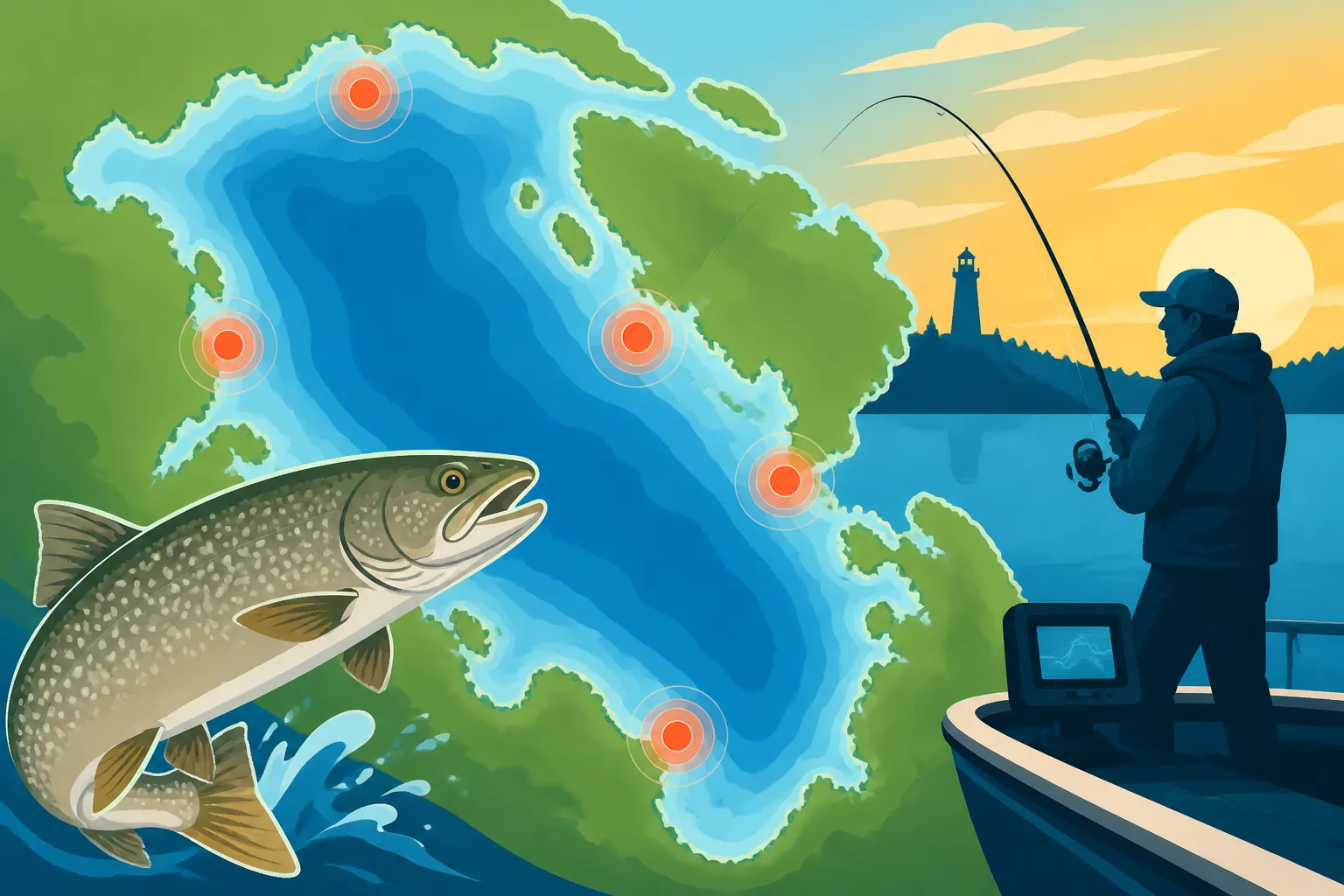
A table outlining some prime Michigan Lake Huron spots for Lake Trout:
| Location (Michigan Waters) | Primary Characteristics | Key Depths (feet) | Best Season(s) | Notes |
|---|---|---|---|---|
| Thunder Bay (off Alpena) | Deep basin, offshore structure, baitfish | 60-150+ | Summer, Fall | Excellent trolling, known for large lake trout, proximity to Best Fishing Spots Near Alpena, Michigan |
| Presque Isle (offshore) | Deep reefs, sudden drop-offs | 80-160+ | Summer, Fall | Productive trolling, can hold schooling fish, good access from Rogers City. |
| Straits of Mackinac | Deep channels, strong currents, varied structure | 50-200+ | Spring, Summer | Challenging but rewarding, fish often hold on current breaks, diverse fishing opportunities. |
| Port Austin (offshore north) | Deep water approaches to Saginaw Bay, structure | 70-120+ | Spring, Early Summer, Fall | Deeper sections of the "Thumb" area, can find transient fish moving. |
| Drummond Island Area | Rocky bottom, deep pockets, transition zones | 50-100+ | Spring, Summer | Near the Canadian border, complex navigation, rewarding for experienced anglers. |
Southern Lake Huron and Saginaw Bay Approaches
While Saginaw Bay itself is generally considered too shallow and warm for consistent lake trout fishing, the deeper waters approaching the bay, particularly north of Port Austin and along the "Thumb" of Michigan, can yield results. In the spring and fall, as water temperatures are cooler throughout the water column, lake trout might venture shallower or migrate through these areas. During the summer, you'll need to focus on the deepest available pockets and offshore structures.
These southern areas often require a keen understanding of contour maps and good sonar to identify the cooler water channels or submerged structure where lake trout might hold. It's less about expansive deep basins here and more about finding those isolated deepwater refuges. An experienced local guide, perhaps booked through a platform like FishingBooker, can be invaluable for pinpointing these less obvious spots in the southern reaches of Lake Huron.
Effective Techniques and Essential Gear for Lake Trout
Lake trout are powerful fish, and successfully targeting them in Lake Huron's vastness requires specific techniques and robust gear. You can't just throw out any old setup and expect to consistently land these deepwater dwellers.
Trolling in Deep Water
Without a doubt, trolling is the most common and effective method for consistently catching lake trout on Lake Huron. This technique allows you to cover vast amounts of water and present your lures at precise depths where lake trout are holding. The key piece of equipment here is the downrigger, which allows you to send your lure down to a specific depth, often 60 to 150 feet, independently of your boat speed.
When setting up your trolling spread, consider using dodgers or flashers paired with spoons or stickbaits. Dodgers and flashers are designed to attract fish from a distance, mimicking schools of baitfish or creating vibrations that draw attention. Popular spoon choices include Michigan Stinger, Dreamweaver, and Silver Streak. For stickbaits, Rapala Deep Tail Dancers or Bandit Walleye Deep are often effective, especially in varying colors and sizes to match the local forage. Experiment with different trolling speeds, usually between 2.0 and 3.5 mph, and use S-turns to vary the depth and action of your lures, often triggering strikes from hesitant fish. Proper line choice is also vital, and many anglers opt for What Line Weight for Michigan Steelhead as a good starting point for similar Great Lakes species.
Jigging and Vertical Fishing
While trolling covers water, jigging and vertical fishing become incredibly effective when you've pinpointed a school of lake trout over a specific structure, such as a deep reef, a sunken island, or a wreck. This technique is all about precision. Once your sonar marks fish, you position your boat directly over them and drop heavy jigging spoons (like a Swedish Pimple, Luhr Jensen K-O Wobbler, or Gibbs Minnow) or bucktail jigs.
The action is typically a lift-and-drop motion, letting the lure flutter enticingly on the fall. The weight of the jig needs to be sufficient to get down quickly and stay vertical in deep water, especially if there's any current. This is a very active form of fishing that requires constant attention to your sonar and rod tip. It's exhilarating when a powerful lake trout smashes a jig in deep water. This tactic is particularly good when you've identified a concentrated group of fish, which can often be found by monitoring your electronics and understanding the nuances of Best Time to Catch Lake Trout on the Great Lakes for peak feeding windows.
Rods, Reels, and Line Selection
For lake trout fishing on Lake Huron, your gear needs to be robust enough to handle powerful fish and the demands of deepwater techniques.
- Rods: For trolling, you'll want medium-heavy to heavy action rods, typically 7 to 9 feet long, designed to handle the pull of downriggers and heavy weights. For jigging, a shorter, sensitive heavy-action rod (6 to 7 feet) is ideal for feeling subtle bites and imparting action to your jig.
- Reels: Baitcasting reels are standard for trolling, offering excellent line capacity and powerful drag systems. Look for models like the Daiwa Sealine, Shimano Tekota, or Okuma Convector. For jigging, either a high-quality baitcasting or heavy-duty spinning reel can work, provided it has a smooth, strong drag.
- Line: Braided line, with its near-zero stretch, is popular for both trolling and jigging, offering superior sensitivity and strength. Spool up with 30-50 pound test braid and attach a 15-25 foot fluorocarbon leader (15-30 pound test) to the end. Fluorocarbon is less visible to fish and offers good abrasion resistance against their sharp teeth.
Seasonal Strategies for Lake Huron Lake Trout
Lake trout fishing on Lake Huron is a year-round pursuit, with each season offering unique opportunities and requiring adjusted tactics. Understanding these seasonal shifts is critical for consistent success.
Springtime Opportunities
As the ice retreats from Lake Huron, typically in April and May, lake trout begin to move into relatively shallower waters compared to their summer haunts. The entire water column is still cold, allowing them to cruise at depths that might be as shallow as 30-60 feet, often chasing schools of smelt or other baitfish that are also moving shallower. This can be a fantastic time to target them, sometimes even with longer lead core lines or dipsy divers without needing the full downrigger setup immediately.
Look for areas near river mouths (though lake trout generally don't ascend rivers like salmon or steelhead), harbor approaches, or shallower reefs that warm up slightly faster than the surrounding deep water. The fish are often aggressive after a long winter and willing to hit a variety of lures. This period can offer some of the most accessible lake trout fishing of the year, before they retreat to the deep.
Summer Deepwater Pursuit
By late June and throughout July and August, Lake Huron's surface waters warm considerably, driving lake trout into their classic deepwater patterns. This is prime time for the deep-water trolling strategies we discussed earlier. Lake trout will congregate in the deepest, coolest sections of the lake, often suspending over vast abyssal plains or holding tight to deep structures like those found in Thunder Bay or off Presque Isle.
The absolute importance of good electronics cannot be overstated during summer. You'll need to meticulously scan for the thermocline (the boundary between warm surface water and cold deep water) and mark baitfish schools. Lake trout will typically be found at or just below the thermocline, or deeper if the baitfish are. Success in summer hinges on your ability to find these temperature breaks and bait concentrations and then present your lures precisely at those depths using downriggers. This pursuit really highlights the need to understand specific fish like Lake Trout Identification in Michigan to ensure you're targeting correctly.
Fall and Pre-Spawn Activity
As the days shorten and Lake Huron's waters begin to cool in September and October, lake trout once again become more active and can be found at varying depths. While some fish may remain deep, others will begin to stage on traditional spawning reefs, often in deeper water, but occasionally shallower depending on the specific location and depth of the reef. This pre-spawn period can offer a final burst of aggressive feeding as the fish prepare for their annual reproduction.
Trolling remains highly effective, but don't discount the possibility of finding fish jigging over specific deep reefs where they are staging. The fall can also bring some of the largest lake trout to the net, as they are at their peak weight and condition. Weather can be a factor during this time of year, with colder temperatures and stronger winds, so always check marine forecasts before heading out. For non-residents planning a fall trip, remember to check into Nonresident Fishing in Michigan: What the Law Requires to ensure you have the correct licenses.
Disclaimer
Fishing conditions and regulations in Michigan can change. Always consult the latest Michigan Department of Natural Resources (DNR) fishing guide and regulations before heading out on the water. This information is intended for general guidance and educational purposes only.