What Pound Test Line for Muskellunge
There's nothing quite as heart-wrenching in Michigan fishing as feeling that monstrous tug on your line, knowing it's a giant muskellunge, only for your line to snap seconds later. It's a common, frustrating scenario that often leaves anglers wondering if their gear, especially their fishing line, was truly up to the task. This comprehensive guide will walk you through everything you need to know about selecting the right pound test line for muskellunge, ensuring you're well-equipped to battle Michigan's apex freshwater predator and bring that trophy fish to the net.
Understanding the Muskellunge Challenge
Before we dive into specific line recommendations, it’s crucial to understand why muskie fishing demands such robust tackle, especially your fishing line. These aren't your average panfish; they are true freshwater leviathans that require specialized approaches.
The Power and Aggression of a Muskie
Muskellunge, often affectionately called "muskies," are apex predators in Michigan's waterways. They are built for power, speed, and explosive strikes. When a muskie hits a lure, it's not a gentle tap; it's an ambush, a violent collision that tests every component of your setup. Imagine a fish that can grow well over 50 inches long, with broad, muscular shoulders and a mouth full of razor-sharp teeth. That's what you're up against.
When hooked, a muskie will often make powerful, drag-screaming runs, followed by head shakes and sometimes even aerial acrobatics. They'll dive into cover, use their immense body to leverage against the line, and try to thrash the hook free. This kind of raw power puts incredible stress on your line, and an undersized line simply won't stand a chance. Many anglers, myself included, have underestimated this power early in our muskie pursuits, leading to lost lures and lost fish – a tough lesson learned. Michigan Muskellunge Fishing Techniques delves deeper into how to handle these powerful fish.
Michigan Muskie Habitats and Obstacles
Michigan's muskie waters, from the vast expanses of Lake St. Clair to the weed-choked bays of inland lakes like Houghton Lake or Lake Hudson, present a gauntlet of obstacles. Muskies often lurk in dense weed beds, around submerged timber, rock piles, or docks, waiting to ambush prey. These environments are fantastic for the fish but terrible for your fishing line.
When a muskie takes off, it will often bolt straight for the nearest cover, trying to snag your line on a branch, fray it against a rock, or cut it on sharp weeds. If your line doesn't have excellent abrasion resistance and sufficient breaking strength, it's a recipe for disaster. Think about retrieving a heavy bait through thick lily pads; if a muskie strikes there, the line needs to be tough enough to pull the fish, and potentially a wad of weeds, out of that cover. A weak line will simply part under the strain, leaving both you and the fish in a difficult situation.
Recommended Pound Test Lines for Muskellunge Fishing
Given the challenges, choosing the right pound test line is paramount. Most experienced muskie anglers gravitate towards specific types and strengths for good reason.
Braided Line: The Go-To Choice
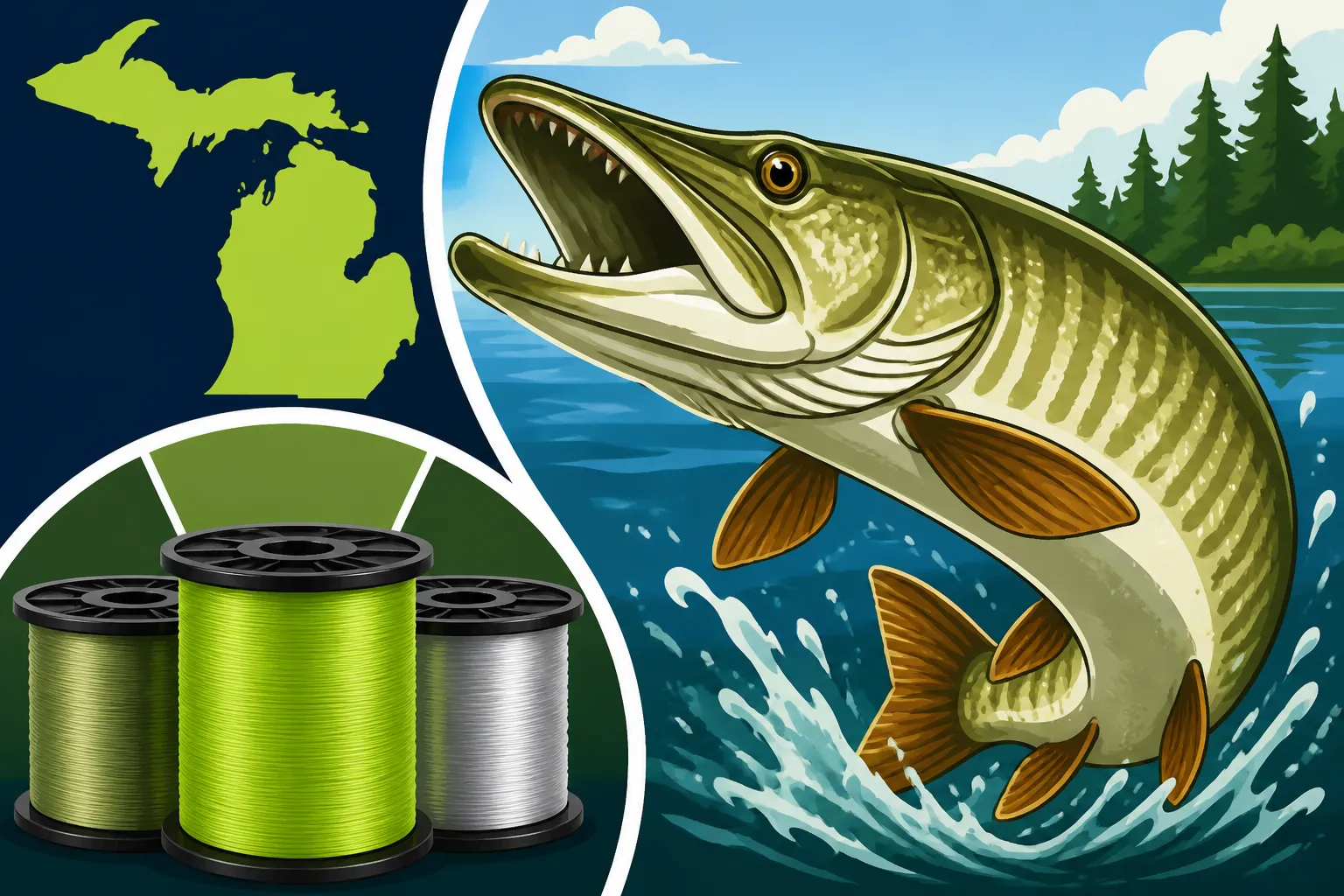
When it comes to muskie fishing, braided line is almost universally recommended as your main line, and for very good reasons. Its combination of strength, small diameter, and lack of stretch makes it ideal for handling these formidable fish and the heavy lures typically used.
First and foremost, braided line offers incredible strength for its diameter. A 65-pound test braided line, for example, has a diameter similar to much lighter monofilament, meaning you can spool more of it onto your reel and cast it further. This strength is crucial when you're setting the hook on a muskie with a hard, bony mouth or when you need to winch a large fish out of heavy cover. The breaking strength of braided line ensures that you have the raw power to turn a fish's head and keep it from burying itself in snags. When you're fishing a place like Lake St. Clair, where muskies can be huge and the current can be strong, that extra power and lack of stretch really make a difference.
Another significant advantage of braided line is its minimal stretch. Unlike monofilament, which can stretch significantly, braid transmits every bump, every weed tick, and every subtle strike directly to your rod tip. This sensitivity is a game-changer for detecting light bites, which, despite their aggression, muskies can sometimes give, especially in colder water. More importantly, the lack of stretch provides a solid connection for powerful hook sets, allowing you to drive those large hooks deep into a muskie's jaw. Without that stretch, you get instant feedback and maximum power transfer. If you're shopping for braided line, you'll find plenty of options at places like Bass Pro Shops or even online through Amazon, with various color choices and spool sizes to fit your needs.
Abrasion resistance is also a key factor. While braided line isn't entirely impervious to cuts, especially from muskie teeth (which is why a leader is essential!), its multi-strand construction generally holds up well against minor scrapes with rocks or wood. However, even the toughest braid can fray over time, so regular inspection of your line is always a good practice. Most muskie anglers will typically use braided line in the 65-pound to 100-pound test range. For general casting of medium to large baits, 80-pound test is a very popular choice, offering a great balance of strength, castability, and manageability. For truly enormous baits or fishing in exceptionally heavy cover, some anglers might even bump up to 100-pound test.
Monofilament and Fluorocarbon: Niche Uses and Considerations
While braided line dominates as the main line for muskie fishing, monofilament and fluorocarbon still have their places, though often in specialized roles or as leaders.
Monofilament Line: Monofilament, or "mono," is a traditional fishing line known for its stretch and affordability. For muskie fishing, it's generally not recommended as a main line due to its significant stretch and lower abrasion resistance compared to braid at similar diameters. That stretch, while sometimes forgiving, makes powerful hook sets difficult with heavy muskie baits and reduces sensitivity. It also has a larger diameter for the same breaking strength as braid, meaning less line on your spool and poorer casting performance with heavy lures.
However, some anglers might use a shorter section of heavy monofilament as a shock leader in certain situations, perhaps for casting very heavy jerkbaits where a bit of stretch can cushion the impact on the cast. But this is far less common than using a dedicated fluorocarbon or wire leader. If you were to use monofilament as a main line for muskies, you'd need something in the 40 to 60-pound test range, but honestly, it's usually best to stick with braid for your primary line for muskie applications.
Fluorocarbon Line: Fluorocarbon is a fantastic line material with several advantages, including excellent abrasion resistance and nearly invisible properties underwater. For muskie fishing, it's primarily used as a leader material, not typically as the main line. Its density makes it sink faster than mono or braid, which can be an issue for some presentations, and its stiffness can make it less enjoyable to cast as a main line, especially in higher pound tests.
However, as a leader, high-pound test fluorocarbon (often 80-pound to 130-pound test) is an excellent choice, especially in clear water or when fishing baits that might benefit from a less visible connection. It provides outstanding abrasion resistance against sharp muskie teeth, though it's still not as cut-proof as wire. Many anglers prefer fluorocarbon leaders when fishing baits like glide baits or soft plastics, where the subtle action might be inhibited by a stiff wire leader. Some muskie enthusiasts even make their own custom fluorocarbon leaders, often purchasing bulk spools from online retailers or at their local Bass Pro Shops.
| Line Type | Typical Pound Test (Muskie Main Line) | Advantages | Disadvantages | Primary Use for Muskies |
|---|---|---|---|---|
| Braided | 65-100 lb | High strength-to-diameter, no stretch, sensitive | Visible, can fray on sharp objects | Main Line for Casting/Trolling |
| Fluorocarbon | (Not typically main line) | High abrasion resistance, low visibility, low stretch | Stiffer, expensive, can be tricky to knot | Leader Material |
| Monofilament | (Not typically main line) | Stretchy, inexpensive, easy to knot | High stretch, lower abrasion resistance, larger diameter | Rare (shock leader) |
Factors Influencing Your Line Choice
Beyond the general recommendations, several specific factors should influence your final decision on pound test line for your muskie setup. It's not a one-size-fits-all situation, and tailoring your choice can significantly improve your success rate.
Lure Size and Type
The size and type of lures you intend to throw are major determinants of your line choice. Muskie lures are notoriously large and heavy, ranging from massive crankbaits and bucktails to heavy jerkbaits and soft plastics.
Heavy Casting: When you're repeatedly casting baits that weigh several ounces, sometimes up to a pound or more, your line takes a tremendous beating. The shock of the cast itself can put enormous strain on the line, especially on the knot where it connects to the lure or leader. Lighter lines simply won't stand up to this abuse over time and will lead to frustrating snap-offs. For large bucktails, deep-diving crankbaits, or heavy soft plastics, a robust 80-pound test braided line provides the confidence you need for aggressive casting and powerful retrieves. Consider this when picking up some new monster baits for your tackle box, maybe from a specialty store or online via Amazon.
Trolling Applications: If you plan on trolling for muskies, especially with large, deep-diving crankbaits that create a lot of drag in the water, a heavier line is also beneficial. The constant pressure from the lure, combined with the potential for a massive muskie strike at high speed, demands a line that won't give out. While some might drop down to 65-pound test for trolling with certain setups to get a bit more depth, 80-pound to 100-pound braid is still a very safe bet, offering the power to control your lure and wrestle a fish in. Trolling for Chinook Salmon on Lake Michigan shares similar principles regarding line strength for big fish.
Fishing Environment and Cover
The specific Michigan waters you're fishing and the amount of cover present will also play a crucial role in your line selection. As mentioned earlier, muskies love cover, and that cover can be detrimental to your fishing line.
Weedy Environments: Lakes like Lake St. Clair or many of Michigan's sprawling inland lakes are famous for their extensive weed beds. When a muskie hits in dense weeds, your line needs to be strong enough to pull that fish, and often a substantial amount of vegetation, out of the tangle. A high-pound test braided line excels here, as its minimal stretch allows you to apply direct pressure and rip the fish free. Anything less and you risk the line getting tangled, frayed, and ultimately breaking.
Rocky or Timber-Heavy Areas: Other muskie hotspots might feature rocky shoals, submerged logs, or standing timber. These sharp, abrasive structures are incredibly dangerous for fishing line. If a muskie drags your line across a sharp rock edge or rubs it against a barnacle-encrusted log, even stout braided line can suffer damage. This is where the overall strength of a heavier line can provide a small buffer of safety, and more importantly, where a strong, abrasion-resistant leader becomes absolutely critical. The heavier your main line, the more forgiving it might be during accidental contact with such obstacles, giving you precious seconds to react.
Personal Preference and Experience
Finally, don't underestimate the role of personal preference and your own experience level when choosing pound test line for muskies.
Confidence in Your Gear: There's a psychological advantage to fishing with gear you trust. If you're constantly worried your line isn't strong enough, it can affect your casting, your hook sets, and your overall enjoyment of the fishing experience. Using a heavier pound test line, say 80-pound or even 100-pound braid, can provide an incredible boost of confidence, allowing you to fish more aggressively and effectively. For many anglers, the peace of mind knowing their line can handle nearly anything a muskie throws at it is worth any minor trade-offs in castability or feel.
Learning Curve: For anglers new to muskie fishing, opting for a heavier pound test can be a wise move. It offers a larger margin for error during hook sets, fights, and when encountering unexpected snags. As you gain experience, learn to read the fish, and become more proficient at fighting them, you might experiment with slightly lighter lines if your technique allows, though many seasoned muskie anglers stick with the heavy stuff because it simply works. Remember, losing a muskie due to line failure is a truly frustrating experience, and a heavier line helps prevent that, especially when you're still getting the hang of things. Best Rods and Reels for Michigan Fishing discusses other gear considerations to match your line choice.
Setting Up Your Muskie Rig for Success
Selecting the correct main line is just one part of the equation. To truly be successful and responsible when targeting muskellunge, your entire rigging needs to be robust, with a particular focus on your leader and knot strength.
The Importance of a Strong Leader
Let's be absolutely clear: you must use a leader when fishing for muskellunge. Period. A muskie's mouth is a formidable array of needle-sharp teeth that can sever even the stoutest braided line in an instant. Fishing without a proper leader is not only a recipe for lost lures, but it also puts the fish's life at risk, as it will swim off with a lure still attached.
Wire Leaders: The most common and robust option for muskie leaders is multi-strand wire, often coated for durability and to prevent kinking. These leaders are generally rated from 80-pound to 150-pound test and come in various lengths, typically 9 to 18 inches. Wire leaders offer the highest level of cut-through protection from those razor-sharp teeth. They are perfect for baits that don't require a lot of subtle action, such as bucktails, large crankbaits, or spoons. When you're buying them, you'll see a range of options at any reputable tackle shop like Bass Pro Shops.
Heavy Fluorocarbon Leaders: As mentioned earlier, heavy fluorocarbon leaders (80-pound to 130-pound test) are also popular, especially among anglers who believe the reduced visibility and more natural presentation help with certain baits. While extremely abrasion-resistant, fluorocarbon can still be cut by muskie teeth, particularly after multiple fish or if a tooth lands just right. For this reason, many anglers will regularly check and replace their fluorocarbon leaders. They are often preferred for baits like glide baits, soft plastics, and twitch baits, where a less rigid connection might impart better action. Whether wire or fluorocarbon, ensure your leader has strong snaps and swivels appropriate for muskie fishing. Best Lures for Muskellunge will show you the kind of baits these leaders need to handle.
Knots That Won't Fail
A chain is only as strong as its weakest link, and in fishing, that weak link is often a poorly tied knot. When muskie fishing, with heavy lines, powerful fish, and expensive lures, your knots absolutely cannot fail. Practice, practice, practice!
Line-to-Leader Knot: This is one of the most critical connections. Since you'll be primarily using braided main line and either a wire or fluorocarbon leader, you need a strong, reliable knot to join these two materials.
- Albright Knot: This is a classic and reliable knot for joining lines of different diameters or materials. It creates a smooth, strong connection.
- FG Knot: Considered by many to be one of the strongest and most streamlined knots for joining braid to fluorocarbon, the FG knot has a learning curve but is incredibly effective once mastered. It allows for smooth casting through rod guides.
- Double Uni Knot: A simpler alternative, the double uni knot can also be used, though it creates a slightly bulkier connection than the Albright or FG.
Leader-to-Lure/Snap Knot: The knot used to attach your leader to your snap (which then connects to your lure) needs to be equally robust.
- Improved Clinch Knot: A widely popular and strong knot for attaching line to swivels, snaps, or hooks.
- Palomar Knot: This is often considered one of the strongest and most reliable knots for tying braided line directly to a snap, swivel, or hook. It's relatively easy to tie, even with heavy braid.
Always moisten your knots before cinching them down, which helps prevent friction heat that can weaken the line. After tying, always give your knots a firm test pull to ensure they are solid. There's nothing worse than making a perfect cast with a new, expensive muskie lure, getting that dream strike, and watching your line snap at a knot because you rushed it. Taking the time to tie strong, reliable knots is an investment in your success and a sign of respect for both the fish and your gear.
Conclusion
Choosing the right pound test line for muskellunge fishing in Michigan isn't just about avoiding lost fish; it's about being prepared for the immense power of these incredible predators and respecting the challenge they present. By understanding the advantages of braided line in the 65-pound to 100-pound test range, recognizing the crucial role of robust leaders, and mastering reliable knots, you'll dramatically increase your chances of landing that trophy muskie. So next time you're gearing up, whether you're browsing the massive selection at Bass Pro Shops or finding specific brands on Amazon, remember that your fishing line is the ultimate connection between you and the fish of a lifetime. Invest wisely, fish confidently, and enjoy the thrill of the chase!
Disclaimer
This article is for general informational purposes only and does not constitute professional advice. Laws, prices and regulations vary by location and change over time. Consult a qualified professional for guidance on your specific situation.