What Are Downriggers Used For
When you're out on the vast, often intimidating waters of Michigan, whether it's the sheer expanse of Lake Michigan or the deep pockets of a larger inland lake, there's a common frustration many anglers face: how do you consistently get your lure down to where the fish are holding without it looking unnatural or getting tangled? This guide will dive deep into the world of downriggers, explaining exactly what they are, why they're indispensable for serious deep-water anglers, and how to use them to elevate your Michigan fishing game.
The Deep-Water Dilemma: Why Anglers Need Downriggers in Michigan
Michigan's diverse aquatic landscapes, from the Great Lakes to its myriad inland waters, offer incredible fishing opportunities. However, many of the most sought-after species, like salmon, lake trout, and even walleye during certain times of the year, spend significant portions of their lives in deeper water. Reaching these fish effectively and consistently is where many traditional methods fall short, leaving anglers feeling like they're just guessing where their bait truly is.
The Elusive Depths of Michigan's Great Lakes
Think about the profound depths of Lake Superior or the cool, nutrient-rich waters of Lake Michigan. Fish, especially cold-water species, aren't just swimming around aimlessly. They're seeking specific temperature zones, often called the thermocline, where oxygen levels are optimal and their preferred forage fish congregate. This sweet spot might be 40 feet down one day, 80 feet the next, or even deeper depending on the season, weather, and lake conditions. Without a way to accurately and consistently place your lure in this narrow band, you're essentially fishing blind, hoping a curious fish wanders up or down to find your offering.
Moreover, these larger bodies of water can have significant currents, even far offshore, which can play havoc with your lure's depth and action if you're not equipped to handle them. A traditional lead sinker might get your bait down, but it will likely be swayed by the current, making it impossible to predict its actual depth or maintain a consistent presentation. The scale of these waters demands a more sophisticated approach.
The Frustration of Inconsistent Depth
Many anglers start out trying to reach deep fish with heavy sinkers, lead core lines, or even diving planers. While these methods can sometimes get the job done, they often come with significant drawbacks. Using heavy weights directly on your main line can drastically reduce the sensitivity you feel from your rod, making it harder to detect subtle bites. It also impairs the natural action of your lure, turning what should be a tantalizing swim into a sluggish drag through the water. Imagine trying to make a spoon wobble enticingly with a two-pound lead ball just a foot in front of it – it just doesn't work as well.
The bigger issue is control. With traditional weights or lead core, you have a general idea of your depth, but it's rarely exact, and it fluctuates significantly with boat speed, current, and line out. If the fish are concentrated in a 10-foot depth range, and your lure is oscillating between 30 and 60 feet, you're missing a huge part of the strike zone. This inconsistency leads to frustration and missed opportunities, especially when fishing for notoriously finicky predators like chinook salmon or trophy lake trout. Trolling for Chinook Salmon on Lake Michigan requires precision, and downriggers provide just that.
Demystifying the Downrigger: How This Essential Gear Works
A downrigger might look intimidating at first glance, especially with its cables, weights, and various levers, but its core principle is surprisingly simple and incredibly effective. It's designed to take your fishing line and lure down to a precise depth, hold it there, and then release it when a fish strikes, allowing you to fight the fish directly without the drag of heavy weights.
Anatomy of a Downrigger
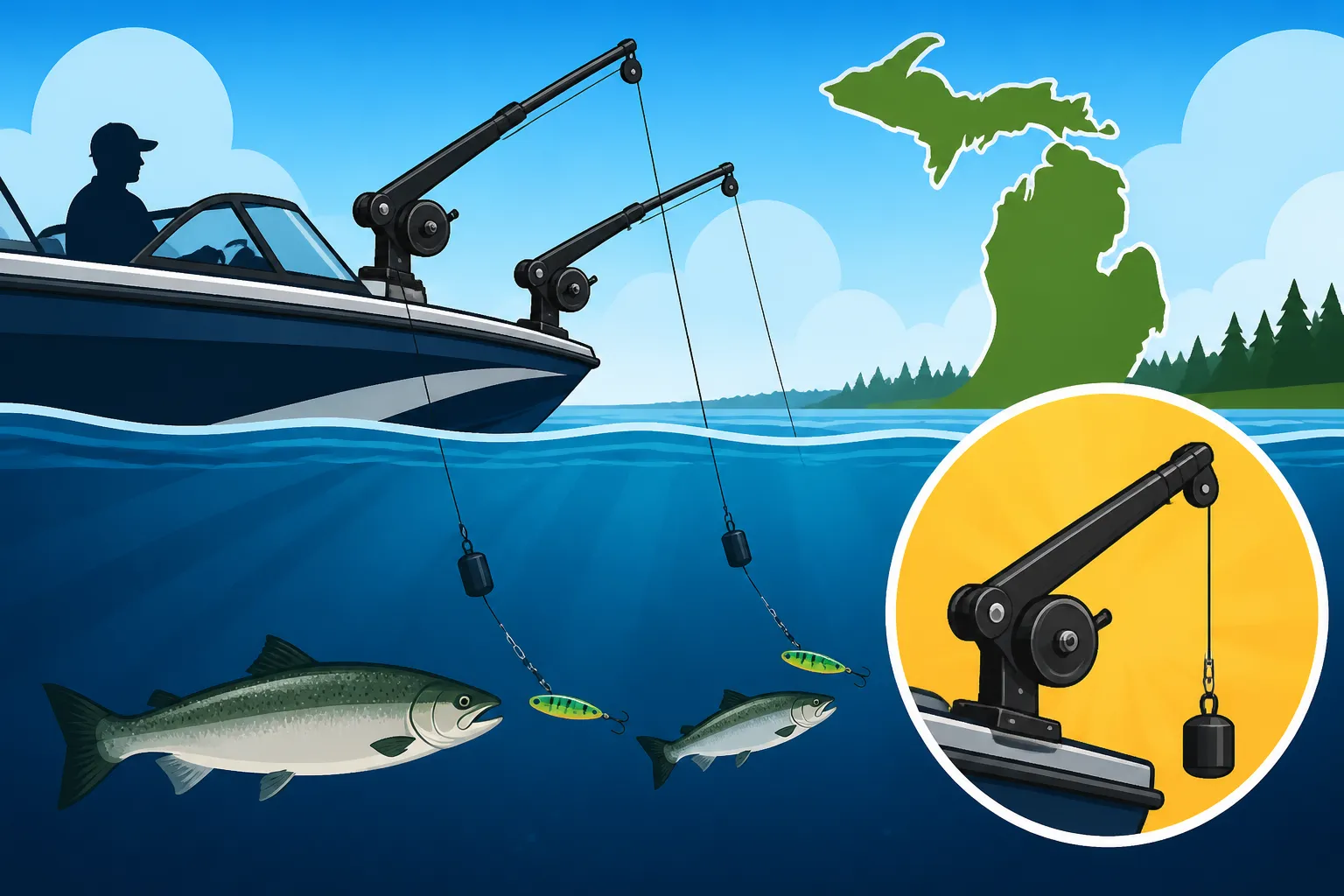
At its heart, a downrigger consists of a few key components. First, there's the main boom and spool, which holds a heavy-duty cable, usually stainless steel or braided, similar to very strong fishing line. This cable is spooled onto a manual crank or an electric motor. At the end of this cable, you'll find a heavy weight, often called a downrigger ball, which can range from 6 to 15 pounds. These weights are typically cannonball-shaped or streamlined to reduce drag as they cut through the water.
Crucially, attached to the downrigger ball (or sometimes to the cable itself) is a release clip. This clip is where you temporarily secure your fishing line after you've deployed your lure. The clip holds your line securely enough to pull your lure down to depth, but lightly enough to release the moment a fish tugs on your bait. Many downriggers, especially the more advanced ones, also feature a swivel base for easy rotation, a rod holder to keep your rod positioned correctly, and a line counter to tell you exactly how much cable is deployed, giving you that critical depth reading. When you're browsing for a new setup, you'll find a wide variety of models from brands available at retailers like Bass Pro Shops.
The Mechanics of Precise Depth Control
Here's the magic trick of a downrigger: you tie your lure onto your fishing line as you normally would, and then let out a relatively short amount of line (often 10-50 feet) behind your boat. This is your "lead" or "dropback." Once you have your desired lead, you simply snap your fishing line into the downrigger release clip. The tension of the clip is adjustable, so you can set it to hold your line firmly but still release with a strike.
With your fishing line secured in the clip, you then use the downrigger's crank or electric motor to lower the heavy downrigger ball, and your attached fishing line, to your desired depth. Because the heavy weight of the ball is pulling the cable straight down, your lure is delivered directly to the precise depth indicated on your downrigger's line counter. When a fish bites, the pull on your fishing line exceeds the tension of the release clip, causing your line to "pop" free. Your rod snaps up, and you're fighting the fish directly on your main line, unencumbered by the heavy downrigger ball. This not only makes the fight more sporting but also prevents the fish from using the weight as leverage.
Different Types for Different Anglers
Downriggers generally come in two main flavors: manual and electric. Manual downriggers are cranked up and down by hand, much like a large reel. They are typically more affordable, simpler in design, and very reliable. They're a great choice for anglers just getting into downrigging or those who only use them occasionally. However, cranking up heavy balls repeatedly, especially when resetting lines or checking bait, can be a workout.
Electric downriggers, on the other hand, are powered by your boat's 12-volt battery. They offer push-button control for deployment and retrieval, often with auto-stop features that bring the ball to the surface or a predetermined depth. Many electric models also boast features like depth cycling (automatically moving the ball up and down through a depth range) or even integrate with sonar. While they represent a larger investment, the convenience and advanced features make them a favorite among serious Great Lakes salmon and trout anglers who spend long hours trolling. You can find many reviews and detailed specifications for both types by searching online marketplaces like Amazon. How to Troll for Chinook Salmon on Lake Michigan often involves electric downriggers for maximum efficiency.
| Feature | Manual Downrigger | Electric Downrigger |
|---|---|---|
| Operation | Hand crank | Push-button motor |
| Cost | Generally lower | Significantly higher |
| Effort | Requires physical cranking | Minimal physical effort |
| Speed | Slower to deploy/retrieve | Faster, more efficient deployment/retrieval |
| Features | Basic depth counter, rod holder | Depth cycling, auto-stop, sonar integration (some) |
| Ideal For | Beginners, occasional use, smaller boats | Serious anglers, frequent use, larger boats, Great Lakes |
| Maintenance | Simpler, fewer electronic parts | More complex, requires battery power |
Unlocking Success: Primary Uses and Strategic Advantages in Michigan Fishing
The real power of downriggers lies in their ability to solve fundamental problems in deep-water trolling, leading to more consistent catches and a better understanding of fish behavior. For Michigan anglers, this means getting on target with key species and presenting baits in ways that simply aren't possible with other methods.
Pinpointing Key Species Like Salmon and Lake Trout
When you're chasing species like chinook (king) salmon, coho (silver) salmon, and lake trout in the Great Lakes, or even deep-holding walleye in places like Saginaw Bay, they often reside in very specific thermal layers. These fish are actively feeding, but they won't expend unnecessary energy chasing a lure that's far from their comfort zone. Downriggers allow you to precisely dial in your lure's depth to match exactly where sonar shows these fish, or where historical data suggests they'll be.
Imagine your fish finder shows a dense school of baitfish with a few larger arches hovering just above them at 65 feet. With a downrigger, you can set your lure right there at 65 feet, directly in the strike zone. You're not just hoping; you're actively targeting. This precision is absolutely critical for success, especially during the warmer months when fish dive deep to escape surface temperatures and bright sunlight. Michigan Salmon Species Explained often highlights the deep-water preferences of these powerful fish.
Masterful Lure Presentation at Exact Depths
One of the biggest advantages of a downrigger is that it takes the heavy weight off your fishing line. This means your lure, whether it's a spoon, a dodger and fly, or a plug, is free to exhibit its intended action without being hampered by heavy lead. A spoon can shimmer and wobble enticingly, a dodger can create its signature thumping action, and a plug can dive and wiggle naturally, all while staying at a predetermined depth. This natural presentation is often the difference between a curious glance and a committed strike.
Furthermore, because your line is clipped into the downrigger, it enters the water at a steep angle and then goes straight down with the ball. This minimizes the amount of fishing line in the water column that could create drag or spook fish. When your line pops from the release, you're fighting the fish with minimal line resistance, enhancing the feel of the battle and reducing the chances of the fish using the line's drag against you. This clean, efficient presentation is a hallmark of effective downrigger fishing.
Expanding Your Trolling Spread Effectively
Downriggers are fantastic on their own, but they truly shine when used as part of a multi-lure trolling spread. Most serious Great Lakes anglers don't just run one or two lines; they often run four, six, or even more lines simultaneously to cover different depths and present a variety of lures. Downriggers are the backbone of this strategy. You can run multiple downriggers, each set to a different depth, creating a "stair-step" effect to probe various layers of the water column.
For example, you might have one downrigger set at 40 feet, another at 60 feet, and a third at 80 feet, each with a different lure or color pattern. This allows you to quickly determine what depth and presentation the fish are responding to on any given day. Beyond just downriggers, they also integrate beautifully with other trolling gear like planer boards, which spread lines horizontally, and dipsy divers or lead core, which can target shallower depths or add even more lines to your spread. This comprehensive approach maximizes your chances of intercepting fish that might be spread out vertically or horizontally. How to Troll for Salmon on the Great Lakes often involves a complex spread.
Getting Started with Downriggers: Setup, Operation, and Advanced Tips
If you're ready to add downriggers to your Michigan fishing arsenal, understanding the basic setup and operation is crucial. While they might seem complex, a methodical approach will have you deploying lines like a pro in no time.
Assembling Your Downrigger System
First, ensure your downrigger is securely mounted to your boat. Swivel bases are highly recommended as they allow you to rotate the downrigger easily for deployment, retrieval, and storage. Next, you'll need a downrigger ball – a good starting point for Great Lakes salmon and lake trout is a 10-12 pound ball, though lighter ones (6-8 pounds) can work for shallower walleye or smaller boats. You'll also need a quality release clip. There are many types, from simple pinch clips to more sophisticated stacker clips that allow you to run multiple lines off a single downrigger cable.
Your fishing rod and reel setup should be appropriate for trolling and handling hard-fighting fish. Many anglers prefer longer, moderate-action trolling rods (7-10 feet) that can absorb the shock of a strike and provide good leverage. Your reel should be spooled with strong, durable line, typically 20-30 pound monofilament or braid, suitable for the species you're targeting. Don't forget an accurate fish finder or sonar unit; this is your eyes underwater and essential for locating fish and bait at specific depths before you deploy your downriggers. Essential Gear for Michigan Steelhead Fishing also includes robust rods and reels, many of which are suitable for downrigger applications.
Best Practices for Deployment and Retrieval
When deploying your downrigger, start by attaching your lure to your fishing line and letting out your desired "dropback" – the length of line between your lure and where it will clip into the downrigger. For salmon and lake trout, a dropback of 10-50 feet is common, allowing the lure to swim freely away from the downrigger ball's disturbance. Then, clip your line into the release clip. Make sure the tension is set appropriately; you want it tight enough to hold, but loose enough to release on a strike.
Once clipped, slowly lower the downrigger ball to your desired depth, watching your line counter. After the ball reaches depth, place your rod in the rod holder, ensuring there's a good bend in the rod tip. This bend, or "load," indicates that your line is properly clipped and under tension. When a fish strikes, you'll see the rod tip snap straight up as the line pops free – this is called a "release." To retrieve, simply reverse the process, slowly bringing the ball up and unclipping your line once it's within reach. Careful retrieval prevents tangles and keeps your gear in good condition. Michigan Great Lakes Fishing Regulations Guide has specific rules about how many lines you can run, so always check before deploying a full spread.
Maximizing Your Success with Complementary Techniques
While downriggers are powerful on their own, they often work best when integrated with other trolling tools. Planer boards are a fantastic addition, allowing you to run lines far out to the sides of your boat, covering a much wider swath of water and targeting fish that might be shy of your boat's presence. You can run planer board lines at shallower depths, while your downriggers target the deeper zones.
Dipsy Divers and lead core line are other popular options for Michigan anglers. Dipsy Divers are small, adjustable diving planers that take your line to a specific depth and angle away from the boat without the need for a heavy weight on the downrigger cable. Lead core line, as its name suggests, is a weighted fishing line that sinks, allowing you to present lures at various depths by letting out different amounts of line. By combining these methods, you can create a truly comprehensive trolling spread, hitting multiple depths and horizontal zones simultaneously. This versatility allows you to adapt to changing fish patterns throughout the day or season.
Ensuring Longevity and Safe Use
Like all fishing gear, downriggers require a bit of care to ensure they last and perform reliably. After each outing, especially in saltwater or Great Lakes freshwater, it's wise to rinse your downriggers thoroughly with fresh water to prevent corrosion, particularly on the cable and moving parts. Periodically check the cable for kinks or fraying and replace it if necessary. Lubricate moving parts and pivots as recommended by the manufacturer. Store your downriggers in a clean, dry place when not in use.
Safety is paramount on the water. Always be mindful of where your downrigger cables are, especially when deploying or retrieving in a crowded area or when making sharp turns. Keep your hands clear of moving parts, particularly with electric downriggers. When setting up your spread, ensure your rods are securely placed in their holders and that your lines are running freely to prevent tangles that could lead to lost gear or injury. A well-maintained downrigger and a mindful angler make for safer, more enjoyable fishing trips.
Disclaimer
This article is for general informational purposes only and does not constitute professional advice. Laws, prices and regulations vary by location and change over time. Consult a qualified professional for guidance on your specific situation.