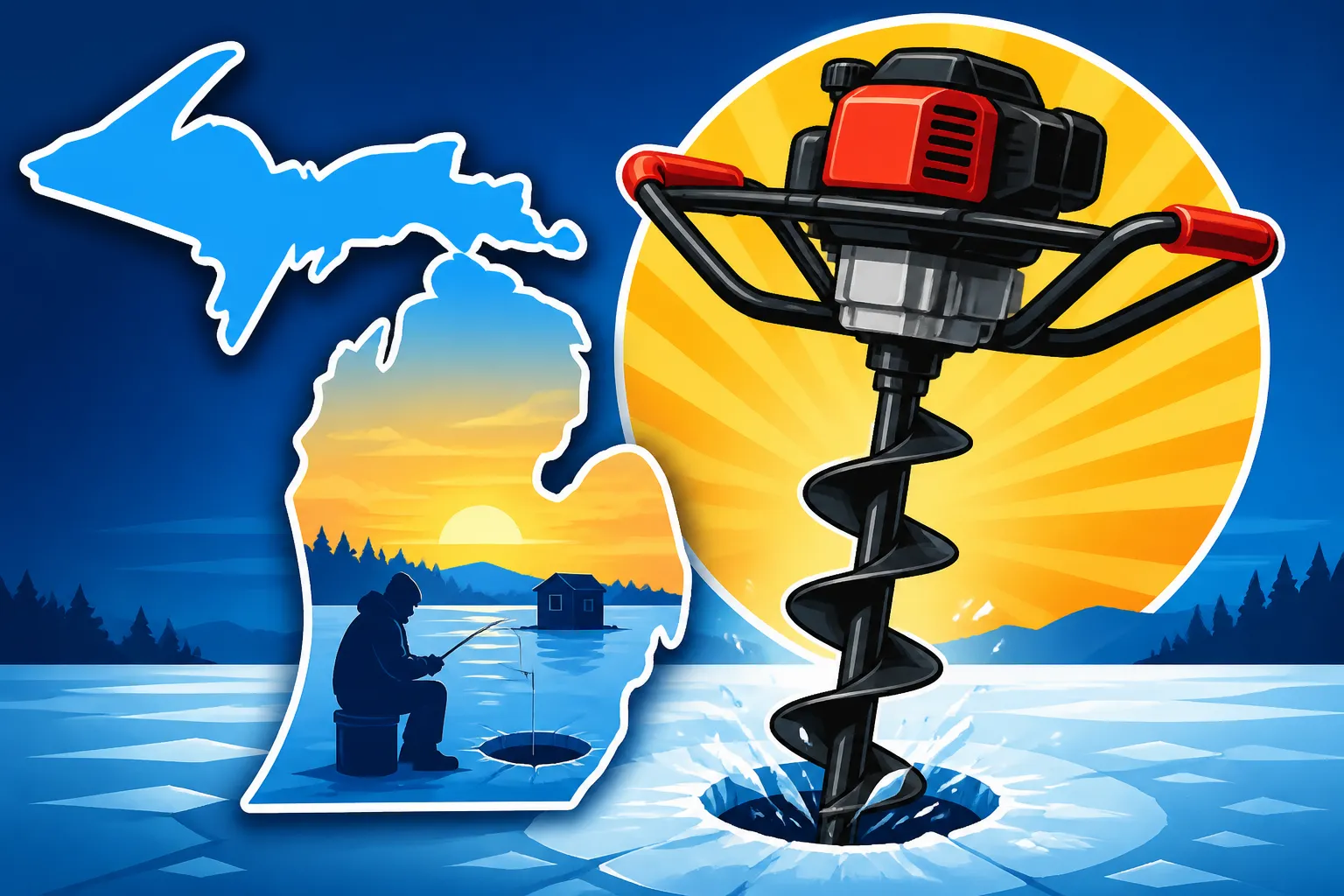
Best Auger for Michigan Ice Fishing
Choosing the right ice auger for your Michigan ice fishing adventures can feel like a daunting task. With so many options available, from traditional hand augers to powerful electric models, it's easy to get overwhelmed trying to figure out what will best serve your needs on frozen lakes like Houghton Lake or the vast expanse of Saginaw Bay. This guide is here to cut through the confusion, helping you understand the different types of augers, their pros and cons, and how to match one perfectly to your unique Michigan ice fishing style, ensuring you spend less time drilling and more time reeling.
Understanding Your Michigan Ice Fishing Needs
Before you even start looking at specific models, it’s crucial to take a honest look at your own fishing habits and the conditions you typically encounter. Michigan's ice fishing landscape is incredibly diverse, from early season ice on smaller inland lakes to formidable mid-winter conditions on the Great Lakes bays. Your personal approach to hitting the hard water will dictate the features that truly matter in an auger.
Ice Thickness and Target Species
The amount of ice you’re cutting through is perhaps the most significant factor in auger selection. Early in the season, when ice is often a manageable 4-8 inches thick, even a manual auger can get the job done without too much effort. However, as winter deepens and you venture onto larger bodies of water, you could be facing several feet of solid ice. Imagine trying to punch a dozen holes through 24 inches of ice on Lake St. Clair with a hand auger—it's certainly a workout, and not one for the faint of heart!
Furthermore, the size of the hole you need is directly related to your target species. If you're primarily chasing panfish like bluegill or perch, a smaller 4-6 inch hole is perfectly adequate, making lighter augers a viable option. These smaller holes are easier and quicker to drill, which is a huge advantage when you're trying to locate a school of fish by drilling numerous holes across a flat or structure. However, if you're specifically targeting Michigan Walleye or even trying for a trophy on the Ice Fishing Techniques for Michigan Walleye, you'll want a wider hole—typically 8-10 inches—to safely land those bigger fish. A small hole can be a heartbreaking bottleneck when you've got a big walleye on the line.
Frequency and Location of Fishing
How often you hit the ice and where you typically go also plays a huge role. Are you a casual angler who only goes out a few times a season, perhaps staying close to home on a small local pond? Or are you a dedicated hardwater enthusiast who spends every weekend trekking across vast stretches of ice, covering miles and drilling dozens of holes in search of the perfect bite? Someone who only fishes occasionally on relatively thin, predictable ice might find a manual auger sufficient and appreciate its lower cost and simplicity.
On the other hand, a seasoned angler who braves varying conditions, from the sheltered bays of Lake Huron to the vast expanse of Lake Gogebic in the Upper Peninsula, will likely prioritize speed, power, and efficiency. Drilling multiple holes quickly to stay mobile and on the fish is a key strategy for many experienced ice anglers. For these folks, the extra investment in a power auger, whether gas or electric, is almost certainly worth it. The time saved and the reduced physical exertion can make a huge difference in their enjoyment and success on the ice, especially when exploring new spots.
Portability and Ease of Use Considerations
Ice fishing often involves a lot of moving around, especially when you're trying to locate active fish or adapt to changing conditions. The weight and bulk of your auger can significantly impact your mobility and overall fishing experience. A heavy gas auger might be powerful, but lugging it across a mile of snow-covered ice, especially if you're not using a sled or ATV, can be exhausting. Consider how you transport your gear – whether you pull a sled by hand, use a snowmobile, or have an ATV or UTV.
Ease of starting and operation is another factor. Gas augers, particularly older models, can sometimes be finicky in cold weather, requiring multiple pulls to get them running. Electric augers, by contrast, offer instant start-up with the press of a button, which is a blessing on a frigid Michigan morning. Noise level can also be a consideration; some anglers prefer the quiet operation of electric or manual augers, believing it's less disruptive to the fish or simply more peaceful for their own experience. Understanding How Thick Does Ice Need to Be to Fish in Michigan is paramount for safety, but it also directly influences your auger choice. And of course, an auger is just one piece of the puzzle; you'll also want to review What Gear Do You Need to Ice Fish in Michigan for a complete setup.
Types of Ice Augers for Michigan Waters
Now that you've thought about your personal needs, let's dive into the different categories of ice augers you'll encounter on the market. Each type has its own set of characteristics that make it more or less suitable for specific Michigan fishing scenarios.
Manual Augers: The Classic Choice
Manual augers are the tried-and-true workhorses of the ice fishing world. They are essentially large, hand-cranked drills designed specifically for cutting through ice. These augers are incredibly simple in design, consisting of a handle, a shaft, and a set of sharp blades at the bottom. Their main appeal lies in their affordability, lightweight nature, and complete lack of reliance on fuel or batteries. They’re perfect for anglers who enjoy a bit of physical exertion, or who primarily fish in areas with thinner ice, especially during early and late season trips when the ice isn't at its thickest.
While a manual auger is budget-friendly and requires no maintenance beyond keeping the blades sharp and protected, it does come with limitations. Drilling through thick, mid-winter ice, especially if you need to make many holes, can quickly become a tiring and time-consuming chore. Imagine trying to punch ten 8-inch holes through 18 inches of ice with a manual auger – you'll certainly be warmed up, but you might also be too exhausted to fish effectively! They are best suited for minimal hole drilling or for those who truly embrace the physical aspect of the sport. For panfish anglers who only need a few small holes, or those who prioritize a quiet, peaceful experience, a quality manual auger can be a fantastic choice.
Power Augers: Gas and Propane Options
Power augers represent a significant step up in drilling capability, allowing anglers to cut holes quickly and with minimal effort, even through very thick ice. Traditionally, these have been dominated by gas-powered models, which use a small internal combustion engine to spin the auger bit. Gas augers are renowned for their raw power and ability to churn through formidable ice conditions, making them a favorite for anglers who chase larger species or frequent big, deep lakes where ice can be several feet thick. Their fuel efficiency is generally good, allowing for many holes on a single tank.
However, gas augers come with a few drawbacks. They are typically heavier and noisier than other options, and they produce exhaust fumes, which can be a concern if you're fishing inside a portable or permanent shanty. Maintenance, including fuel mixing (for 2-stroke models), oil changes, and spark plug checks, is also required. Propane augers emerged as an alternative, addressing some of the gas auger's issues. They run on standard propane cylinders, eliminating the need for mixing fuel and reducing fumes. While often a bit less powerful than their gas counterparts, they are generally cleaner, quieter, and offer easier starting in cold weather. Both gas and propane options excel in drilling numerous large holes, but anglers must weigh the convenience of power against the added weight, noise, and maintenance.
Electric Augers: The Modern Revolution
Electric augers have rapidly grown in popularity, becoming a true game-changer for many Michigan ice anglers. These augers are powered by rechargeable lithium-ion batteries, which drive a powerful electric motor. Their main advantages are numerous: they are incredibly quiet, start instantly with the push of a button (no frustrating pull-starts in the cold!), and produce zero emissions, making them ideal for use inside enclosed shelters. They are also often lighter than gas augers, which greatly improves portability when you're moving around a lot on the ice.
The major consideration with electric augers is battery life, especially in Michigan's often brutally cold winter temperatures. While modern lithium-ion batteries are much improved, extreme cold can still reduce their efficiency. Many anglers mitigate this by carrying spare batteries, which can be purchased from retailers like Amazon, or by keeping their batteries warm in a pocket or insulated bag until needed. Charging time is another factor to consider. Despite these considerations, the convenience, cleanliness, and quiet operation of electric augers make them an increasingly attractive option for a wide range of anglers, from those targeting panfish with many small holes to those drilling bigger holes for walleye. Imagine setting up your tip-ups, perhaps trying to How to Catch Walleye Through the Ice in Michigan on a prime structure – the quiet hum of an electric auger won't spook fish like a loud gas motor. Or maybe you're dropping a tiny jig for perch, hoping to replicate the success of How to Catch Perch Through the Ice in Michigan from last season.
Key Features to Look For in a Michigan Ice Auger
Once you've narrowed down the type of auger that suits your fishing style, it's time to examine the specific features that differentiate one model from another. These details can significantly impact performance, durability, and your overall satisfaction with the tool.
Auger Blade Design and Material
The blades are the business end of any auger, and their design and material are crucial for efficient ice cutting. There are generally two main types:
- Chipper Blades: These blades have a serrated or saw-tooth edge and are designed to chip away at the ice. They tend to be more forgiving if you hit something unexpected under the ice, like a submerged log or rock, and can often be resharpened. They work well in rough or dirty ice, though they might be slower than shaver blades.
- Shaver Blades: These blades are incredibly sharp and designed to shave off thin layers of ice with each rotation. They are typically faster and require less downward pressure, especially in clean, clear ice. However, they are more susceptible to damage from hitting foreign objects and usually need to be replaced rather than simply resharpened if dulled or chipped.
Most quality auger blades are made from hardened steel, which holds a sharp edge well. Some premium models might feature stainless steel or even titanium for corrosion resistance and lighter weight. Always ensure the blades are sharp and protected with a blade guard when not in use. Dull blades make any auger, regardless of its power source, incredibly inefficient and frustrating to use. You'll find a variety of replacement blades and blade guards on platforms like Amazon, making it easy to keep your auger in top shape.
Power Source and Battery Life
For power augers, the source of their energy is a critical feature. For gas augers, consider the engine size (typically measured in cubic centimeters, or CCs) and whether it's a 2-stroke or 4-stroke. 2-stroke engines are generally lighter and more powerful for their size but require mixing oil with gasoline. 4-stroke engines run on straight gas, are usually quieter and cleaner, but can be a bit heavier. Propane augers offer the convenience of clean-burning fuel, but you'll need to factor in the cost and availability of propane cylinders.
When it comes to electric augers, the battery is paramount. Look at the voltage (e.g., 18V, 40V, 80V) and amp-hour (Ah) rating. Higher voltage usually indicates more power, while a higher Ah rating means longer run time. A single battery might be enough for a casual day, but serious anglers often carry one or two spare batteries, especially when fishing in extreme cold or drilling many holes. The charging time of the battery is also worth considering, as is the availability of quick chargers. Pairing your chosen auger with the Best Ice Fishing Rods for Cold-Weather Anglers for your target species can truly elevate your experience.
Weight, Portability, and Noise Levels
These factors directly influence your comfort and efficiency on the ice.
- Weight: A lighter auger is easier to transport, whether you're carrying it by hand, pulling it on a sled, or moving between holes. Manual augers are the lightest, followed by many electric models, with gas augers typically being the heaviest. If you're often walking long distances to your fishing spot, a few pounds can make a big difference by the end of the day.
- Portability: Beyond just weight, consider the auger's overall bulk and whether it breaks down for easier transport. Many augers have collapsible handles or removable powerheads, which can be a huge benefit when fitting it into a vehicle or storing it. Some even come with cases or bags.
- Noise Levels: Manual and electric augers are incredibly quiet, which is a big plus for a peaceful fishing experience and for not spooking fish in shallower water. Gas augers, by contrast, are much louder. The noise can be a minor annoyance for some, or a significant deterrent for others, especially those who fish in close quarters or prefer a tranquil environment. And while your auger is carving holes, you'll appreciate having a warm sanctuary, so be sure to consider the Best Ice Shelters for Michigan Ice Fishing.
Making Your Decision: Matching Auger to Angler
The "best" auger isn't a universal answer; it's the one that best fits your specific needs, budget, and fishing style in Michigan. Let's break down some common angler profiles and suggest the types of augers that might be ideal for each.
Best Auger for the Casual Weekend Angler
If you're someone who only gets out on the ice a few times a season, sticks to smaller, local lakes, and perhaps targets panfish or smaller species, a manual auger might be your perfect match. You won't be drilling dozens of holes, and the ice thickness is likely manageable, especially during early and late season. A quality 6-inch manual auger is lightweight, incredibly reliable, and won't break the bank. It offers a great way to enjoy the sport without a large upfront investment or the hassle of fuel and battery maintenance.
However, if you appreciate a bit more convenience without the bulk of a gas auger, a lighter electric auger with a single battery could also be a fantastic option. Many anglers find the instant start and quiet operation a huge upgrade. You'll still want to keep an eye on battery life, especially if the temperature drops significantly, but for moderate use, it's a comfortable middle ground. You can find many affordable and reliable manual and entry-level electric augers online on platforms like Amazon, often with helpful customer reviews.
Best Auger for the Serious Multi-Species Hunter
For the dedicated angler who spends countless hours on the ice, chasing everything from perch and walleye to northern pike and even muskellunge across Michigan's diverse waters, a powerful and efficient auger is a necessity. These anglers need to drill many holes, often through thick ice, and sometimes need wider holes for bigger fish. Both gas and electric power augers are strong contenders here, each with their own loyal following.
A high-performance gas auger (like an 8-10 inch model) offers unmatched power and the ability to drill virtually unlimited holes as long as you have fuel. It's built for heavy-duty use and will conquer any ice Michigan can throw at it. On the other hand, a top-tier electric auger, especially a model with a high voltage and amp-hour battery (or multiple batteries), provides comparable drilling speed and power to many gas models, but with the added benefits of quiet operation, no fumes, and instant starting. The choice often comes down to personal preference regarding fuel vs. battery and whether the slightly higher initial cost of a powerful electric model (including spare batteries) is justified by its convenience. If your goal is to hit a hot bite for panfish, mastering the Best Time to Ice Fish for Perch can be just as crucial as having the right equipment to get through the ice.
Considering Your Budget and Maintenance
Budget is always a factor when investing in fishing gear. Manual augers are by far the most affordable, making them an excellent entry point into ice fishing. Gas augers fall in the mid-range price bracket, while high-end electric augers with multiple batteries can be the most expensive upfront. However, it's important to look beyond the initial purchase price.
Consider the long-term costs:
- Manual: Very low. Occasional blade sharpening or replacement.
- Gas: Ongoing fuel costs, oil (for 2-stroke), spark plugs, air filters, and potential repair costs.
- Electric: Cost of spare batteries (which can be significant), and eventual battery replacement over time. Electricity cost for charging is negligible.
Maintenance also varies. Manual augers require minimal attention. Gas augers need regular engine maintenance, fuel stabilizer, and proper storage. Electric augers are generally maintenance-free beyond keeping the blades sharp and charging the batteries. If you are going to be out all day in remote locations, a gas auger might offer more peace of mind regarding continuous power, whereas an electric user would need to manage and warm their battery supply carefully. Remember to always adhere to regulations, especially regarding how many lines or How Many Tip-Ups Can You Use in Michigan when setting up your spread. Ultimately, the right auger lets you access productive spots faster, whether you're targeting new grounds or revisiting your favorite Best Ice Fishing Lakes in Michigan.
Here's a quick comparison of the different auger types to help you weigh your options:
| Auger Type | Pros | Cons | Ideal Use Case |
|---|---|---|---|
| Manual | Lightweight, affordable, quiet, no fuel/batteries, minimal maintenance. | Requires physical effort, slow on thick ice, tiring for many holes. | Casual angler, thin ice (under 12"), limited budget, panfish. |
| Gas | Very powerful, fast, handles thick ice and many holes easily, generally good run time. | Heavy, noisy, fumes, requires fuel mixing/maintenance, harder starting in cold. | Dedicated angler, very thick ice, many large holes, remote locations. |
| Electric | Quiet, instant start, no fumes, lighter than gas, easy to use. | Battery life (especially in extreme cold), higher upfront cost (with spare batteries), charging time. | Mobile angler, varied ice thickness, frequent hole drilling, preference for cleanliness/quiet. |
Disclaimer
This article is for general informational purposes only and does not constitute professional advice. Laws, prices and regulations vary by location and change over time. Consult a qualified professional for guidance on your specific situation.