How to Set Up Downriggers for Salmon Trolling
One of the biggest frustrations many anglers face when chasing salmon on Michigan's vast Great Lakes is getting their lures down to the right depth consistently. Salmon, especially Chinook and Coho, often suspend in specific temperature zones or near structure far below the surface, making traditional trolling methods ineffective. This guide will walk you through the essential steps and considerations for setting up downriggers, transforming your trolling game and helping you consistently put your bait in the strike zone.
Understanding Downriggers and Why They're Essential for Michigan Salmon
When you're out on Lake Michigan or Lake Huron, those big Chinook and Coho salmon aren't usually hanging out on the surface. They’re often in cooler water, sometimes hundreds of feet down, following baitfish or a specific thermocline. Trying to get your spoon or plug down to that exact depth with just lead core or diving planes can be a real guessing game, and it’s frustrating when you know the fish are there but your lures aren't reaching them. That's where downriggers come in – they are game-changers for precision depth control in deep water trolling.
What Downriggers Do
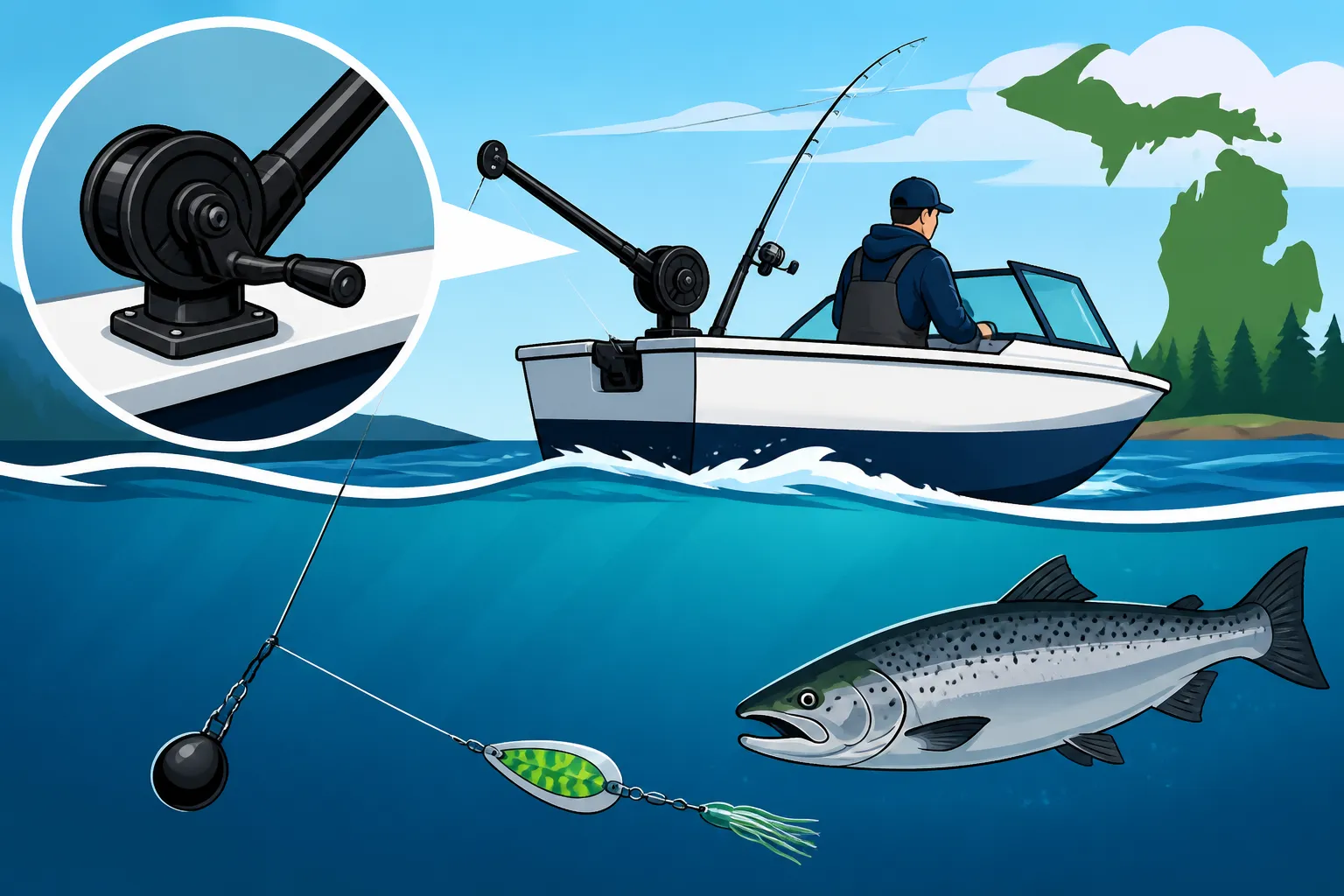
At its core, a downrigger is a specialized piece of equipment designed to accurately and consistently present your fishing lure at a predetermined depth below your boat. It uses a heavy weight, often referred to as a "cannonball," attached to a strong cable, which is then lowered to your desired depth. Your fishing line, with its lure, is attached to this main cable via a release clip. When a fish strikes, the clip releases your line, allowing you to fight the fish directly without the drag of the heavy downrigger weight. This system lets you target specific depths with incredible accuracy, which is absolutely crucial when salmon are holding tight to a particular thermocline or depth contour.
Imagine trying to hit a moving target with a blindfold on – that's often what deep-water trolling feels like without a downrigger. With one, you're taking off the blindfold and gaining pinpoint control. This control not only increases your chances of connecting with fish but also helps you replicate successful patterns. If you find salmon at 70 feet on one pass, you can confidently return to that exact depth, knowing your lure is where it needs to be. For anglers serious about Trolling for Chinook Salmon on Lake Michigan or Trolling for Coho Salmon on the Great Lakes, downriggers are not just an accessory; they're a necessity.
Why They're Critical for Salmon
Michigan's Great Lakes are massive, deep, and ever-changing environments. Salmon, particularly the larger mature fish, exhibit specific behaviors related to water temperature, light penetration, and baitfish location. They often prefer cooler water, typically in the 40-50 degree Fahrenheit range, which can be found at varying depths depending on the season and specific lake conditions. Without downriggers, you might have lures running at 20 feet while the fish are comfortably sitting at 60 feet. It’s like fishing in two different lakes.
Downriggers allow you to precisely position your lures in the "strike zone," which is that optimal depth where salmon are actively feeding. This precision minimizes wasted time and maximizes your fishing efficiency. Furthermore, downriggers enable you to run multiple lines at different depths off the same boat, creating a diverse spread that covers various layers of the water column. This ability to experiment with depths until you find what the fish are keying in on is invaluable, especially on days when salmon are scattered or picky. Whether you're targeting big lake trout that hug the bottom or suspended salmon, downriggers give you the ability to present your offering exactly where it needs to be. For more information on precise depth targeting, check out our guide on How Deep to Troll for Lake Trout.
Essential Components for Your Downrigger Setup
Getting your downrigger system just right involves more than simply buying the main unit. Each component plays a vital role in the overall effectiveness and reliability of your salmon trolling efforts. From the downrigger itself to the weights and release clips, understanding and selecting the right gear is paramount to a successful day on the water.
The Downrigger Unit Itself
Downriggers come in various styles, primarily manual and electric. Manual downriggers are cranked up and down by hand, which is perfectly suitable for occasional use or smaller boats with limited power. They are typically less expensive and simpler in design, making them a good entry point for anglers looking to try out downrigger fishing without a huge initial investment. You can often find decent manual units at retailers like Bass Pro Shops or even online through Amazon. However, constantly cranking up a heavy weight, especially when repositioning frequently or running multiple lines, can become quite a workout over the course of a long day.
Electric downriggers, on the other hand, offer the convenience of push-button operation. They do the heavy lifting for you, allowing for quicker adjustments to depth, retrieving weights with ease, and often featuring capabilities like auto-up, preset depth stops, and even integration with your boat's sonar system. While a larger investment, the ease of use and added features of electric models make them a popular choice for serious Great Lakes salmon anglers, especially those running multiple downriggers simultaneously. When choosing a unit, consider the boom length (longer booms allow for wider lure spreads), retrieve speed, and construction materials for durability in harsh marine environments.
Weights and Releases
The downrigger weight, often called a cannonball, is crucial for getting your line down and keeping it stable in the water. These weights typically range from 6 to 15 pounds, with 8 to 12 pounds being common for Michigan salmon trolling. Heavier weights help maintain depth better in strong currents or when trolling at higher speeds, but they require more powerful downrigger motors (for electric units) or more effort to retrieve (for manual units). The shape also matters; round cannonballs are classic, while specialized designs like pancakes or "fish-shaped" weights are designed to reduce blowback (the tendency for the weight to rise in the water column at speed).
Release clips are the simple but genius component that connects your fishing line to the downrigger cable. There are various types, from basic pinch clips to adjustable tension clips and stacker releases. The key is to select a clip that holds your line securely enough to prevent false releases from boat movement or small waves, but releases cleanly when a salmon strikes. Adjustable tension clips are particularly useful as they allow you to fine-tune the holding power based on your lure size, trolling speed, and target species. Stacker releases allow you to run multiple lines off a single downrigger weight, effectively doubling your spread without needing an extra downrigger, though this requires careful management to avoid tangles.
Rods, Reels, and Line
While downriggers do the work of depth control, your fishing rod, reel, and line are still paramount for fighting the fish once it's released. For downrigger trolling, specific rods are designed to handle the stress. Best Trolling Rods for Michigan Salmon are typically longer, often 8 to 10.5 feet, with a parabolic action that acts as a shock absorber. This soft tip absorbs the sudden snap of the line releasing from the downrigger clip, preventing break-offs, while the powerful butt section gives you the leverage to fight large salmon.
Reels for downrigger fishing should be robust baitcasting or conventional reels with a reliable drag system and good line capacity. Salmon pull hard, so a quality reel is non-negotiable. Line choice is also critical. Many anglers opt for monofilament line, usually 20-30 pound test, for its stretch, which further cushions the strike and helps absorb head shakes during the fight. Some prefer fluorocarbon leaders for their invisibility in clear Great Lakes waters. While braid is incredibly strong and sensitive, its lack of stretch can put more strain on your rod and knots, especially with the sudden release of a downrigger clip. Always choose line strong enough to handle a big fish but light enough to allow your lures to swim naturally.
Step-by-Step Guide to Rigging Your Downriggers
Now that you have all your components, it's time to assemble your downrigger system. Proper installation and rigging are key to safety, efficiency, and ultimately, success on the water. Rushing through this stage can lead to frustrating tangles or lost gear.
Mounting the Downrigger
First things first, you need to securely mount your downriggers to your boat. Most downriggers come with a mounting base that needs to be bolted to a sturdy part of your boat, typically the transom or gunwales. Position is crucial: you want them far enough apart to create a wide spread for your lures, but also easily accessible for operation and netting fish. Consider your boat's layout, where rod holders are located, and how you’ll move around the boat during a chaotic salmon bite. Some anglers use track systems that allow them to slide downriggers and other accessories to various positions, offering flexibility. Always use appropriate stainless steel hardware and backing plates to distribute the load, preventing damage to your boat's hull. When fishing the larger waters of Michigan, your boat will take a pounding, so a solid mount is essential. If you're using a smaller craft, you might find that Best Boat for Lake Michigan Salmon Trolling options often include built-in mounting points.
After securing the base, attach the downrigger unit to it according to the manufacturer's instructions. Ensure it's locked into place and can pivot if designed to do so. Before you even get on the water, do a dry run on land to make sure everything feels solid and you can easily operate the downrigger without stretching awkwardly or feeling off-balance. Safety first, always!
Attaching the Cable and Weight
Once the downrigger is mounted, it’s time to spool on the downrigger cable and attach your weight. Downrigger cable is typically stainless steel wire or a specialized braided line (like Dyneema or Spectra). Wire is traditional and durable, but braid can be quieter, lighter, and less prone to kinking. Spool the cable onto the downrigger reel, ensuring it's wound neatly under tension to prevent digging in.
Next, attach your cannonball weight to the end of the cable. Most weights have a loop or swivel built in for this purpose. Use a strong, reliable connection – a heavy-duty snap swivel or a specialized downrigger termination kit is usually recommended. Double-check all knots and connections; losing a valuable downrigger weight (and potentially a fish) due to a faulty connection is incredibly frustrating.
Rigging the Release Clip
Now for the critical connection to your fishing line: the release clip. The downrigger cable typically has a small ball stopper or crimped sleeve a few feet above the weight. This is where you'll attach your release clip. Some clips attach directly to the cable, while others use a "stacker" or a short leader that attaches to the cable's main line.
Here's a general step-by-step for rigging:
- Lower the Weight: Use the downrigger to lower the cannonball weight into the water, just below the surface, to test everything.
- Attach Lure to Fishing Line: Get your fishing rod ready with your chosen salmon lure (spoon, plug, fly, etc.). Make sure your lure is running cleanly behind the boat first to check its action.
- Position Your Rod: Place your fishing rod in its dedicated rod holder, angling it away from the boat so the line clears any obstacles.
- Clip In: Take the main fishing line, about 10-20 feet above your lure, and gently place it into the release clip on the downrigger cable. You want enough line out from your rod tip to the clip so that when the downrigger is deployed, your rod tip has a good bend in it, indicating tension. This "loaded" rod tip is crucial for detecting strikes.
- Lower to Depth: Slowly lower the downrigger weight to your desired depth. Watch your depth finder and the downrigger counter closely. As you lower, your fishing line will pay out from the reel, loading the rod tip.
This setup ensures that your lure is precisely at the depth of the cannonball. When a salmon hits, the pressure on the line will pop it free from the release clip, and you'll be fighting the fish directly on your fishing rod. The initial "pop" and the sudden straightening of your rod tip are unmistakable signs of a strike. For effective use, consider how Downriggers for Michigan Great Lakes Trolling are typically configured on charter boats.
| Component | Purpose | Key Considerations |
|---|---|---|
| Downrigger Unit | Lowers weight and controls depth | Manual vs. Electric, Boom Length, Retrieve Speed |
| Cannonball Weight | Gets lure to desired depth, reduces blowback | Weight (8-12 lbs common), Shape (round, pancake), Material |
| Release Clip | Connects fishing line to cable, releases on strike | Adjustable Tension, Stacker Capability, Reliability |
| Downrigger Cable | Connects unit to weight | Stainless Wire vs. Braided Line, Strength, Resistance to Kinks |
| Trolling Rod | Absorbs strike, fights fish | Length (8-10.5 ft), Action (parabolic), Power |
| Trolling Reel | Holds line, manages drag | Line Capacity, Drag System Quality, Durability |
| Fishing Line | Main connection to lure, fights fish | Monofilament (stretch) vs. Braid (sensitivity), Test Strength |
Fine-Tuning and Troubleshooting Your Downrigger Spread
Setting up your downriggers is one thing; mastering them for optimal salmon production on the Great Lakes is another. It involves continuous adjustment, observation, and understanding how various factors affect your lure's presentation.
Depth Control and Sonar Integration
One of the greatest advantages of downriggers is precise depth control, but simply setting a depth on the downrigger counter isn't always enough. Factors like trolling speed, current, and the type/weight of your cannonball can cause "blowback," where the weight rides higher in the water than your counter indicates. Many modern electric downriggers can integrate with your boat's fish finder or GPS, allowing you to see your downrigger weights on the sonar screen. This is incredibly valuable as it gives you real-time feedback on the actual depth of your weights and, by extension, your lures.
Always pay attention to your fish finder. Look for baitfish schools, thermoclines, and marks of salmon. Adjust your downriggers to place your lures just above, in the middle of, or just below these key areas. If you're consistently marking fish at 60 feet but your downrigger counter says 60 feet and your sonar shows the weight at 50 feet, you'll need to drop your downrigger an additional 10 feet to reach the fish. Experimentation is key; start by positioning your lures near where you're seeing bait or temperature breaks, then adjust up or down by 5-10 foot increments until you start getting bites. This kind of precise targeting is what makes downrigger fishing so effective. You'll find more insights into this in articles like Best Depth to Set a Downrigger.
Spacing Your Lures
A common setup for Michigan salmon fishing involves a "spread" of multiple lines, often utilizing several downriggers, planer boards, and perhaps even lead core lines. When using multiple downriggers, spacing your weights and lures is crucial to avoid tangles and present a wide array of options to the fish. Typically, you'll run your deepest lines furthest back and your shallower lines closer to the boat. You might run two downriggers off the stern, one set at 80 feet and the other at 70 feet, for instance.
You can also "stack" lines on a single downrigger. A stacker release clip allows you to run a second lure higher in the water column off the same downrigger cable, creating a mini-spread from one unit. For example, your main line might be clipped at 70 feet, and a stacker line at 50 feet. Just be mindful of the potential for tangles, especially during sharp turns or when fighting multiple fish. The goal is to create a diverse and enticing presentation that mimics a school of baitfish, covering multiple depths and horizontal areas. Remember, What Are Downriggers Used For often extends beyond just depth control to managing a complex trolling pattern.
Common Issues and Solutions
Even with a perfectly rigged system, you might encounter issues. One of the most common is "false releases," where your line pops out of the clip without a fish strike. This can be caused by too-light tension on the clip, a strong wave rocking the boat, or even excessive lure action. To fix this, first, try adjusting the tension on your release clip if it's an adjustable model. If not, you might need a different style of clip or a slightly heavier fishing line to increase the line's diameter, which can help it grip better.
Another issue is tangles, especially when deploying or retrieving multiple lines. This often happens if you're not careful about your trolling speed or turning too sharply. Always deploy the deepest lines first and retrieve them last. When making turns, do so gradually to allow your lures to maintain their separation. Sometimes, your downrigger cable can hum or vibrate, which can spook fish. If this happens, check for kinks in the cable or ensure your weight isn't damaged. For larger boats or those engaging in frequent trolling, investing in quality gear from trusted brands available at places like Bass Pro Shops or online through Amazon can reduce many of these common frustrations. Understanding Best Trolling Speed for Coho Salmon and other species will also minimize tangles.
Ultimately, downrigger fishing is an art that combines precise engineering with keen observation. It’s about more than just dropping a weight; it’s about strategically placing your offerings where the salmon are, responding to their behavior, and constantly refining your presentation. With a solid setup and a willingness to learn, you'll be well on your way to consistent success on Michigan's incredible salmon waters.
Disclaimer
This article is for general informational purposes only and does not constitute professional advice. Laws, prices and regulations vary by location and change over time. Consult a qualified professional for guidance on your specific situation.