Downriggers for Michigan Great Lakes Trolling
There’s nothing quite as frustrating as heading out onto the vast, beautiful expanse of Michigan’s Great Lakes, knowing those prized salmon and lake trout are lurking deep below, but feeling utterly helpless to get your lures down to them consistently. You spend hours, burn fuel, and try every trick in the book, only to come back with stories of "almost" or "they just weren't biting." This comprehensive guide is here to unravel the mystery of downriggers for Michigan Great Lakes trolling, showing you how this crucial piece of gear can transform your deepwater fishing success and make those trophy fish a tangible reality.
Understanding Downriggers: Your Key to Deepwater Success
When you're out on the big water, whether it's Lake Michigan, Huron, or Superior, the fish aren't always hanging out near the surface. In fact, many of our most sought-after species, like Chinook salmon and lake trout, spend a good portion of their lives cruising in much deeper, colder water. Getting your lure down to that precise depth and keeping it there, even at trolling speeds, is where downriggers truly shine. Without them, you're essentially guessing, and that's not a recipe for consistent catches.
What Exactly is a Downrigger and Why Do You Need One?
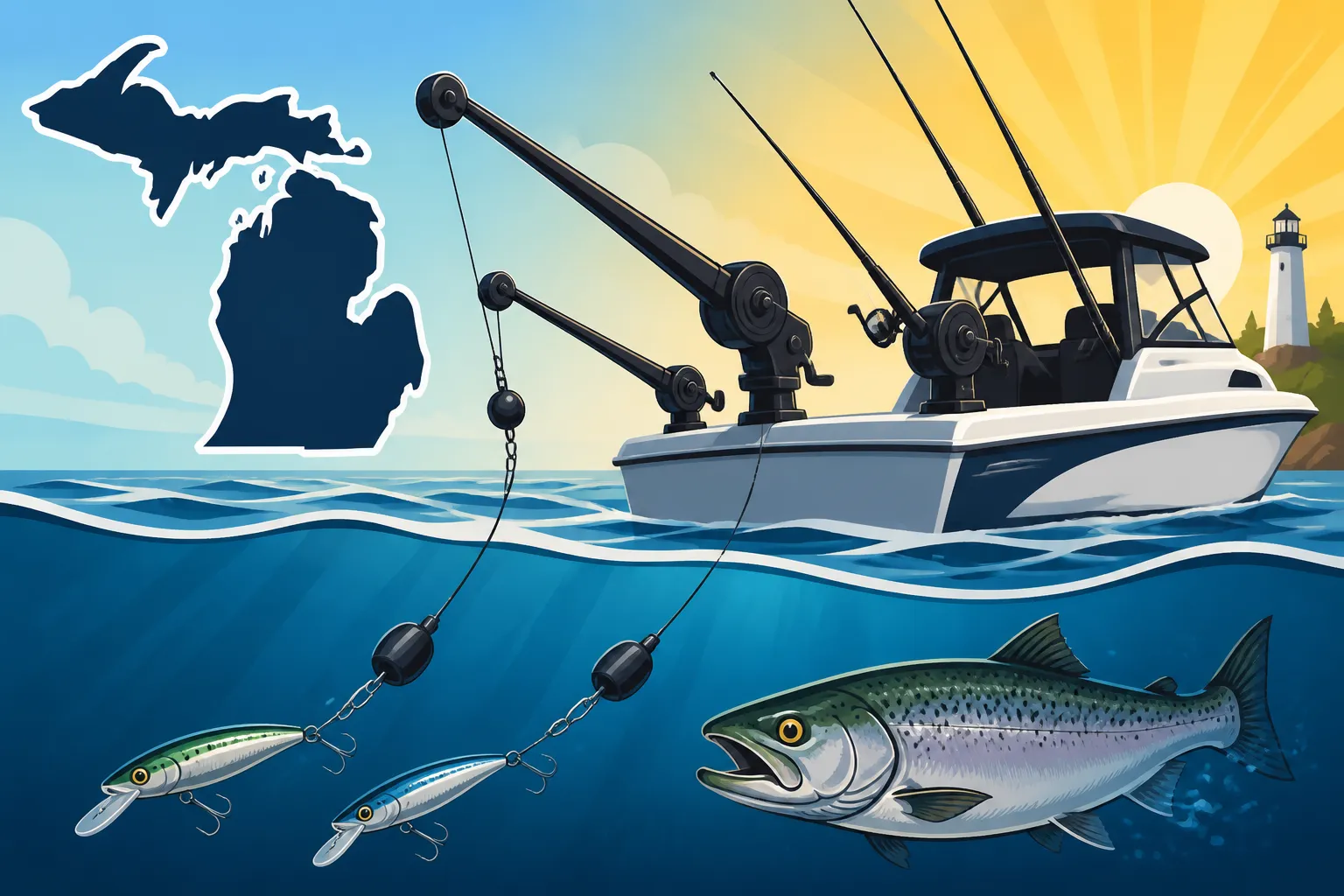
At its core, a downrigger is a specialized piece of fishing equipment designed to precisely control the depth of your lure while trolling. Think of it as a heavy-duty elevator for your bait. It consists of a large reel, a sturdy boom that extends out from your boat, a heavy lead weight (often called a cannonball), and a special release clip. Your fishing line, with its lure attached, is clipped into this release, and then the weight is lowered, pulling your line and lure down to a predetermined depth. When a fish strikes, the tension of the strike pulls your line free from the clip, allowing you to fight the fish directly without the heavy weight impeding the battle.
Why do you need one for Great Lakes trolling? Simple: precision. Unlike planer boards that spread lures horizontally, downriggers take them vertically. Fish often suspend at very specific temperature breaks or depths where baitfish congregate. If your lure is even a few feet above or below that zone, you could miss the bite entirely. Downriggers allow you to put your bait right in the strike zone, time after time, regardless of currents, lure drag, or boat speed. This level of control is absolutely essential for consistent success on the vast, deep waters of the Great Lakes, especially when targeting species that hold in thermoclines or near the bottom.
The Unbeatable Advantage of Precision Depth Control
The biggest game-changer with downriggers is their ability to place your lure exactly where you want it and keep it there. Imagine you're marking fish on your sonar at 60 feet down. Without a downrigger, trying to get a spoon or a plug to stay at that exact depth while your boat is moving at 2.5 mph is incredibly difficult. Your lure might dive to 30 feet, then ride up to 40 feet, constantly fluctuating. With a downrigger, you set your weight to 60 feet, and your lure stays at 60 feet, giving those fish a perfect presentation. This is paramount for species like lake trout, which often hug tight to bottom structures or specific depths.
This precision isn't just about single lures, either. Many anglers run multiple downriggers at different depths, effectively "fishing the water column." You might have one lure at 50 feet, another at 65, and a third at 80, covering a broader range and increasing your chances of finding the fish. This vertical coverage is a significant advantage over other trolling methods, especially when fish are scattered or their preferred depth is uncertain. It reduces guesswork and maximizes your time in the strike zone, which is precious when you're spending good money on fuel and bait.
Common Frustrations Without Downriggers
If you've spent any significant time trolling the Great Lakes without downriggers, you've likely felt the sting of frustration. One of the most common complaints is the sheer uncertainty of lure depth. You might be running a diving plug, but how deep is it really going at your current speed and with your specific line type? Without active depth control, it's a constant variable. You could be convinced the fish are at 40 feet, only to realize later your favorite spoon was only reaching 25 feet. This leads to endless tinkering, changing lures, and speeding up or slowing down, often without a clear understanding of what’s actually happening beneath the surface.
Another huge headache is the inability to get your baits deep enough for species like Chinook salmon when they're holding over 100 feet of water. Standard diving lures, even with lead core line, might struggle to hit those depths efficiently, especially if you want to run multiple lines. You end up relying heavily on snap weights or specialized weighted lines, which can be cumbersome, slow to retrieve, and still lack the precise control of a downrigger. The feeling of seeing big fish arcs on your Best Boat Electronics for Michigan Great Lakes Fishing but being unable to present a lure effectively at that depth is enough to make any angler pull their hair out. Downriggers solve these fundamental depth challenges, giving you confidence that your lure is exactly where it needs to be.
Types of Downriggers for Great Lakes Fishing
When you're ready to invest in downriggers for your Michigan fishing adventures, you'll quickly find there are a few main types to choose from. Each has its pros and cons, and the "best" one really depends on your budget, your boat setup, and how frequently you plan to use them. Whether you're a weekend warrior or a seasoned charter captain, there's a downrigger system designed to meet your needs.
Manual Downriggers: The Workhorse for Many Anglers
Manual downriggers are often the starting point for many Great Lakes anglers, and for good reason. They are typically less expensive than their electric counterparts and offer reliable performance. As the name suggests, you manually crank a handle to raise and lower the downrigger weight. This requires a bit of elbow grease, especially when you're pulling up a 10 or 12-pound cannonball from 100 feet down, but it's a system many anglers swear by. Brands like Scotty and Cannon offer excellent manual models that are very popular among recreational fishermen. You can often find a good selection at outdoor retail giants like Bass Pro Shops.
The simplicity of manual downriggers is a significant advantage. There are fewer electronic components to potentially malfunction, making them a robust choice for choppy Great Lakes conditions. While retrieving the weight after a fish strike can be a bit of a workout, many anglers don't mind the physical aspect, seeing it as part of the fishing experience. For boats with limited battery capacity or those looking for a more budget-friendly entry into downrigger fishing, manual units are an excellent, dependable option. They are perfectly capable of getting your lures to the depths where Chinook Salmon in Michigan's Great Lakes and lake trout reside.
Electric Downriggers: Power and Convenience
Electric downriggers represent the pinnacle of convenience and efficiency in deepwater trolling. Instead of cranking, a push of a button or a toggle of a switch sends your weight plummeting to the desired depth or effortlessly retrieves it. This is a huge advantage, especially when you're fishing in very deep water, constantly adjusting depths, or running multiple downriggers. Many electric models also come with advanced features like auto-up, which retrieves the weight at a preset speed, or even integrated positive ion control to attract fish.
While they come with a higher price tag and require a reliable 12-volt power source on your boat, the ease of use of electric downriggers is hard to beat. They save your arms and allow you to focus more on boat control and fishing action. For serious Great Lakes anglers or those frequently targeting Michigan Salmon Species Explained and Michigan Trout Species Explained in the deep, these units are often considered a worthwhile investment. Brands like Scotty and Cannon are leaders in electric downriggers, offering models with various boom lengths and features that can significantly enhance your fishing experience. Checking out customer reviews on online marketplaces like Amazon can help you find the perfect model.
Fixed Mount vs. Clamp-On Options
Beyond manual versus electric, you'll also encounter different mounting styles for downriggers: fixed mount and clamp-on. Each has its place depending on your boat's design and your needs.
Fixed-mount downriggers, as the name implies, are permanently bolted to your boat's gunwales, transom, or a specialized downrigger board. This provides the most stable and secure installation, crucial when you're dropping heavy weights and putting significant stress on the system in rough water. For dedicated Great Lakes trolling boats, fixed mounts are usually the preferred choice. They offer maximum stability and integrate seamlessly into your boat's fishing platform. While installation might be more involved, often requiring drilling holes, the resulting robust setup ensures your downriggers stay put, even when you're fighting a strong current or navigating choppy seas. This permanent fixture also means less setup time at the launch ramp, allowing you to get your lines in the water faster.
Clamp-on downriggers, on the other hand, offer more flexibility. These units attach to your boat's gunwales or transom via a sturdy clamp, requiring no permanent modifications. They are ideal for smaller boats, occasional users, or those who need to easily remove their downriggers for other types of fishing or storage. While generally less robust than fixed mounts, modern clamp-on designs are surprisingly strong and can handle significant weights. They might have a slightly shorter boom length to maintain stability. If you're using a smaller boat or a vessel that pulls double duty for cruising and fishing, a clamp-on downrigger can be a fantastic solution, allowing you to easily convert your boat for trolling when the mood strikes. They are a good option for anglers who might not yet be ready to commit to drilling into their boat or for those who occasionally venture out on the Great Lakes but primarily fish inland waters.
Essential Components of a Downrigger Setup
Getting your downrigger system just right involves more than just picking a unit. There are several key components that work together to ensure your lures get to depth, stay there, and release cleanly when a fish hits. Understanding each part is crucial for maximizing your efficiency and success on the water. It’s not just about the downrigger itself; it’s the whole interconnected system that makes the magic happen.
The Downrigger Unit: Boom, Base, and Release
Let's break down the main parts of the downrigger unit itself. The boom is the arm that extends out from the boat. Booms come in various lengths, typically ranging from 24 inches to over 60 inches. Longer booms allow you to get your lines further away from the boat, reducing prop wash interference and allowing for wider spreads, especially when running multiple downriggers or in conjunction with planer boards. However, longer booms also require more stability and can be cumbersome on smaller vessels. For most Great Lakes applications, a boom in the 48-inch range offers a good balance of spread and manageability.
The base is the mounting platform that secures the downrigger to your boat. As discussed, this can be a fixed mount, bolted directly to the boat, or a clamp-on style. Many fixed bases feature swivel mounts, allowing you to rotate the downrigger for easier access when rigging or for swinging the weight into the boat for retrieval. This swivel feature is incredibly handy, especially when you're battling a big fish and need to quickly reset lines or clear obstacles.
Finally, the release clip is arguably one of the most critical components. This is the device that holds your fishing line (with your lure and rod) to the downrigger line and weight. When a fish strikes, the sudden pull on your fishing line causes it to pop free from the clip. Release clips come in various designs, from simple pinch clips to more sophisticated adjustable tension models. The key is to find a clip that holds your line securely enough to prevent false releases from current or lure action, but releases cleanly and easily when a fish hits, even a smaller one. Many anglers experiment with different types of releases to find what works best for their specific lures and target species. Cannon and Scotty both offer a variety of high-quality release clips, and you can often find them at your local tackle shop or through online retailers.
Weights, Line, and Stackers
No downrigger system is complete without the proper weights and line. Downrigger weights, often called cannonballs, are typically made of lead and range from 6 to 15 pounds, with 8 to 12 pounds being common for Great Lakes trolling. The weight's job is to keep your downrigger line vertical and at the desired depth, even against water resistance and currents. Heavier weights are better for deeper depths, faster trolling speeds, or when running multiple lures on a single downrigger (stacking). Some weights are torpedo-shaped, designed to cut through the water with less resistance.
The downrigger line itself is usually heavy-duty braided stainless steel cable or specialized monofilament/braid, ranging from 150 to 300-pound test. Steel cable is traditional and very durable but can kink. Newer synthetic braids offer strength, less hum in the water, and are more forgiving. This line is spooled onto the downrigger's reel and connects directly to your cannonball weight. Always inspect your downrigger line regularly for frays or kinks, as a broken line can mean losing an expensive weight and potentially a fish.
Stackers are a clever accessory that allows you to run multiple fishing lines off a single downrigger. A stacker clip attaches to the main downrigger line at a desired depth above your primary lure. You then attach a second fishing line to this stacker clip, essentially creating another presentation at a shallower depth. This is a fantastic way to increase your fishing spread without adding more downrigger units to your boat. You can run two or even three lines off one downrigger, each at a different depth, which is incredibly efficient when fish are spread out vertically. Just remember to use slightly lighter weights when stacking to avoid too much drag.
Rods, Reels, and Line for Downrigger Fishing
The fishing tackle you use with downriggers is a crucial part of the overall system. While almost any conventional rod and reel setup can be used, optimizing your gear will greatly enhance your experience and success.
Rods for downrigger fishing are typically longer (8 to 10 feet), medium to medium-heavy power, with a moderate or slow action. This forgiving action is vital because the rod's tip needs to absorb the initial shock of the strike when the line releases from the downrigger clip. A stiff rod can lead to broken lines or pulled hooks. Many specialized "downrigger rods" feature a soft tip that flexes nicely when clipped into the downrigger, indicating proper tension, but plenty of backbone to fight larger fish. Brands like Daiwa, Shimano, and Okuma offer great options specifically designed for this type of fishing. For specific recommendations, check out Best Trolling Rods for Michigan Salmon.
Reels should be conventional (baitcasting) reels with a good line counter. This allows you to accurately measure how much line is out between your rod tip and the downrigger release, which is critical for replicating successful presentations. A quality drag system is also paramount, as you'll be fighting powerful fish like Michigan Salmon Species Explained and large lake trout. Spool capacity is also important, as you might need to let out a good amount of line before clipping into the downrigger.
Line choice varies, but monofilament is a popular choice for downrigger applications. Its stretch acts as a shock absorber during the strike and helps cushion the fight. Common line tests range from 20 to 30 pounds. Some anglers prefer braided line for its sensitivity and lack of stretch, especially when targeting deeper fish. If using braid, it's often paired with a monofilament or fluorocarbon leader to provide some shock absorption and invisibility. The key is to match your line to your target species, the lures you're running, and the overall conditions you expect to encounter on the Great Lakes. Remember, your line is what connects you directly to that fish, so don't skimp on quality.
| Component | Primary Function | Key Considerations | Common Great Lakes Use |
|---|---|---|---|
| Downrigger Unit | Lowers/raises weight; attaches to boat | Manual vs. Electric, Boom Length, Mount Type | All Great Lakes species, various boat sizes |
| Downrigger Weight | Keeps downrigger line at desired depth | 8-12 lbs common, torpedo shape for less drag | Deep water, fast trolling, strong currents |
| Release Clip | Holds fishing line to downrigger line; releases on strike | Adjustable tension, clean release, reliable holding | Critical for all downrigger applications |
| Downrigger Line | Connects weight to unit | Stainless steel cable vs. synthetic braid, strength | 150-300 lb test, regularly inspected |
| Stacker Clip | Allows multiple lures on one downrigger | Secure grip on downrigger line, easy attachment | Increasing spread, finding fish at multiple depths |
| Fishing Rod | Fights the fish after release | 8-10 ft, medium-heavy, moderate/slow action, soft tip | Absorbing strike, fighting powerful fish |
| Fishing Reel | Holds fishing line, manages drag, counts line | Line counter, smooth drag, adequate capacity | Accurate depth, control during fight |
| Fishing Line | Connects reel to lure | Monofilament (stretch) vs. Braid (sensitivity), test | 20-30 lb mono, braid with leader for sensitivity |
Setting Up and Using Downriggers for Trolling
Now that you understand the components, let's talk about getting them on your boat and into action. Setting up downriggers correctly and using them efficiently is a skill that comes with practice, but understanding the basics will get you off to a great start on the Michigan Great Lakes Fishing Guide. It's all about smooth operation, safety, and getting your lures in the fish's face.
Initial Installation and Rigging Your Boat
The first step is properly installing your downriggers on your boat. If you have fixed-mount units, this involves carefully choosing a location on your gunwales or transom that offers good clearance for the boom and easy access for rigging. Make sure the mounting surface is strong enough to handle the stress of the downrigger, especially when pulling up heavy weights. Many boats have reinforced areas specifically for this purpose. Always use backing plates and stainless steel hardware for a secure, long-lasting installation. If you're unsure, consulting with a marine professional for installation is a wise choice.
For clamp-on units, the process is simpler but still requires care. Securely clamp the downrigger to a sturdy part of your boat, ensuring it won't slip or shift during operation. Before you even leave the dock, spool your downrigger line onto the reel, making sure it's taut and properly wound. Attach your chosen cannonball weight to the end of the downrigger line, usually with a heavy-duty snap or clevis. This setup should be done methodically to avoid tangles or lost weights on your first outing. Double-check all connections, and make sure your release clip is properly attached to the downrigger cable, ready for your fishing line.
Deploying and Retrieving Your Lures
The actual process of deploying and retrieving your lures with downriggers becomes second nature with practice. Here’s a basic rundown:
- Prepare Your Fishing Line: First, let out your fishing line with the lure attached. The amount of line you let out, often called the "lead length" or "setback," depends on the lure type and how much separation you want from the downrigger weight. Typically, this is anywhere from 10 to 50 feet. Use your line counter reel to be precise.
- Attach to Release Clip: Once your desired lead length is out, attach your fishing line into the downrigger release clip. Ensure it’s securely clipped, but not so tight that it damages your line or prevents a clean release.
- Lower the Weight: Now, using either the manual crank or the electric switch, slowly lower the downrigger weight into the water. As it descends, keep an eye on your rod tip. It should load up with a nice bend as the lure is pulled down and creates resistance. This "load" on the rod tip is often called the "downrigger bow" and indicates proper tension.
- Set Your Depth: Continue lowering until your downrigger's depth counter (either mechanical or digital) shows your desired depth. Lock the downrigger reel.
- Repeat for Other Downriggers: If you’re running multiple downriggers, repeat the process, staggering depths and lead lengths to prevent tangles and cover more of the water column. When you're ready to Trolling for Chinook Salmon on Lake Michigan or target those deep lake trout, you'll likely be running several.
Retrieving is essentially the reverse process:
- Reel Up Slack: If you're just checking bait or moving spots, slowly reel up any slack in your fishing line until the lure is close to the downrigger weight.
- Raise the Weight: Slowly raise the downrigger weight using the crank or switch. This allows your fishing line to gradually lose tension.
- Unclip and Reel In: Once the weight is near the surface, unclip your fishing line from the release and reel in your lure.
If a fish strikes, the line will pop from the release, and your rod will spring straight up. Grab the rod, fight the fish, and then retrieve the downrigger weight if you need to clear it from the way.
Reading Your Sonar and Adjusting Depth
Your boat's sonar (fish finder) is your best friend when using downriggers. It provides critical information about baitfish, target fish, and underwater structure, all of which dictate where you should set your downriggers. Don't just drop your weights to a random depth; use your electronics to guide you. When you’re out on Lake Huron looking for Atlantic salmon, understanding the water column on your screen is key.
Look for arcs that indicate fish. Pay attention to how deep those arcs are appearing. Are they clustered at 60 feet? Or are they spread out from 40 to 80 feet? This tells you where to deploy your lures. Also, keep an eye on the thermocline – the layer of water where the temperature changes rapidly. Many Great Lakes species, particularly salmon, will often hold just above, in, or just below the thermocline because that's where baitfish congregate. Your sonar will typically show this as a distinct band.
Adjusting your downrigger depth based on your sonar readings is a constant process while trolling. If you stop seeing fish at your current depth, try moving one downrigger up or down 5-10 feet. Experimentation is key. Sometimes a slight adjustment can make all the difference. For example, if you're marking fish at 70 feet but they seem a bit lethargic, try putting a lure right at 70, and another just above them at 65, and maybe one just below at 75. This allows you to "dial in" on their preferred feeding zone.
Mastering Downrigger Trolling Techniques in Michigan
Downriggers are versatile tools that can be adapted to target a variety of species across Michigan's diverse Great Lakes fisheries. Mastering a few specific techniques can significantly boost your catch rates for various salmon and trout. It’s about more than just putting the lure deep; it’s about strategic presentation.
Targeting Chinook and Coho Salmon
Chinook salmon, often called "Kings," and Coho salmon are two of the most popular Great Lakes trolling targets. Both are powerful fighters and highly sought after. Downriggers are absolutely indispensable for these species, especially as they often feed in deeper water. For Chinook, which can grow quite large, you'll typically be targeting depths anywhere from 50 to 120 feet, sometimes even deeper. Coho tend to feed a bit shallower, often in the top 50 feet, but downriggers are still crucial for precise depth control, particularly in the spring and fall.
When targeting Chinook, using heavy spoons or large plugs with a moderate lead length (20-30 feet) behind the downrigger ball is effective. Many anglers will set multiple downriggers at different depths, perhaps one at 60, one at 80, and one at 100 feet, to cover the column where fish are suspending. Trolling for Coho Salmon on the Great Lakes often involves running baits higher in the water column, but still with downriggers to keep them consistently in the strike zone, especially when targeting younger fish. Pay close attention to your sonar for baitfish schools, as Chinook and Coho will often be found nearby. Adjust your depth to put your lures right through the densest part of those bait balls.
Chasing Lake Trout and Steelhead
Lake trout are classic deepwater residents of the Great Lakes and are a prime target for downrigger anglers. These fish often hug the bottom structure or suspend in very cold water, sometimes at depths exceeding 150 feet. Downriggers are essential for getting heavy spoons, flasher-fly combinations, or even live bait down to these extreme depths. When targeting lake trout, many anglers will run their downrigger ball within 5-10 feet of the bottom, or even "bounce" the ball off the bottom occasionally to stir up sediment and attract attention. You'll need substantial downrigger weights for this kind of deep fishing, often 12-15 pounds, to ensure your line stays vertical. Getting your bait to How Deep to Troll for Lake Trout effectively is impossible without this gear.
Steelhead, or migratory rainbow trout, present a different challenge. While they can be caught closer to shore in rivers during their spawning runs, out on the Great Lakes, they often suspend high in the water column, chasing baitfish. Downriggers can be used to target steelhead effectively by running light spoons or small plugs at precise, shallower depths, typically from the surface down to 50 feet. Often, anglers will combine downriggers with planer boards to spread out their steelhead presentations. The key with steelhead is finding the right depth and trolling speed, as they can be finicky. The downrigger allows you to present your lure at the exact depth they are feeding, even when they are just 20 feet below the surface.
Advanced Strategies: Stacking and Steering
Once you're comfortable with the basics, you can explore advanced downrigger strategies to further enhance your success.
Stacking is a technique we touched on earlier, where you run multiple fishing lines off a single downrigger. This is particularly effective when you want to cover a wider range of depths vertically without adding more downrigger units. For example, you might have your main lure running 20 feet behind the downrigger ball at 80 feet, and then use a stacker clip to add a second line with a different lure, 15 feet behind the stacker, set at 60 feet. This allows you to present two different baits at two different depths with just one downrigger. When fishing for Michigan's Combined Trout and Salmon Possession Limit, maximizing your offerings can be very beneficial. It's a great way to experiment with different baits and depths to see what the fish are responding to on any given day. Remember to use stacker clips that are easy to deploy and retrieve, and ensure the lines don't tangle.
Steering with downriggers involves strategically placing your downrigger lines to create a wider spread or to avoid specific obstacles. By running longer booms, you can get your downrigger weights further away from the boat. Additionally, some anglers will use slight adjustments to boat speed or turning radius to make their downrigger weights "fly" out to the side a bit, effectively widening their trolling pattern. This is often done in conjunction with Planer Boards for Michigan Great Lakes Trolling to achieve a truly massive spread. Another steering trick involves running a downrigger with a lighter weight on one side of the boat and a heavier weight on the other. This can cause the lighter weight to "fly" out slightly and the heavier weight to track straighter, creating a subtle but effective separation between your lines. These nuances can make a big difference on crowded waters or when fish are particularly spooky.
Maintenance and Troubleshooting Your Downriggers
Like any piece of valuable fishing gear, downriggers require regular maintenance to ensure they function properly and last for many seasons of Great Lakes abuse. A little preventative care can save you a lot of headache and potential lost fish or equipment out on the water. Even the most robust downriggers, like those from Cannon or Scotty, need attention.
Regular Care for Longevity
After every outing, especially if you've been in saltwater (though most of Michigan's Great Lakes are freshwater, they can still be corrosive) or choppy conditions, it's a good idea to give your downriggers a quick rinse with fresh water. This helps remove any grit, grime, or fish slime that can build up. Pay particular attention to the reel and any moving parts. Once rinsed, allow them to air dry.
Periodically, you should inspect all components for wear and tear. Check the downrigger cable or braid for frays, kinks, or signs of fatigue. If you see any damage, replace it immediately. Lubricate moving parts like the reel handle, boom pivot points, and any gears with a marine-grade lubricant. This keeps things running smoothly and prevents corrosion. Inspect your release clips to ensure they are clean and functioning correctly – a sticky clip can cause false releases, and a loose one might not hold your line. Also, check all mounting hardware to ensure it's tight and secure. Vibrations from boat travel and trolling can loosen bolts over time. By taking these few simple steps, you can drastically extend the life of your downriggers and ensure they are always ready for your next fishing trip.
Common Issues and Quick Fixes
Even with the best care, sometimes issues arise with downriggers. Being able to quickly diagnose and fix common problems can save your fishing day.
One frequent issue is the downrigger line humming or vibrating excessively. This is often caused by steel cable vibrating in the water, especially at certain trolling speeds. While sometimes unavoidable, ensuring your cable is spooled tightly and not kinked can help. Some anglers switch to synthetic downrigger braid to eliminate this noise, as fish can sometimes be spooked by the vibration.
Another common problem is the release clip not holding or not releasing properly. If the clip isn't holding, check if it's dirty or worn, or if the tension adjustment (if it has one) is set too light. Clean it thoroughly, and if it's old, consider replacing it. If it's not releasing, the tension might be too high, or your line might be wrapped incorrectly. Adjust the tension or re-clip your line properly. Sometimes, very light lures or slow trolling speeds don't create enough tension to trip the release, so you might need to manually snap it off or use a lighter tension clip.
Finally, losing a downrigger weight is a frustrating but not uncommon occurrence. This can happen due to a frayed downrigger line, the weight snagging on bottom structure, or even a violent strike if the release doesn't trip. To prevent this, always inspect your downrigger line before each trip and avoid dragging your weight on the bottom in unfamiliar territory. If you do lose a weight, it's not the end of the world. Many outdoor retailers and online stores carry replacement weights, and having a spare onboard is always a good idea. Looking for a new weight or other Trolling Gear for Michigan's Great Lakes? Check out resources like Bass Pro Shops or Amazon for a wide selection.
Disclaimer
This article is for general informational purposes only and does not constitute professional advice. Laws, prices and regulations vary by location and change over time. Consult a qualified professional for guidance on your specific situation.