Trolling Gear for Michigan’s Great Lakes
Few things are as frustrating as heading out onto the vast, beautiful waters of Michigan's Great Lakes with the dream of landing a trophy salmon or walleye, only to realize your gear isn't quite up to the task. The waves are bigger, the fish are deeper, and the currents are stronger than anything you're used to on an inland lake, leaving you feeling undergunned and out of your depth. This guide is all about equipping you with the right trolling gear, so you can confidently tackle the unique challenges of Great Lakes fishing and turn those dreams into unforgettable catches.
The Lure of Great Lakes Trolling: Why Specialized Gear Matters
Stepping onto a charter boat or talking to seasoned Great Lakes anglers, you'll quickly notice a difference in their tackle setups compared to what you might use for bass or panfish on smaller waters. It's not just about bigger fish; it's about a whole different environment that demands a robust, specialized approach. Trying to adapt your standard freshwater rod and reel to the demands of Lake Michigan or Lake Huron is often a recipe for frustration, broken gear, and missed opportunities.
Understanding the Unique Challenges of Great Lakes Trolling
Imagine this: you're miles offshore on Lake Superior, a stiff breeze kicking up a decent chop. You're trying to present a lure 100 feet down, hoping to tempt a lurking lake trout. Your typical bass rod just won't cut it. The sheer size and depth of the Great Lakes are the primary drivers for specialized gear. Fish can be suspended at incredible depths, requiring heavy weights or specialized equipment to get your lure into the strike zone. The currents can be deceptively strong, creating drag on your lines and making it difficult to maintain a consistent presentation.
Furthermore, the fish themselves are often larger and more powerful than their inland counterparts. A King Salmon (Chinook) can rip line off a reel at an alarming rate, testing drag systems to their absolute limits. A big Lake Trout can put up a sustained, bulldog fight from the depths. And don't even get me started on a determined Muskellunge; those brutes require serious stopping power. Your gear needs to be able to withstand these powerful runs and prolonged battles without failing. This isn't just about catching fish; it's about responsibly landing them so they can be either harvested or released successfully.
Why Standard Inland Lake Gear Falls Short
It’s tempting to think you can just use your existing tackle, maybe just a heavier version, but Great Lakes trolling is a different beast entirely. Your standard bass rod, even a heavy one, typically lacks the forgiving action needed to absorb the shock of a big salmon strike while still being stiff enough to handle heavy weights and fight a powerful fish. The guides might not be designed for the constant pressure of heavy trolling lines, leading to premature wear or even snapping.
Your typical spinning reel or baitcaster, while excellent for casting and retrieving, often lacks the line capacity and the robust drag system required for Great Lakes trolling. Imagine hooking into a 20-pound Chinook salmon that makes a 200-yard run. If your reel only holds 150 yards of line, you're in trouble. Inland lake reels also aren't built to withstand the relentless strain of pulling heavy diving devices like downriggers or large planer boards for hours on end. The gears can strip, the drags can overheat, and the overall longevity will suffer. Trust me, investing in the right gear specifically designed for Great Lakes trolling will save you money and headaches in the long run.
Essential Rods and Reels for Great Lakes Trolling
When it comes to Great Lakes trolling, your rod and reel setup forms the foundation of your entire operation. This isn't a place to skimp, as these components will dictate your success, endurance, and ability to handle the mighty fish lurking below. You need a system that can withstand constant pressure, deliver precise lure placement, and — most importantly — bring that trophy fish to the net.
The Backbone: Trolling Rod Characteristics and Selection
Great Lakes trolling rods are designed with very specific attributes to handle the unique demands of the environment. Unlike casting rods that prioritize sensitivity and casting distance, trolling rods focus on durability, shock absorption, and leverage. You'll typically find them in lengths ranging from 7 to 10 feet, with medium-heavy to heavy power ratings. The extra length helps spread out your lines, prevent tangles, and provide a longer lever arm to fight big fish.
The action of a good trolling rod is crucial. You want a moderate or moderate-fast action, meaning the rod bends through the middle or upper half of its blank, rather than just the tip. This allows the rod to absorb the jarring strike of a big salmon or lake trout without pulling the hooks, while still providing enough backbone to apply steady pressure during the fight. A fast-action rod, while great for jigging, might be too stiff for trolling and could result in pulled hooks. Look for rods with durable guides, often made of ceramic or stainless steel, that can withstand the constant friction of heavy fishing lines and the wear and tear of a bustling boat. Brands like Ugly Stik or Daiwa often have popular models designed for this kind of rigorous use.
When selecting your rods, consider the species you're targeting and the techniques you'll be using. If you're primarily targeting salmon and lake trout with downriggers or dipsy divers, a 7-foot, medium-heavy rod might suffice. If you're running planer boards and spreading out a large spread of lines, an 8 to 10-foot rod will be much more effective. Many anglers will purchase several rods of varying lengths and powers to create a versatile spread for different conditions and target species. Think of it as building an arsenal, rather than just buying a single tool.
Powering Up: Reel Types, Drag Systems, and Line Capacity
The reel is arguably even more critical than the rod for Great Lakes trolling. Here, baitcasting reels, specifically conventional levelwind reels, are king. Spinning reels are generally not suited for the constant drag and heavy loads of trolling. Conventional reels are built like tanks, designed to handle immense pressure and offer superior cranking power. The levelwind feature is a huge plus, as it ensures even line lay on the spool, preventing tangles and ensuring smooth line release and retrieval, which is vital when you're letting out hundreds of feet of line.
When choosing a trolling reel, focus on three key areas:
- Line Capacity: You need a reel that can hold a substantial amount of line, typically at least 250-300 yards of 20-30 pound test monofilament, or more if you're using braided line. Big Great Lakes fish can make long, powerful runs, and running out of line is a nightmare scenario.
- Drag System: This is where many cheaper reels fail. A smooth, consistent, and powerful drag system is paramount. When a powerful Chinook salmon hits your lure, the drag needs to release line without hesitation or sticking, otherwise, your line will snap. Look for reels with carbon fiber or multi-disk drag systems that can be finely adjusted and won't overheat under pressure. A good drag will hum, not jerk, as line peels off.
- Gear Ratio: While not as critical as capacity or drag, a lower gear ratio (e.g., 4.0:1 or 3.8:1) can provide more cranking power for fighting big fish and retrieving heavy weights, though modern higher-ratio reels are often strong enough.
For serious Great Lakes trolling, look at reels from trusted manufacturers like Daiwa, Shimano, or Penn. Many anglers find great deals on these workhorses at places like Bass Pro Shops or through online retailers like Amazon. Remember, you're investing in a piece of equipment that will see a lot of heavy use, so quality pays off in the long run.
| Feature | Trolling Rod | Trolling Reel |
|---|---|---|
| Purpose | Absorb shock, provide leverage, guide line | Store line, manage drag, retrieve fish/lure |
| Typical Length | 7-10 feet | N/A (refer to line capacity) |
| Power | Medium-heavy to Heavy | N/A (refer to drag/capacity) |
| Action | Moderate to Moderate-Fast | N/A |
| Type | Fiberglass or Composite | Conventional Levelwind |
| Key Attributes | Durable guides, sturdy blank, comfortable grip | High line capacity, smooth & powerful drag, robust gears |
| Why it Matters | Prevents pulled hooks, handles heavy weights | Prevents line breaks, tires big fish effectively |
Line Choices: Connecting You to the Catch of a Lifetime
Your fishing line is the crucial connection between your gear and the fish. In Great Lakes trolling, this connection is subjected to immense stress – from the drag of heavy weights and lures, to the shock of a powerful strike, and the sustained battle with a strong fish. Choosing the right line for each part of your setup is not just about strength; it's about elasticity, visibility, and how it interacts with your other trolling devices.
Mainline Matters: Monofilament, Braided, and Fluorocarbon Options
The choice of mainline for Great Lakes trolling often comes down to personal preference and the specific technique, but each type of line brings its own advantages and disadvantages.
Monofilament (Mono): This is the traditional workhorse for many trollers. It’s relatively inexpensive, easy to tie, and has a good amount of stretch, which acts as a shock absorber when a big fish hits. This elasticity can be particularly beneficial with the jarring strikes of salmon, helping to prevent hooks from tearing out. Monofilament also has a thicker diameter for its breaking strength compared to braid, which can sometimes be an advantage for certain trolling techniques where a bit more water resistance is desired. However, its stretch can make it harder to detect subtle bites, especially when hundreds of feet of line are out, and it's more susceptible to abrasion. Common strengths for Great Lakes trolling range from 20 to 30 lb test.
Braided Line (Braid): Braided line has gained significant popularity in recent years due to its incredibly thin diameter, extreme strength, and virtually zero stretch. The thin diameter allows you to spool more line onto your reel, or achieve deeper depths with less weight. The lack of stretch provides unparalleled sensitivity, meaning you can feel even the lightest tap on your lure, and it gives you direct control over the fish during the fight. However, braid is highly visible in the water, which can spook wary fish, and its lack of stretch offers no forgiveness, requiring a rod with a more moderate action to absorb shock. Braid also cuts easily if it rubs against something sharp, and it can be difficult to tie properly. When using braid, you almost always need a fluorocarbon leader. Popular braid strengths are often 30 to 50 lb test.
Fluorocarbon: While rarely used as a full mainline due to its cost and stiffness, fluorocarbon is primarily valued for its near-invisibility underwater and its excellent abrasion resistance. It has less stretch than monofilament but more than braid, offering a good balance of sensitivity and shock absorption. For trolling, fluorocarbon shines as a leader material, which we'll discuss next. Its high density also helps it sink, which can be an advantage for certain lure presentations.
Many seasoned anglers opt for a combination: braided mainline for sensitivity and strength, backed by a significant length of monofilament for some shock absorption and easier handling, and then topped off with a fluorocarbon leader for stealth. This hybrid approach offers the best of all worlds. You can learn more about What Line Weight for Michigan Steelhead if you're targeting those specific fish.
Leader Lines and Terminal Tackle for Success
Once you've chosen your mainline, the leader line and terminal tackle become critical. This is the "business end" of your setup, where precision and strength merge to present your lure effectively and secure your catch.
Leader Lines: As mentioned, fluorocarbon is the preferred choice for leaders when Great Lakes trolling, especially for species like salmon and walleye that can be line-shy. Its refractive index is very close to that of water, making it virtually invisible underwater. This stealth factor can significantly increase your strike rate. Leaders are typically tied to your mainline using a strong knot like a FG knot or a blood knot, and their length can vary from a few feet to over 20 feet, depending on how wary the fish are and the type of lure you're running. A good starting point for a leader is 10-20 lb test fluorocarbon for salmon and lake trout, sometimes even heavier if muskie are in the area. Best Leader for Muskellunge Fishing provides more specific details for those toothy critters.
Terminal Tackle: This includes everything from swivels, snap swivels, and split rings to hooks. Quality is paramount here. Cheap swivels can fail under the strain of a big fish or simply not spin freely, causing line twist. High-quality ball bearing swivels are often recommended to prevent line twist, especially when trolling spoons or rotating baits. Snap swivels allow for quick lure changes, a huge convenience when trying to find what the fish are hitting. Ensure all components have a breaking strength equal to or greater than your leader line.
Hooks, whether on your lures or as replacement trebles, should be sharp and strong. Regular inspection and sharpening are vital. If you're using bait, choose hooks appropriate for the bait size and species. Don't forget to carry a good pair of pliers or side cutters for crimping split shot or cutting wire leaders, and a hook file to keep those points needle-sharp. This small investment in quality terminal tackle can be the difference between a successful trip and a heartbreaking loss.
The Deep Dive: Downriggers, Planer Boards, and Dipsy Divers
Great Lakes trolling isn't just about dragging a lure behind your boat; it's about strategically placing that lure at a very specific depth and distance from your vessel. This is where specialized depth control and line spreading devices come into play, allowing you to present your offerings in a vast underwater world effectively. Without these tools, you'd be severely limited in your ability to reach where the fish are holding.
Downriggers: Precision Depth Control for Deep Water
Downriggers are the ultimate tool for precise depth control in deep water trolling. They allow you to present lures at exact depths, regardless of boat speed or line drag. The basic principle is simple: a heavy cannonball weight (often 8-12 lbs) is lowered into the water on a cable. Your fishing line, with a lure attached, is then clipped to the downrigger cable using a release clip. The clip holds your line securely but releases when a fish strikes, allowing you to fight the fish directly on your fishing rod without the weight of the cannonball.
The beauty of a downrigger lies in its accuracy. You can monitor the depth of your cannonball on a counter, placing your lure exactly where you're seeing fish on your fish finder. This is invaluable when fish are suspended in a tight temperature band or holding near specific underwater structures. Many downriggers feature electric motors, making retrieval of the heavy weights effortless. Manual models are also available and are a more budget-friendly option, though they require more physical effort.
When setting up downriggers, consider the spread of your lines. Some boats run multiple downriggers, staggering their depths and positions to cover a wider water column. Remember to check your release clips regularly to ensure they're holding your line securely but releasing properly when a fish hits. There's nothing worse than missing a fish because your clip was too tight, or losing a fish because it was too loose and let go prematurely. You can learn more about How Deep to Troll for Lake Trout to maximize your downrigger effectiveness for that species.
Planer Boards: Spreading Your Spread and Covering Water
While downriggers are excellent for depth, planer boards are designed to spread your lures out horizontally, away from the boat. This is crucial for several reasons. First, it allows you to run a much wider spread of lines, covering more water and increasing your chances of encountering fish. Second, it gets your lures away from the disturbance and noise of your boat, which can spook wary fish, especially in clear water.
There are two main types of planer boards:
- In-line Planer Boards: These are smaller, individual boards that clip directly to your fishing line. They pull your line out to the side as you troll, and when a fish strikes, they typically slide down the line towards the fish, or you can retrieve them manually. They are great for smaller boats or when running fewer lines.
- Mast Systems (Big Boards): For serious multi-line trolling, a mast system with larger planer boards (often called "big boards") is used. The mast is mounted on the bow of the boat, and long lines run from the mast to the large planer boards, which pull out to the sides. Your fishing lines are then attached to these main planer lines with release clips, allowing you to run multiple lines off each side.
Planer boards are particularly effective for targeting species that might be spooked by boat traffic or for covering vast expanses of water. They're often used in conjunction with other depth-seeking devices like lead core line or small diving weights. Mastering planer board use takes practice, but the ability to present multiple lures in a wide, stealthy spread is a huge advantage.
Dipsy Divers and Lead Core: Alternative Depth Seekers
Beyond downriggers, other devices help get your lures into the strike zone without the need for heavy cannonballs or elaborate setups.
Dipsy Divers (or Disk Divers): These are self-planing diving devices that attach directly to your fishing line. They have an adjustable trip mechanism that causes them to dive to a specific depth and angle away from the boat. When a fish strikes, the trip mechanism releases, and the diver "trips," reducing resistance and allowing you to fight the fish more easily. Dipsy divers come in various sizes and colors, and their directional adjustments allow you to run multiple divers without tangling, spreading your lures both out to the side and down to depth. They are a versatile tool for salmon, lake trout, and walleye.
Lead Core Line: This is a specialized fishing line that has a lead core wrapped in a braided sheath. The lead makes the line heavy, causing it to sink as you troll. Lead core is colored in 10-yard sections, making it easy to know how much line you have out and, consequently, how deep your lure is running. A general rule of thumb is that each color (10 yards) of lead core will get your lure down about 5 feet at typical trolling speeds, though this can vary with lure type and speed. Lead core is usually spooled onto a conventional reel, often with a monofilament or fluorocarbon backing and a fluorocarbon leader. It's an excellent way to cover a wide range of depths, especially for suspended fish, and it adds a bit of stretch that helps absorb strikes.
These alternative depth seekers offer flexibility and can be integrated into a diverse trolling spread. Many anglers will use a combination of downriggers, planer boards, dipsy divers, and lead core to cover the entire water column and width, maximizing their chances on any given day. Check out guides on How to Troll for Chinook Salmon on Lake Michigan for more specific applications of these devices.
Lures and Baits: Enticing Great Lakes Giants
Once you have your rods, reels, and depth control devices sorted, it's time to think about what you're actually putting in front of the fish. The Great Lakes are home to a diverse array of predatory species, and they often have very specific preferences when it comes to lures and baits. Matching the hatch, understanding water conditions, and knowing what triggers a strike are all crucial elements in filling your cooler.
Spoon Plugs: The Classic Great Lakes Killer
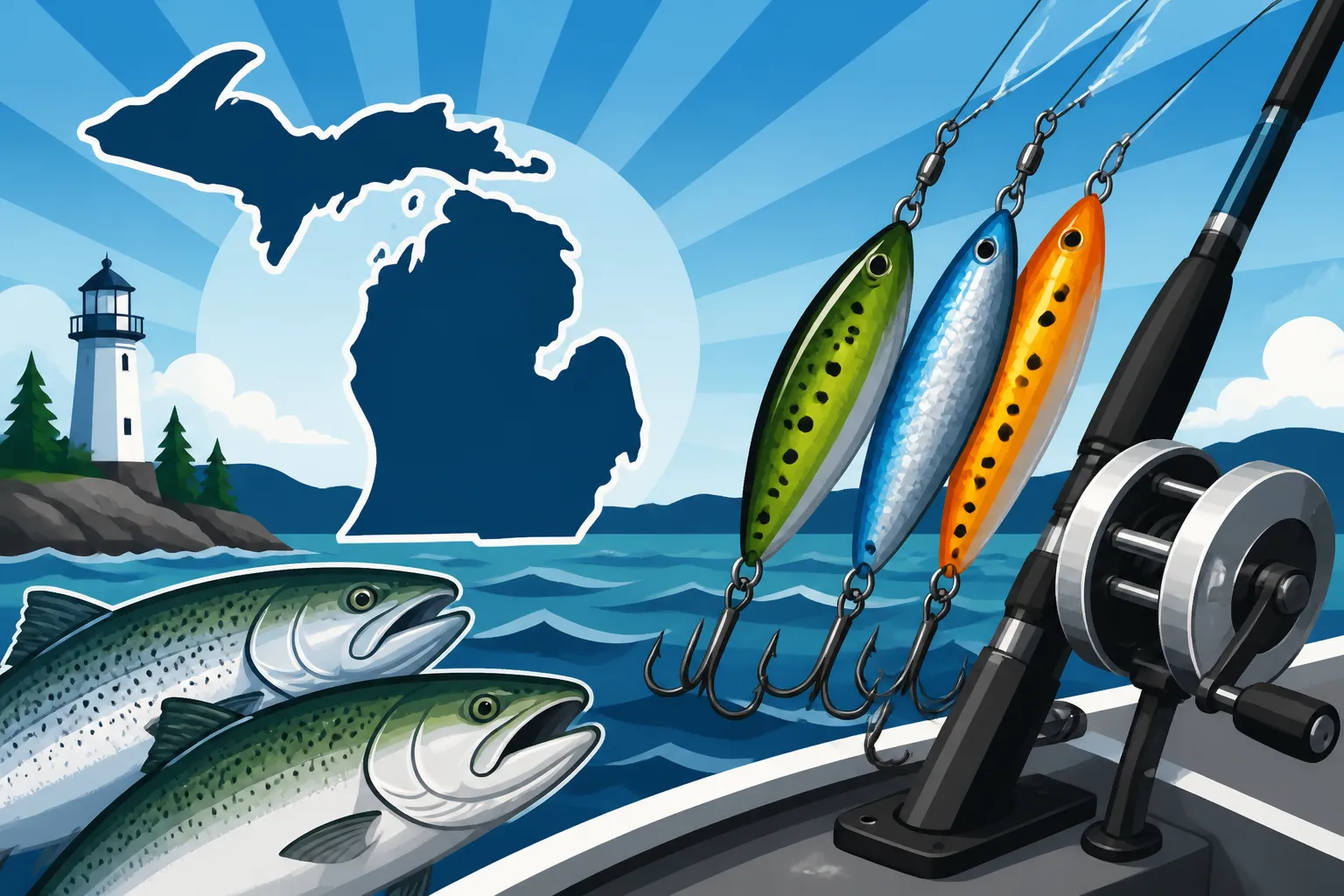
When you talk about Great Lakes trolling, spoon plugs are often the first thing that comes to mind. These elongated, curved metal lures flutter and dart through the water, mimicking fleeing baitfish like alewives, smelt, and shiners – the primary forage for many salmon and trout. Their erratic action, combined with their flashy appearance, makes them irresistible to predatory fish.
Spoons come in an astonishing array of sizes, shapes, and colors. Different shapes create different actions:
- Thin, long spoons might have a tight, fast wobble.
- Wider, shorter spoons often produce a slower, wider sway.
- Cupped spoons can create a darting, diving action.
Color is also critically important. On bright, sunny days with clear water, natural baitfish patterns like silver, blue, or green are often effective. In overcast conditions or stained water, brighter, more aggressive colors like chartreuse, orange, or even glow-in-the-dark patterns can be deadly. Many anglers will have tackle boxes filled with dozens, if not hundreds, of different spoons, ready to cycle through them until they find what the fish are keying in on. Popular brands are often found at local bait shops or larger retailers like Bass Pro Shops. Remember to check the quality of the hooks; upgrading to stronger, sharper treble hooks can significantly improve your hook-up ratio.
Crankbaits and Stickbaits: Versatility for Various Species
While spoons dominate the salmon and lake trout scene, crankbaits and stickbaits offer incredible versatility, especially when targeting walleye, brown trout, and even smaller salmon species. These lures are designed to mimic a wide range of baitfish, from minnows to perch, and their diving lips allow them to reach various depths.
Crankbaits: These lures typically have a broad, often round or oval body with a diving lip. They produce a distinct wobbling action as they're pulled through the water. Different lip designs and body shapes will dictate their diving depth and action. Deep-diving crankbaits are fantastic for getting down to walleye holding on structure or brown trout cruising deeper flats. Medium and shallow divers can be effective for targeting fish closer to the surface or in shallower bays. How to Fish a Crankbait for Michigan Walleye provides excellent guidance on using these lures effectively for that species.
Stickbaits: Also known as minnow plugs, stickbaits are typically long, slender lures that closely resemble common baitfish. They usually have a more subtle, erratic side-to-side wobble compared to crankbaits. Some are suspending, meaning they stay at their depth when paused, while others are floating or sinking. Stickbaits are incredibly effective for walleye, especially in the spring and fall, and for brown trout, which often key in on slender baitfish. Trolling stickbaits behind planer boards or with lead core line can cover a lot of water and entice strikes from wary predators.
Both crankbaits and stickbaits come in a vast array of colors and sizes. Again, matching the local forage and experimenting with different patterns based on water clarity and light conditions is key. Keep an eye out for tackle sales on Amazon to build up your collection.
Flasher-Fly Combos: Irresistible Attractors
For salmon and sometimes lake trout, the flasher-fly or dodger-fly combo is an absolute game-changer. These aren't just lures; they're an entire system designed to attract fish from a distance and then present a small, enticing meal.
Flashers and Dodgers: These are large, often brightly colored, paddle-shaped or S-shaped devices that are trolled ahead of your actual lure. Their primary purpose is to create flash, vibration, and erratic movement in the water. This commotion mimics a school of confused baitfish or a struggling injured fish, drawing in predators from afar. Flashers typically rotate, while dodgers have a more side-to-side, rocking motion. The action they impart to the trailing lure is also critical.
Flies (Trolling Flies): Trailing behind the flasher or dodger, typically on a leader of 18-36 inches, is a small, often unassuming "fly." These aren't fly-fishing flies but rather small, often Mylar or synthetic material streamers, designed to mimic a small baitfish or an invertebrate. The erratic action of the flasher or dodger gives the fly an incredibly lifelike darting and pausing motion, making it irresistible to salmon. The length of the leader between the flasher/dodger and the fly is often critical and can vary based on species and conditions.
Flasher-fly combos are particularly effective for Chinook and Coho salmon, especially when they are actively feeding on alewives. Experiment with different flasher colors (e.g., green, chartreuse, white, blue) and fly patterns (e.g., green/glow, blue/silver, white) until you find what triggers bites. The combined attraction and presentation make this one of the most productive setups for Michigan's Great Lakes salmon.
Electronics and Navigation: Your Eyes Beneath the Waves
In the vastness of the Great Lakes, knowing where you are and what lies beneath your boat isn't just helpful; it's absolutely essential for safety and success. Modern marine electronics provide an angler with an unparalleled view of the underwater world, transforming fishing from a blind cast into a targeted pursuit.
Fish Finders and Chartplotters: Unveiling Underwater Secrets
Think of your fish finder and chartplotter as your personal underwater scout and navigator. These integrated units are arguably the most important piece of electronics on a Great Lakes trolling boat, offering a comprehensive view of the fishing grounds.
Fish Finders (Sonar): Modern fish finders utilize various sonar technologies to paint a picture of what's below your hull.
- Traditional 2D Sonar: This gives you a classic arch display, showing fish, baitfish schools, and underwater structure. It's excellent for identifying fish suspended in the water column or holding near the bottom.
- Down Imaging/Side Imaging: These technologies provide photographic-like images of the bottom and structure directly below or to the sides of your boat. This is incredibly useful for identifying subtle contours, wrecks, rock piles, or transition areas where fish might be holding. Being able to "see" a school of baitfish with salmon arches nearby is a game-changer.
- Chirp Sonar: This advanced technology sends a range of frequencies, providing clearer, more defined target separation, even in deep water or at speed.
A good fish finder allows you to identify depth, bottom composition, thermoclines (crucial for finding salmon and trout), and, most importantly, the presence of fish and bait. Without it, you're truly fishing blind.
Chartplotters (GPS): Integrated with your fish finder, the chartplotter provides real-time navigation and mapping. This is critical for:
- Staying on course: Trolling in a straight line or along a contour is much easier with a GPS track.
- Marking Waypoints: You can save exact locations where you found fish, hit a productive depth, or saw interesting structure. This allows you to return to those spots with pinpoint accuracy.
- Creating Routes: Plan your trolling passes over known productive areas.
- Safety: Knowing your exact position, especially in fog or low light, is a fundamental safety measure.
Look for units with high-resolution screens and intuitive interfaces. Brands like Humminbird, Lowrance, and Garmin offer excellent options tailored for Great Lakes fishing. These tools help you understand How Deep Is Muskegon Lake or pinpoint specific structures that hold fish.
GPS and Marine Radios: Safety and Navigation Essentials
While integrated chartplotters handle navigation, dedicated GPS units and marine radios serve critical safety and communication functions, especially on large bodies of water like the Great Lakes.
Dedicated GPS (as backup): Even if you have a chartplotter, a handheld or secondary fixed-mount GPS unit can be a lifesaver. Electronics can fail, and having a backup for navigation, especially if you venture far from shore, is a prudent safety measure. These units often run on their own power source, providing redundancy in case of an electrical issue on your main system. They allow you to mark waypoints, track your movement, and navigate back to port.
Marine Radios (VHF): A marine VHF radio is non-negotiable for safety on the Great Lakes. It provides communication with other boats, the Coast Guard, and local marine assistance.
- Emergency Communications: In a distress situation (engine failure, medical emergency, capsize), a VHF radio is your most reliable way to call for help. The Coast Guard monitors channel 16 constantly.
- Weather Updates: Many channels broadcast continuous weather forecasts and warnings, crucial for making informed decisions about staying out or heading back to shore when conditions can change rapidly.
- Boat-to-Boat Communication: Talk to fishing buddies or other anglers for real-time fishing reports, depths, or what lures are working.
Always ensure your marine radio is in good working order and you know how to use it. Consider a Digital Selective Calling (DSC) enabled VHF radio, which, when connected to your GPS, can automatically send your precise location during an emergency call. This is an absolute must-have for safe operation on the Great Lakes. Michigan Boating Laws for Anglers often includes requirements for marine safety equipment.
Onboard Essentials: Maximizing Comfort and Efficiency
Successful Great Lakes trolling isn't just about the rods, reels, and electronics; it's also about how your boat is set up to maximize efficiency, organization, and angler comfort. When you're spending long hours on the water, often in varying conditions, having the right onboard accessories can make a huge difference in your enjoyment and productivity.
Rod Holders and Storage Solutions
Imagine a typical Great Lakes trolling spread: you might have two downrigger rods, two dipsy diver rods, and two planer board rods all deployed simultaneously. That's six rods, and potentially more. Without proper rod holders, your deck would be a tangled mess, and you'd have no way to manage your lines effectively or safely.
Rod Holders: These are paramount. You'll need sturdy, adjustable rod holders that can securely hold your rods while trolling, withstand the shock of a strike from a large fish, and allow for easy removal when it's time to fight. Many serious trollers opt for heavy-duty, aluminum, or stainless steel rod holders that mount permanently to the boat's gunwales or a track system. Track systems are particularly popular as they allow you to easily slide and adjust the position of multiple rod holders, giving you flexibility in your spread. Consider angles: some holders keep rods straight out, others angle them up or down, all designed to help spread lines and manage tangles.
Storage Solutions: Beyond active rod holders, you need dedicated storage for your additional rods, nets, and gaffs. Rod racks, whether horizontal or vertical, keep your spare rods safe and out of the way. Tackle storage systems, like those found at Bass Pro Shops or specialty marine stores, are essential for organizing the vast array of spoons, crankbaits, and terminal tackle you'll accumulate. Waterproof tackle boxes, dedicated storage compartments, and even smaller on-deck bags for frequently used items all contribute to a clutter-free and efficient fishing environment. A well-organized boat means less fumbling and more time fishing.
Nets, Coolers, and Safety Gear
Even with the best rods and reels, you need the right tools to safely land and store your catch, and crucial safety gear for yourself and your crew.
Landing Nets: A large, sturdy landing net is absolutely essential for Great Lakes trolling. These aren't your average trout nets. You need a net with a wide hoop and a deep, rubberized mesh to handle large, powerful fish like Chinook salmon or lake trout without damaging them, especially if you plan on catch and release. A long, extendable handle is a huge advantage, allowing you to reach fish boatside, especially when fishing solo or with a small crew. Trying to hoist a 20-pound salmon into the boat by the line alone is a recipe for heartbreak.
Coolers: Once you've landed your prize, you need a way to keep it fresh. Large, high-quality coolers are a must. They should be big enough to accommodate multiple large fish and have excellent insulation to keep ice frozen for extended periods. Consider coolers with drain plugs for easy cleaning. Having a dedicated cooler for fish and another for drinks and food keeps everything sanitary and organized. Nothing beats fresh Great Lakes salmon, and a good cooler ensures it stays in prime condition until you get back to shore.
Safety Gear: This is paramount, never to be overlooked. While Michigan Boating Laws for Anglers outlines minimum requirements, consider going beyond.
- Life Jackets: Ensure you have enough USCG-approved life jackets for everyone on board, and that they are easily accessible. Consider wearing them at all times, especially in rough water or cold conditions.
- First Aid Kit: A well-stocked first aid kit is crucial for handling minor cuts, scrapes, or other emergencies.
- Fire Extinguisher: Required by law on many boats, ensure it's charged and easily accessible.
- Sound Producing Device: A horn or whistle is a legal requirement.
- Visual Distress Signals: Flares or an electronic visual distress signal are essential for emergencies.
- Anchor and Line: For holding your position in an emergency or while working on an issue.
- Paddle/Oars: If your main engine fails, you'll need a way to maneuver.
- Emergency Communication: As discussed, a VHF radio.
- Sun Protection: Sunscreen, hats, and sunglasses are vital for long days on the water.
Being prepared for anything that the Great Lakes can throw at you will not only keep you safe but also allow you to enjoy your fishing trips with peace of mind.
Maintenance and Preparation: Protecting Your Investment
You’ve invested time, effort, and money into assembling your Great Lakes trolling gear. To ensure it performs flawlessly trip after trip and lasts for years to come, proper maintenance and preparation are absolutely non-negotiable. Neglecting your gear, especially after exposure to the harsh conditions of the Great Lakes, is a sure path to premature failure and costly replacements.
Post-Trip Care for Salt and Freshwater Exposure
While the Great Lakes are freshwater, they are vast, and the sheer volume of water, combined with fluctuating temperatures and sometimes harsh weather, can still take a toll on your equipment. More importantly, lake water isn't perfectly pure; it contains minerals, microscopic organisms, and sometimes pollutants that can lead to corrosion and grime buildup.
Rinsing is Key: The most important post-trip task is a thorough rinse of all your rods, reels, downriggers, planer boards, and other tackle that came into contact with water. Use fresh, clean tap water, and don't be shy. Pay particular attention to reels, ensuring you flush out any debris from the spool and drag system. A light spray with a hose is usually sufficient, but for reels, a more direct rinse can be beneficial.
Drying and Lubrication: After rinsing, allow everything to air dry completely. Don't put wet gear back into storage, as this can lead to mildew, rust, and corrosion. Once dry, reels, downrigger components, and any moving parts should receive a light application of a marine-grade lubricant or corrosion inhibitor. A tiny drop of reel oil on moving parts like handles and levelwind mechanisms can keep them running smoothly. Avoid over-lubricating, as this can attract dirt and grime. For downriggers, check the cable for fraying and lightly oil the pulleys and pivot points.
Lure and Terminal Tackle Care: Rinse all your lures and terminal tackle. Pay special attention to hooks, as they are prone to rusting. Dry them thoroughly. If you notice any rust, immediately replace the hook or clean it with a wire brush and apply a protective coating. Store lures in well-organized, dry tackle boxes. This is a great time to inspect leader lines for nicks and abrasions, and replace them if necessary. This diligent care will extend the life of your expensive gear and ensure it's ready for your next adventure.
Pre-Season Checks and Gear Organization
Before the season kicks off or a big trip, a comprehensive pre-season check and a solid organization system will set you up for success.
Rod and Reel Inspection: Start by inspecting all your rods. Check the guides for cracks or missing inserts, as these can quickly fray or cut your line. Inspect the reel seats for any looseness or damage. On your reels, check the drag system for smoothness and ensure it holds tension correctly. Test the anti-reverse. Look for any unusual noises or stiffness in the retrieve. It might be time for fresh line; monofilament, in particular, can degrade over time and lose strength and elasticity. Respooling with fresh line each season is a good practice. Learn more about Michigan Fishing License Renewal Each Spring as you prepare for the new season.
Downrigger and Planer Board Systems: For downriggers, inspect the cable for any kinks, fraying, or rust. Check all bolts and mounts for tightness. Ensure the retrieve mechanism is working smoothly. For planer boards and mast systems, check lines for fraying and inspect all clips and pulleys. Make sure the boards themselves are free of cracks or damage.
Tackle Box Overhaul: This is the perfect time to go through your tackle boxes. Remove any rusty hooks, broken lures, or tangled leaders. Sharpen any dull hooks. Replenish your supply of essential terminal tackle like swivels, snap swivels, and leader material. Organize your lures by type, size, and color so you can quickly find what you need on the water. A well-organized tackle box reduces frustration and saves valuable fishing time.
Boat Systems Check: Beyond fishing gear, ensure your boat's engine, electronics, lights, and safety gear are all in top working order. Check battery levels, fuel lines, and bilge pumps. Make sure your fire extinguisher is charged and your life jackets are accessible and in good condition. Taking these preventative steps before you hit the water means you can focus entirely on the thrill of the catch rather than worrying about equipment failures. Your future self (and your fishing partners) will thank you for it!
Disclaimer
This article is for general informational purposes only and does not constitute professional advice. Laws, prices and regulations vary by location and change over time. Consult a qualified professional for guidance on your specific situation.