How to Tell a Muskellunge From a Northern Pike
Oh, the age-old Michigan fishing conundrum! You've just pulled a toothy, powerful fish from the weeds, and your heart is pounding. Is it a magnificent muskellunge, a true fish of a thousand casts, or a feisty northern pike, ready to give you a thrill? For many anglers, especially those new to Michigan's incredible waters, telling these two apex predators apart can feel like trying to solve a riddle while wrestling a wet rope. This guide is here to untangle that confusion, giving you the definitive characteristics to confidently identify whether you've landed a muskie or a pike, ensuring you follow the right regulations and handle your catch with care.
The Perplexing Similarities: Why Anglers Get Confused
It's completely understandable why so many anglers, from seasoned veterans to excited beginners, find themselves scratching their heads when confronted with a Esox species. These fish are cut from very similar cloth, and in the heat of the moment, with adrenaline pumping and a fish flopping, those subtle differences can seem impossible to discern.
A Shared Appearance and Habitat
Both muskellunge and northern pike boast that quintessential long, torpedo-shaped body, designed for explosive ambush strikes. Their dorsal and anal fins are set far back on their bodies, near the tail, giving them incredible bursts of speed to pounce on unsuspecting prey. Their mouths are large, armed with an impressive array of sharp, needle-like teeth – definitely a feature that commands respect and caution.
Beyond their physical build, they often share similar hunting grounds. You'll frequently find both pike and muskie lurking in the same types of cover: dense weed beds, submerged timber, rocky points, and along the edges of drop-offs in Michigan's inland lakes and larger rivers. They are masters of camouflage, their mottled green and brown patterns blending seamlessly into their surroundings, waiting patiently for a meal to swim by. This habitat overlap means that encountering either species in almost any body of water known for one of them is a distinct possibility. It's not uncommon to target pike in a lake and be utterly surprised by a muskie, or vice versa. The thrill of the unknown is part of their allure, but also a source of identification headaches!
The "Esox" Family Resemblance
The core of the confusion lies in their biological classification. Both muskellunge (Esox masquinongy) and northern pike (Esox lucius) belong to the same genus, Esox, commonly known as the pike family. This means they are cousins, sharing a common ancestor and many evolutionary traits that make them incredibly similar in appearance and behavior. Think of it like distinguishing between two different breeds of large, sleek hunting dogs – they might both be powerful and fast, but subtle differences in their markings, build, and sometimes even their temperament, set them apart.
This close genetic relationship means that without careful observation, an angler might easily mistake a smaller muskie for a large pike, or a darkly marked pike for a barred muskie. The problem intensifies when you consider that coloration can vary wildly within a single species, influenced by water clarity, diet, and even geographic location. A pike from a tannin-stained river might look darker than one from a clear, sandy lake, potentially muddling the visual cues even further. This shared heritage and variable appearance are why knowing the precise, anatomical distinctions is absolutely critical. It’s also why being informed about Michigan Fishing Regulations Every Angler Should Know is so important, as rules differ for each species.
Unmasking the Differences: Key Identification Marks
While the similarities are striking, there are definitive ways to tell these two magnificent fish apart. These aren't just subtle nuances; once you know what to look for, the differences become quite clear.
Jaw Droppers: Spotting the Distinctive Patterns on Their Cheeks and Gill Covers
This is the absolute most reliable identifier for distinguishing between a muskellunge and a northern pike. Forget the spots, forget the size for a moment – look at the scales on their heads.
Northern pike have fully scaled cheeks and gill covers. Imagine their entire cheek area, from behind the eye to the gill slit, and the entire gill cover behind that – it will be covered in scales. It’s like their whole face is wearing a textured, scaly mask.
Muskellunge, on the other hand, have scales only on the upper half of their cheeks and gill covers. The lower half will be smooth, unscaled skin. Think of it as wearing a half-mask, with the bottom jaw and gill plate area exposed. This difference is stark once you know to look for it.
To safely check this feature on a live fish, you must handle it with extreme care. Always use a large, rubberized net to secure the fish in the water, or a specialized muskie cradle. Avoid handling the fish by its gills or eyes. If you must lift it for a quick photograph or identification check, use a jaw gripper designed for large fish, supporting the body with your other hand. Gently lift just enough to observe the cheek and gill plate area. You can often see this detail even with the fish mostly submerged in a net or cradle. Misidentifying this feature can lead to unintended violations, especially since muskie often have very specific regulations, like Michigan's catch-and-release mandate on many waters and mandatory reporting. For instance, knowing the Michigan Muskellunge Daily Catch Limit often means knowing it's "one per season" or "zero retention" depending on the water.
The Spotting Game: Pattern, Color, and Markings
While less reliable than the scale pattern, the overall body markings can offer strong clues, especially after you've become familiar with many specimens.
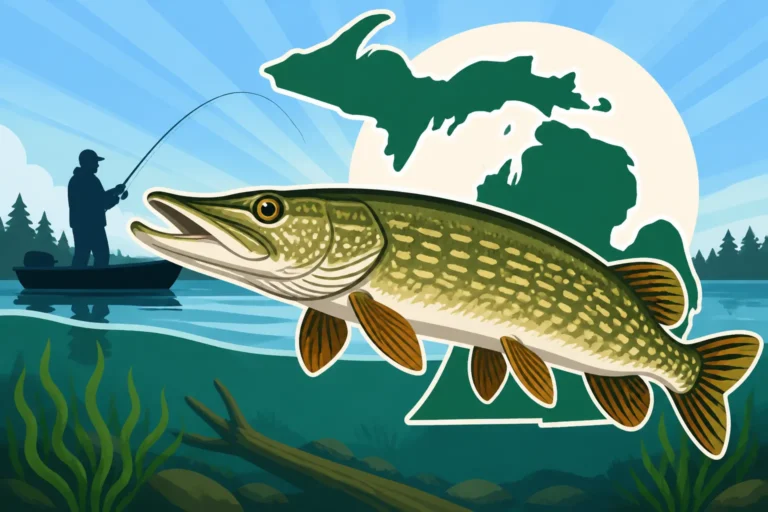
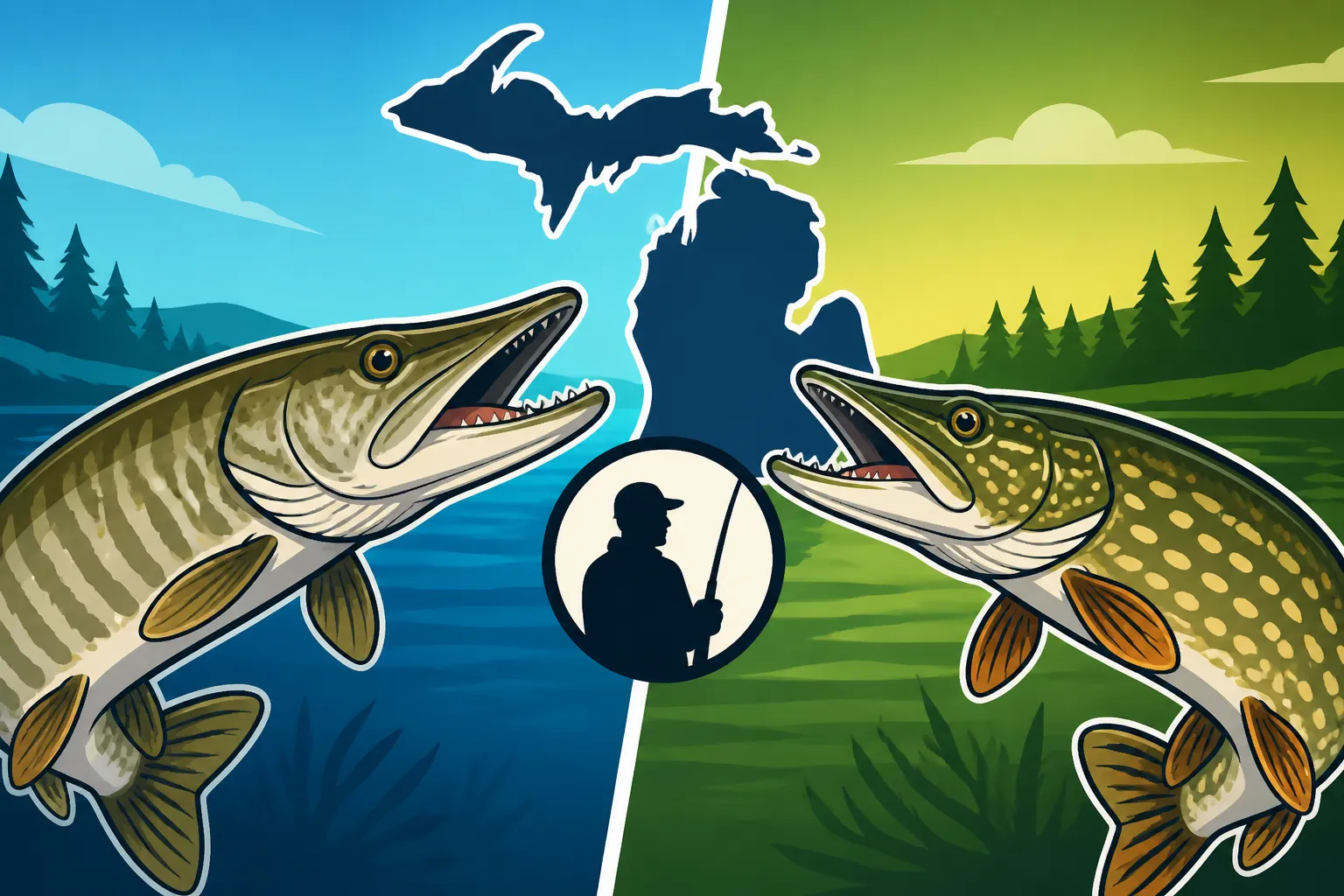
Northern pike typically display lighter, bean-shaped spots on a darker, greenish body. Think of it as a dark background with light markings painted on. The spots can sometimes merge into irregular bars, but the general impression is lighter markings on a darker base. Their fins often have a reddish or orange hue, sometimes tipped with darker spots. These patterns can sometimes be quite vivid, giving them a striking appearance as they burst from cover.
Muskellunge, however, tend to have darker bars or spots on a lighter, often silvery or brownish-green body. This is the inverse of the pike. Imagine a lighter background with darker markings applied. These markings can range from distinct, dark bars (hence the common name "barred muskie") to solid spots ("spotted muskie"), or even irregular blotches. Some muskie might appear almost clear-sided, especially in very clear water, making the cheek scale pattern even more vital for identification. Their fins are usually darker, often with faint blotches or spots, and typically lack the reddish tint common in pike.
It's important to remember that these color patterns can vary depending on the specific water body, time of year, and even the fish's diet. A muskie from a clear, sandy-bottomed lake might appear much lighter than one from a dark, tannin-stained river system. So, while helpful, always back up your pattern assessment with the definitive cheek and gill plate scale check.
The Tail and Fin Fan-Out
Another, albeit more subtle, differentiator can be found in their caudal (tail) fin and other fins. Again, this is a secondary characteristic to the gill plate scales.
Northern pike generally have a more rounded or slightly convex edge to their tail fin. The tips of the tail lobes are often rounded. Their fins might also appear somewhat softer or less rigid than those of a muskie.
Muskellunge, in contrast, typically have a more pointed or concave (forked) edge to their tail fin. The tips of the tail lobes are often noticeably sharper and more pointed. Their fins overall tend to be larger, more robust, and more rigid, which makes sense given their potential for larger size and powerful bursts of speed.
While these fin differences exist, they can be challenging to judge accurately, especially if the fish is thrashing or if you’re not looking at it head-on in a calm, controlled manner. It’s not uncommon for individual fish to show slight variations, so relying solely on fin shape could lead to misidentification. Always prioritize the cheek and gill cover scale count.
Beyond the Scales: Behavioral and Practical Distinctions
While anatomical differences are key, understanding the general characteristics of each species in terms of size, habitat, and even attitude can further aid in your identification, or at least help you manage your expectations when a fish strikes.
Size Expectations and Growth Rates
Generally speaking, muskellunge grow larger and live longer than northern pike in Michigan waters. When you hook into something truly monstrous, the odds lean more towards it being a muskie. How Big Does a Muskellunge Get in Michigan is often answered with tales of giants pushing into the 50-inch range, and occasionally even larger. These fish are slow-growing, taking many years to reach trophy status, which is why catch and release is so heavily promoted for muskie.
Northern pike, while still respectable in size and certainly capable of reaching impressive lengths, rarely attain the sheer mass of a large muskie. A truly big northern pike in Michigan might push 40 inches, but anything beyond that is quite rare. How Big Do Northern Pike Get in Michigan typically sees responses in the 20-30 inch range for common catches, with bigger fish being a real treat.
Here’s a simplified comparison:
| Feature | Northern Pike | Muskellunge |
|---|---|---|
| Cheeks & Gill Covers | Fully scaled | Scales only on upper half |
| Body Pattern | Light spots on a darker body | Dark bars or spots on a lighter body |
| Tail Fin | More rounded or slightly convex | More pointed or distinctly forked |
| Overall Size Potential | Generally smaller (common to 30", rarely 40"+) | Generally larger (common to 40", often 50"+) |
| Longevity | Shorter lifespan | Longer lifespan |
| Aggression | Highly aggressive, often readily strikes | Can be more elusive, "fish of a thousand casts" |
Habitat Preferences and Habits
While there's certainly an overlap in where you'll find these fish, they often show subtle preferences that can sometimes hint at what you've hooked.
Northern pike are incredibly adaptable and are found in a vast array of Michigan waters, from small, shallow inland lakes to large rivers and even the Great Lakes. They thrive in areas with abundant vegetation, using the weeds as prime ambush points. They are often more tolerant of warmer, shallower water than muskies and can be quite abundant in many systems. You might encounter them lurking in just a few feet of water, often tucked right into the densest weeds. Many anglers targeting panfish or bass are surprised by a pike strike in these weedier environs. For ideas on where to find them, check out Best Michigan Lakes for Northern Pike.
Muskellunge tend to prefer slightly larger, clearer, and often deeper waters, though they will still utilize weed lines and structure for cover. They are often considered more solitary predators than pike. While they'll certainly patrol shallow areas, especially during cooler periods or low light, they often have larger home ranges and might be associated with deeper breaks or larger submerged structures. They are also known for being more challenging to catch, hence the moniker "fish of a thousand casts," though some dedicated muskie waters can be quite productive. If you're wondering where to specifically target these giants, our guide to Best Michigan Lakes for Muskellunge might be helpful.
Handling Your Catch Responsibly
This is paramount for both species, but especially for muskellunge, which are almost universally managed as a catch-and-release fishery in Michigan. Their slow growth and relatively low numbers mean every fish is precious for maintaining a healthy population.
When you hook either a pike or a muskie, be prepared. Have a large, rubberized landing net or a muskie cradle ready. Avoid cheap, knotty nets that can damage fins, remove protective slime, or entangle hooks. Never lip a pike or muskie like a bass; their teeth are razor-sharp and will cause serious injury. Use long-nosed pliers or a specialized hook remover to extract hooks. If the hook is deeply set, consider cutting the line as close to the hook as possible, as the hook will eventually rust out. Amazon has a great selection of muskie-specific release tools, including extra-long pliers and jaw spreaders, that are essential for safe handling.
For muskie, rapid release is key. Minimize their time out of the water to seconds, not minutes. Keep them in the net or cradle in the water for photos, if possible. Ensure they are revived properly, holding them gently upright in the water until they can swim away strongly on their own. This commitment to proper handling helps ensure these incredible fish can continue to thrill anglers for generations. Detailed advice can be found in our post on How to Catch and Release a Muskellunge.
Making the Call: What to Do After Identification
Once you've made a confident identification, the next steps are crucial for the health of the fish and for your compliance with Michigan's fishing regulations.
Releasing Without Harm
Whether it's a pike or a muskie, the goal should always be to ensure the fish's survival, especially if you're not planning to keep it (and in many cases, with muskie, you legally cannot). Always use proper handling techniques:
- Minimize Air Exposure: Keep the fish in the water as much as possible. A large, rubberized net or a muskie cradle is invaluable for this.
- Avoid Contact with Dry Surfaces: Don't lay the fish on the boat deck, ground, or any dry surface, as this can remove their protective slime layer, making them vulnerable to disease.
- Use Proper Tools: Long-nose pliers, hook removers, and jaw spreaders are essential. You can find excellent, heavy-duty versions on Amazon that are designed to handle these toothy critters safely.
- Support the Fish: If you must lift it, support its body horizontally. Never hold a large fish vertically by the jaw alone, as this can damage its spine and internal organs.
- Revive Gently: If the fish seems sluggish, hold it gently in the water, facing into any current, until it regains strength and swims away on its own.
Understanding Michigan's Regulations
Michigan has specific regulations for both northern pike and muskellunge, including different size limits, possession limits, and even reporting requirements. For instance, muskellunge often have much higher minimum size limits, and in many waters, they are strictly catch-and-release. If you do harvest a legal muskie, there's usually a Michigan Muskellunge Harvest Reporting Rules requirement, which means registering your catch with the DNR within 24 hours. This is vital data for fisheries management. Northern pike, while also managed, typically have less stringent rules regarding harvest and reporting, though minimum size limits like What Is the Northern Pike Size Limit in Michigan and daily possession limits still apply.
Always consult the latest Michigan Fishing Regulations Digest before you head out, or use the Michigan's DNR Hunt Fish App for Licenses and Reporting on your phone. Regulations can vary by water body and change periodically, so what was legal on one lake might not be on another, or even in the same lake next season. Knowing What Is the Michigan Muskellunge Size Limit is critical, as violating these rules can result in significant fines and penalties.
Learning Resources for Anglers
The best way to get better at identification is through practice and education. Spend time studying images of both species, paying close attention to the details discussed here. Many excellent field guides for Michigan fish species are available, and a good waterproof identification card can be invaluable on the water. These resources, often found on Amazon, can serve as quick reference guides when you're uncertain.
Participate in fishing forums or local angler groups; many experienced fishermen are happy to share their knowledge. The Michigan DNR website also provides a wealth of information. The more you educate yourself and spend time on the water observing these magnificent fish, the more confident you'll become in telling a muskie from a pike, truly appreciating the unique characteristics of each.
Remember, the thrill of the catch is only part of the experience. Being a responsible angler means understanding the fish you pursue, respecting their habitats, and doing your part to ensure their future in Michigan's incredible waters.
Disclaimer
This article is for general informational purposes only and does not constitute professional advice. Laws, prices and regulations vary by location and change over time. Consult a qualified professional for guidance on your specific situation.