What Electronics Help Find Walleye
Finding walleye in Michigan can sometimes feel like searching for a needle in a haystack, especially in our vast Great Lakes or expansive inland waters. These elusive, finicky fish often hold to specific structures or depths, and without the right tools, you might spend more time guessing than catching. This guide will help you understand the essential marine electronics that can drastically improve your walleye fishing success, making your time on the water more productive and enjoyable.
The Walleye Hunter's Edge: Why Electronics Are Non-Negotiable
Walleye are masters of camouflage and often prefer to hug bottom structures, transitions, or subtle depth changes. They don't always show up as big, bright arches on traditional sonar, especially when they're belly-to-the-bottom in deep water. This means relying solely on visual cues or guesswork often leads to frustration. Modern marine electronics are not just about seeing fish; they're about understanding the underwater world, pinpointing prime habitat, and anticipating where walleye will be.
It's a common misconception that fish finders just, well, find fish. While they certainly do that, their true power lies in revealing the contours of the lakebed, identifying weed lines, rock piles, drop-offs, and even subtle changes in bottom composition that scream "walleye hangout." Without this crucial intel, you're essentially blind fishing, hoping your bait drifts over a productive spot by sheer luck. In a state with such diverse fisheries, from the sprawling Saginaw Bay to the deep pockets of inland lakes, having a clear picture of what's beneath your boat is paramount.
Understanding the Elusive Nature of Michigan Walleye
Michigan walleye are known for their light-sensitive eyes, often making them most active during low-light conditions like dawn, dusk, or even dead of night. During the day, they frequently retreat to deeper, darker waters or hide in dense cover. This behavior means that simply cruising around won't cut it. You need to be able to identify these hidden sanctuaries, even when the fish themselves aren't actively chasing bait in the open water column.
Imagine you're out on Houghton Lake, trying to find a decent walleye bite. You know they like structure, but what kind? Is it a submerged hum, a deep weed edge, or a rock pile? Without a clear electronic picture, you could spend hours drifting over barren bottom. With a good fish finder, you can quickly scan wide areas, mark promising spots, and return to them with precision, significantly reducing wasted time and fuel. This is especially true when you're targeting specific depths or trying to stay on a subtle break line, which is critical for consistent walleye success. If you're wondering how to maximize your chances, checking out Michigan Walleye Fishing Techniques can give you an edge.
The Role of Detailed Mapping in Walleye Success
Beyond actively "finding" fish, electronics play a massive role in navigation and strategic planning. Modern chartplotters, often integrated with fish finders, come with highly detailed lake maps that show contours, navigation markers, and even submerged structures. For walleye anglers, contour lines are gold. Walleye love to relate to changes in depth – sharp drop-offs, underwater points, and the edges of flats.
Having a high-definition map allows you to identify these features before you even get on the water, letting you plan your drifts or trolling passes with incredible accuracy. You can mark waypoints on productive rock piles or deep humps, ensuring you can return to them even in choppy conditions or low visibility. This planning becomes even more crucial when exploring vast bodies of water like Lake Erie's Michigan waters or Saginaw Bay, where covering miles of water efficiently is key to finding those feeding schools. For more on navigating these bigger systems, take a look at Michigan's Great Lakes Fishing Guide.
Decoding the Depths: Types of Fish Finders for Walleye
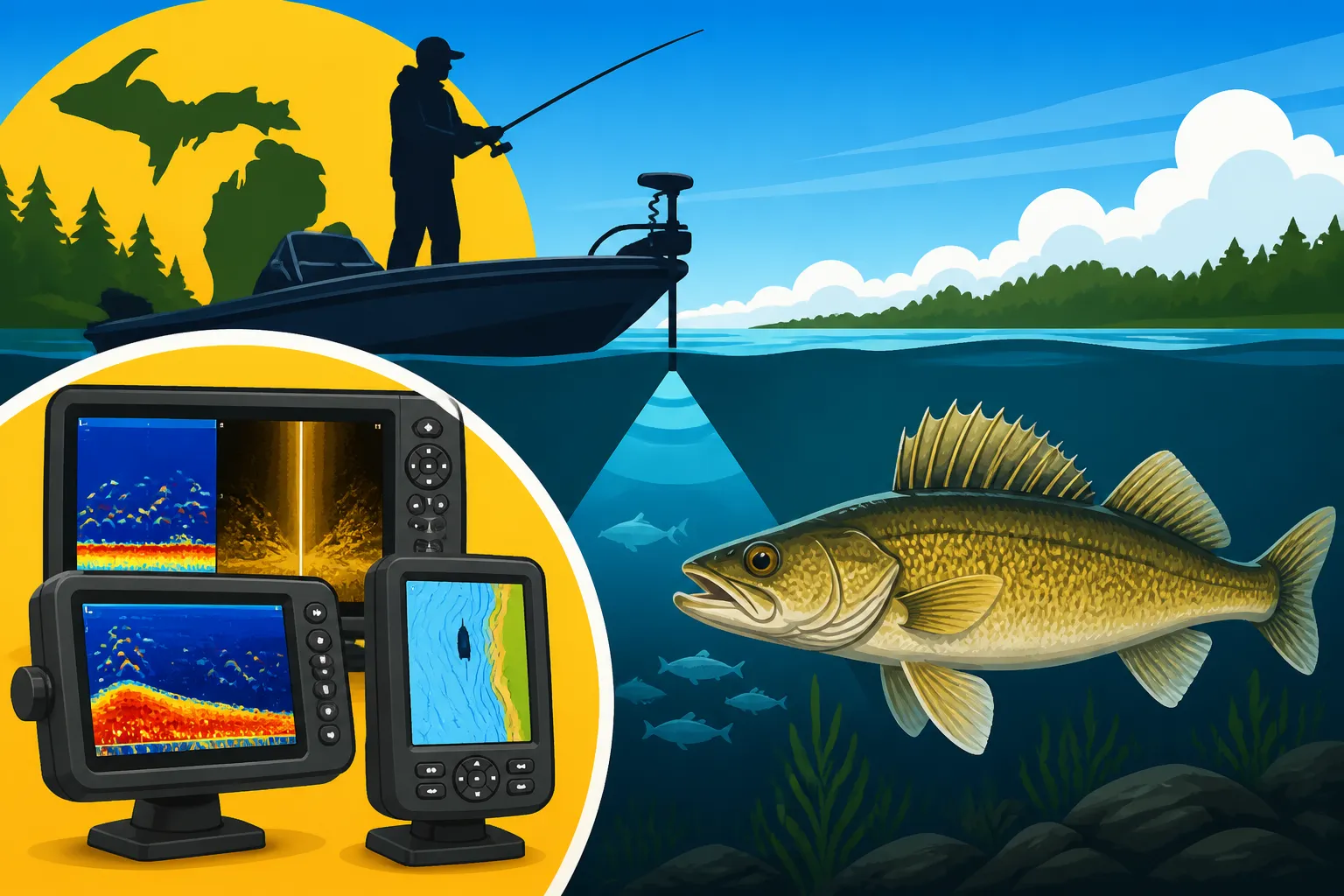
When it comes to fish finders, you're not just looking for a device that beeps when a fish swims by. Modern technology offers a suite of sonar options, each providing a different perspective of the underwater world. Understanding these differences is key to choosing the right system for your walleye pursuits.
Traditional 2D Sonar: The Classic Walleye View
This is the bedrock of fish finding technology. Traditional 2D sonar sends a cone-shaped pulse of sound into the water, and when it hits objects (fish, structure, bottom), it bounces back, creating an image on your screen. Fish often appear as arches, while structure shows up as irregular shapes. For walleye, who often sit tight to the bottom, this can sometimes make them hard to distinguish from the bottom itself, especially on lower-resolution units. However, with practice, you'll learn to differentiate a "hard" bottom echo from a fish arch close to it.
The beauty of 2D sonar is its simplicity and effectiveness. You can adjust sensitivity, ping speed, and frequency to get a clearer picture. Lower frequencies penetrate deeper but offer less detail, while higher frequencies provide more detail in shallower water. Many seasoned walleye anglers still rely heavily on 2D sonar, especially for identifying schools of baitfish, which are often a precursor to finding walleye. It's excellent for seeing the general depth and presence of fish directly under your boat, which is perfect for vertical jigging or drifting presentations.
Down Imaging: A Photographic View of Structure
Down Imaging (often called DownScan by some brands) uses a different, much narrower beam of high-frequency sonar that provides a photographic-like view directly beneath your boat. Instead of arches, fish appear as distinct shapes, and structure like stumps, rock piles, or sunken trees look incredibly realistic. This technology excels at helping you differentiate between a brush pile, a submerged tree, or a cluster of rocks – all prime walleye habitat.
For walleye anglers, Down Imaging is invaluable for identifying the subtle nuances of bottom structure where these fish like to hide. You can clearly see a walleye holding tight to a log or sitting in the ambush position at the base of a sharp drop-off. It removes a lot of the guesswork associated with interpreting traditional 2D sonar, giving you a clearer picture of what you're seeing and helping you decide if it's worth dropping a jig or letting out a planer board.
Side Imaging: Scanning the Walleye Highways
Side Imaging (or SideScan) is a game-changer for covering water and finding offshore structure. It sends beams out to the sides of your boat, typically up to hundreds of feet on each side, painting a wide picture of the lakebed. This allows you to scan vast areas quickly, identifying weed lines, rock reefs, sunken boats, and other productive walleye features that you might otherwise drive right over without seeing.
Imagine trolling Saginaw Bay for walleye. Instead of just seeing what's under your boat, Side Imaging lets you see 100 feet to your left and 100 feet to your right. You can quickly spot a subtle reef or a schooling bait ball off to the side, then make a turn to investigate it directly. This technology is incredibly efficient for locating transitions and structure, allowing you to mark waypoints on promising areas and then come back to them with your traditional sonar or Down Imaging for a closer look. For serious walleye hunters, especially those who troll or cast large areas, Side Imaging is almost a must-have tool to truly unlock the potential of a fishery.
Live Sonar: Seeing Walleye in Real-Time
This newer technology, often referred to as "Live" or "Real-Time" sonar, is perhaps the biggest leap forward for anglers. Unlike traditional sonar that paints a historical picture of what you've passed over, Live Sonar shows you what's happening right now. You can see your lure falling, fish reacting to it, and even watch them swim away or approach.
For walleye, this means you can target individual fish, observe their behavior, and adjust your presentation on the fly. If you see a walleye sitting near a rock pile, you can drop your jig precisely to it and watch how the fish reacts. If it ignores your offering, you can change baits or techniques instantly. This is particularly effective for vertical jigging, ice fishing, or any situation where you're trying to coax finicky fish into biting. It requires a bit of a learning curve, but the ability to see fish in real-time opens up incredible tactical opportunities for discerning walleye behavior.
| Sonar Type | Primary Benefit for Walleye Fishing | Best Use Cases | Walleye Appearance |
|---|---|---|---|
| Traditional 2D | Good for general fish detection, bait balls, and bottom hardness. | Vertical jigging, identifying bait, general depth. | Arches or streaks |
| Down Imaging | Clear, photo-like detail of structure directly below the boat. | Pinpointing specific bottom structure (logs, rocks). | Distinct shapes |
| Side Imaging | Wide-area scanning for structure and fish off to the sides of the boat. | Trolling, searching large areas, finding hidden reefs. | Dots, shadows |
| Live Sonar | Real-time view of fish and lures, observing fish behavior. | Target fishing, vertical jigging, ice fishing. | Moving lines/dots |
Navigating to Success: GPS and Chartplotters
While fish finders show you what's under the water, GPS and chartplotters tell you where you are and help you get to where the fish are most likely to be. These are often integrated into the same unit as your sonar, creating a powerful combination.
Marking Waypoints and Following Contours
One of the most fundamental uses of GPS for walleye fishing is marking waypoints. When you find a productive spot – a submerged hump, a deep weed edge, or a school of actively feeding walleye – you can mark it with a waypoint. This ensures you can return to that exact spot again and again. This is invaluable on large bodies of water where features can be subtle and hard to relocate. Many anglers rely on marking waypoints for Michigan's Trout and Salmon Season on the Great Lakes as well, which share similar structural preferences with walleye.
Moreover, chartplotters display detailed lake maps with contour lines. Walleye are notorious for relating to these contours. They might patrol a specific depth range, follow a break line, or ambush baitfish as they move up or down a slope. With a detailed map, you can make precise trolling passes along a 20-foot contour or drift a jig along a sharp drop-off, knowing exactly where you are in relation to the structure. This precision dramatically increases your chances of putting your bait in front of fish.
Mapping the Unknown: Preloaded vs. Custom Charts
Most modern chartplotters come preloaded with high-definition mapping. These maps can vary in detail, but many offer excellent bathymetry for Michigan's major lakes and rivers. Features like Navionics or LakeMaster charts are popular among walleye anglers for their precise contour lines and ability to highlight specific depth ranges. When buying a unit, always check what mapping is included and if it covers your primary fishing grounds.
Beyond preloaded maps, some systems allow for custom mapping. This means your sonar unit can record depth and bottom data as you travel, building a personalized, highly detailed map of areas that might not be fully charted, or where you want even finer resolution. This is particularly useful for exploring new, less-fished waters or for creating extremely precise maps of your favorite walleye holes. Imagine creating a high-definition map of a previously un-chartered walleye hot spot on a remote Upper Peninsula lake – that's a serious competitive advantage.
Why Auto-Pilots and Trolling Motors with GPS Integration are Game Changers
For walleye anglers, especially those who troll or drift, GPS-enabled trolling motors and integrated auto-pilot systems are nothing short of revolutionary. These systems allow you to set a course, maintain a specific speed, or even "anchor" electronically in one spot (known as "spot lock" or "virtual anchor").
When trolling for walleye on Lake Huron's Saginaw Bay, maintaining a precise speed and direction along a contour or over a specific structure is crucial. An auto-pilot system can do this far more accurately than you can manually, freeing you up to adjust lines, net fish, or focus on your sonar. Similarly, if you find a school of walleye with your electronics while drifting an inland lake, a GPS-enabled trolling motor can hold you exactly over that school, even against wind and current, allowing you to vertical jig effectively. This level of control is transformative, turning challenging conditions into manageable fishing opportunities.
Putting It All Together: Maximizing Your Electronics on the Water
Having the best electronics won't guarantee success if you don't know how to use them effectively. It's about combining the visual information with your knowledge of walleye behavior and fishing techniques.
Reading Your Screen: Beyond the Arches
Learning to interpret your fish finder screen takes practice. Don't just look for "fish arches." Instead, focus on the overall picture:
- Bottom Hardness: A thick, bright bottom return usually indicates a hard bottom (rock, gravel), while a thinner, softer return suggests mud or silt. Walleye often prefer hard bottoms.
- Structure: Identify humps, depressions, drop-offs, weed lines, and submerged timber. These are all prime ambush points or resting areas for walleye.
- Baitfish: Look for clouds of baitfish. Where there's bait, there are often predators. Walleye will follow their food source.
- Fish on the Bottom: Pay close attention to fish returns that are right on the bottom. These are often walleye, especially during the day when they're less active.
Many units allow you to customize color palettes, sensitivity settings, and scroll speeds. Experiment with these settings to find what works best for your eyes and the conditions you're fishing in. It's a continuous learning process.
Combining Sonar Views for a Complete Picture
The true power of modern electronics comes from integrating different sonar technologies. Many units offer split-screen views, allowing you to see 2D sonar, Down Imaging, and Side Imaging all at once.
For example, you might use Side Imaging to scan a wide area and locate a promising rock pile off to your side. Once you've marked it with a waypoint, you can steer directly over it, then switch to a split-screen of 2D sonar and Down Imaging to get a detailed view of the structure and any walleye holding tight to it. If you see active fish, you might then deploy Live Sonar to watch your jig drop and observe their reaction. This layered approach provides the most comprehensive understanding of the underwater environment and maximizes your ability to find and catch walleye. If you're looking for more general insights, Best Fish Finder for Boat Fishing in Michigan offers a good overview.
Practical Tips for Michigan Walleye Waters
Michigan offers a diverse range of walleye habitats, and your electronic strategy might vary slightly depending on where you're fishing.
- Great Lakes (e.g., Saginaw Bay, Lake Erie): Here, Side Imaging is often king for covering vast areas and finding subtle structure or schools of baitfish in open water. GPS is critical for long trolling passes and staying on productive contours. You can find more detail on targeting these fish in Michigan Walleye Daily Possession Limit.
- Large Inland Lakes (e.g., Houghton Lake, Lake St. Clair): Down Imaging and 2D sonar are excellent for dissecting humps, weed lines, and deep breaks. GPS helps you mark and return to specific points of interest. Ice fishing also benefits greatly from portable units and Live Sonar; check out Michigan Ice Fishing Guide for more information.
- Rivers (e.g., Detroit River, St. Clair River): The current can make things tricky. Down Imaging helps identify current breaks and deep holes where walleye ambush bait. GPS is essential for navigating channels and marking precise spots, especially when current wants to push you off course. Understanding Jigging Techniques for Michigan Walleye becomes crucial here, often guided by precise electronic readings.
Remember, walleye are often found where baitfish congregate, or near significant changes in bottom topography. Your electronics are the windows into this hidden world, allowing you to put yourself in the best possible position. You can find a vast array of these powerful electronic tools, from compact fish finders to advanced multi-function displays, at specialized retailers like Bass Pro Shops or through online platforms such as Amazon. Investing in quality electronics and taking the time to learn them will undoubtedly elevate your walleye fishing game in Michigan.
Disclaimer
This article is for general informational purposes only and does not constitute professional advice. Laws, prices and regulations vary by location and change over time. Consult a qualified professional for guidance on your specific situation.