Fish Finders for Michigan Boat Fishing
There's nothing quite as frustrating as spending hours on Michigan's beautiful lakes and rivers, feeling like you're just casting blind into the great unknown. You know the fish are somewhere out there, but finding them can often feel like a guessing game that only seasoned pros with secret spots ever win. This guide is here to demystify the world of fish finders, showing you how these incredible pieces of technology can transform your Michigan boat fishing experience, helping you locate fish, understand underwater structure, and fish more efficiently.
Why a Fish Finder is a Game-Changer on Michigan Waters
For anyone who loves casting a line in Michigan, whether it's on the vast expanse of Lake Michigan or a quiet inland lake, a fish finder isn't just a fancy gadget—it's a fundamental tool. It’s about moving beyond hope and into informed strategy. Think of it as gaining x-ray vision into the aquatic world below your boat.
Beyond Guesswork: The Science of Sonar
At its heart, a fish finder uses sonar technology, which stands for SOund NAvigation and Ranging. It's a remarkably clever system that works by sending out sound waves from a device called a transducer, which is mounted on your boat. These sound waves travel through the water until they hit an object—it could be the lake bottom, a submerged log, a school of baitfish, or even a trophy walleye. When these sound waves strike an object, they bounce back to the transducer, which then sends this information to the display unit.
The fish finder's processor then interprets these echoes, translating them into the images you see on your screen. The time it takes for the sound wave to return tells the unit how deep the object is, and the strength of the echo helps determine the size and hardness of what it hit. This isn't just about showing you some abstract squiggly lines; it's literally painting a picture of the underwater landscape and its inhabitants. No more wondering if you're over a barren sandy flat or a bustling underwater city of stumps and fish.
Navigating Diverse Michigan Habitats
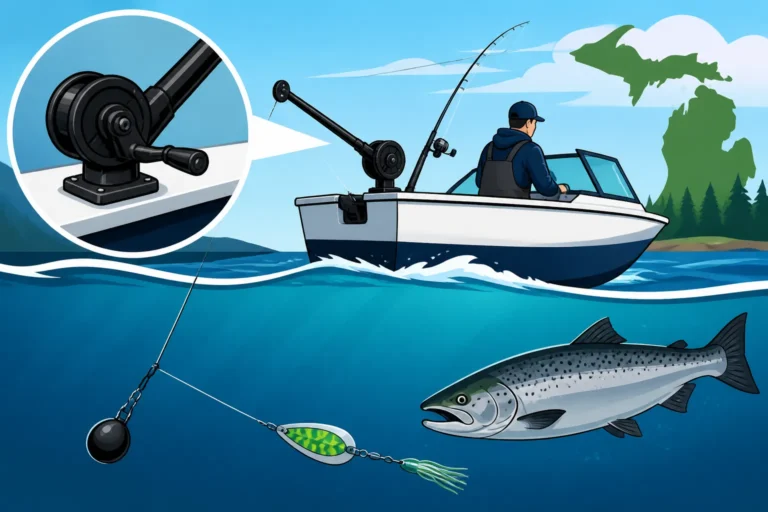
Michigan fishing offers an incredible variety of environments, from the deep, vast waters of the Great Lakes to the winding, current-laden rivers and thousands of tranquil inland lakes. Each of these presents unique challenges and opportunities, and a fish finder is indispensable across the board. On the Great Lakes, for example, trolling for salmon and trout often involves working specific depth contours or suspended baitfish schools in hundreds of feet of water. Without a fish finder, pinpointing these crucial depths and features would be virtually impossible. Your sonar unit becomes your guide to the thermocline and the baitfish holding tight to it. You can learn more about navigating these waters in our Michigan Great Lakes Fishing Regulations Guide.
Similarly, on an inland gem like Houghton Lake or one of the many smaller bodies of water, understanding the nuances of bottom structure is key. Fish finders allow you to identify subtle drop-offs, observe submerged weed beds where bass might be lurking, or find those critical areas where hard bottom meets soft bottom—often a prime location for various species. In rivers, the sonar can help you identify deeper pockets, current breaks behind large rocks, or log jams that provide cover for steelhead or smallmouth bass. It helps you quickly zero in on productive areas, saving you precious fishing time. If you're looking for where to apply these techniques, our guide on Michigan Inland Lakes Worth Fishing can give you some ideas.
Enhancing Safety and Efficiency
While the primary allure of a fish finder is, well, finding fish, its benefits extend far beyond just locating your quarry. Safety on the water is paramount, especially when exploring new areas or navigating shallower sections of a lake. A fish finder constantly displays the depth beneath your boat, helping you avoid unexpected shoals, submerged rock piles, or sunken logs that could damage your prop or even your hull. This is particularly valuable in less-traveled areas or during changing water levels.
Beyond safety, a fish finder dramatically boosts your fishing efficiency. Instead of blindly casting or trolling, you can quickly scan an area, identify potential holding spots for fish, and then focus your efforts there. Many modern units integrate GPS, allowing you to mark waypoints for productive spots, creating a digital map of your personal fishing holes. This means when you hit a hot spot for walleye in Saginaw Bay, you can mark it and return to it with precision later that day or even next season. This saves gas, time, and ultimately leads to more successful outings, making your time on the water more rewarding.
Understanding the Core Technologies in Modern Fish Finders
The world of fish finders has evolved dramatically over the years, moving beyond simple depth sounders to sophisticated imaging systems. To truly leverage these tools on Michigan waters, it's helpful to understand the different technologies at play. Each offers a unique perspective of the underwater world, and often, the best units combine several of these for a comprehensive view.
2D Sonar: The Foundation
Traditional 2D sonar, often simply called "broadband" or "conventional" sonar, is the backbone of almost every fish finder out there. This technology works by sending out a conical sound wave directly beneath your boat. When these waves bounce off fish, baitfish, or the bottom, they return to the transducer and are displayed on your screen as arches or lines. A classic fish arch is formed as your boat moves over a fish, causing the fish to enter and exit the sonar cone, creating a curved mark on the scrolling display.
The beauty of 2D sonar lies in its reliability and broad coverage. It's excellent for quickly assessing depth, identifying major drop-offs, and seeing suspended fish or bait schools in the water column. For many anglers, particularly those just starting out or working in shallower, more uniform depths, a quality 2D sonar is more than sufficient. However, interpreting those arches takes a bit of practice. A small, tight arch might be a large fish that quickly passed through the cone, while a stretched-out arch could be a smaller fish lingering. The challenge can be distinguishing fish from other underwater clutter, especially if you're not familiar with the typical "look" of fish arches on your particular unit.
DownScan and SideScan Imaging: Seeing with Clarity
When anglers talk about "seeing fish" or "seeing structure," they're often referring to DownScan and SideScan imaging technologies. These systems operate at much higher frequencies than traditional 2D sonar, allowing them to render incredibly detailed, photographic-like images of what's beneath and to the sides of your boat. They work by using a very narrow, fan-shaped beam that essentially "slices" through the water, providing a much crisper view than the conical beam of 2D sonar.
DownScan Imaging (sometimes called DownVu or ClearVü by different manufacturers) gives you a crystal-clear picture of what's directly below your boat. Instead of arches, you'll see actual images of submerged trees, rock piles, brush, and even individual fish distinctly separated from the structure. It’s like looking at an underwater photograph. SideScan Imaging (or SideVu/StructureScan) takes this concept and expands it outwards. It sends beams out to the left and right of your boat, creating a wide, panoramic view of the bottom and structure up to several hundred feet on either side. This is an absolute game-changer for covering vast areas, locating offshore humps, weed lines, or identifying isolated pieces of cover that fish might be holding on to. Imagine scanning a wide flat on Lake St. Clair for smallmouth bass or searching for submerged cribs on an inland lake—SideScan can show you where to focus your efforts without driving directly over every inch of the bottom. You can often find units with these advanced features at retailers like Bass Pro Shops or online at Amazon.
Chirp Sonar: Superior Target Separation
CHIRP stands for Compressed High-Intensity Radiated Pulse, and it's a technology that has revolutionized sonar performance. Unlike traditional 2D sonar, which typically sends out a single frequency at a time, CHIRP sonar sends a continuous sweep of frequencies, ranging from low to high, with each pulse. When these multiple frequencies return to the transducer, the fish finder's advanced processor interprets them, resulting in an incredibly detailed and clear image on your screen.
The primary benefit of CHIRP sonar is its superior target separation. This means it's much better at distinguishing individual fish, even when they're tightly packed in a school or hugging close to structure. Instead of a blob on your screen, you might actually see distinct fish within a bait ball. It also provides clearer images at greater depths and reduces clutter, making it easier to identify fish in challenging conditions. For Michigan anglers targeting finicky walleye in deeper water or trying to pick out a steelhead from a log jam, the clarity and precision of CHIRP sonar can make a significant difference in hook-up ratios. It helps you understand exactly what you're seeing, leading to more informed decisions about where and how to present your bait.
Key Features to Look For in a Michigan Fish Finder
Choosing a fish finder can feel overwhelming with the sheer number of options available. To simplify the process and ensure you get a unit that truly enhances your Michigan fishing adventures, it's helpful to focus on a few core features. These elements directly impact performance, usability, and your overall success on the water.
Screen Size and Resolution
The display is your window to the underwater world, so its quality is paramount. When considering screen size, think about where you'll mount the unit on your boat and how far away you'll be viewing it. A larger screen (7 inches or more, measured diagonally) generally makes it easier to interpret complex sonar images, especially when split-screening multiple views like 2D sonar, DownScan, and a chartplotter. However, a larger screen also takes up more dashboard real estate and usually comes with a higher price tag.
Resolution, expressed in pixels (e.g., 800×480 or 1024×768), is arguably even more critical. Higher resolution means more pixels packed into the screen, resulting in sharper, more detailed images. This clarity is invaluable for distinguishing between fish and structure, especially with DownScan and SideScan imaging. Imagine trying to identify a smallmouth bass tucked into a specific rock pile; a high-resolution screen will make that subtle detail much clearer, even in bright Michigan sunlight. Ensure the screen is also bright enough to be visible in direct sun and has good backlighting for those early morning or late evening bites.
GPS and Chartplotting Capabilities
For any serious boat angler in Michigan, integrated GPS and chartplotting are non-negotiable features. Without them, a fish finder is just a depth sounder. The GPS functionality allows you to pinpoint your exact location on the water, mark productive fishing spots (known as waypoints), and save tracks of your trolling passes or river drifts. This is incredibly useful for returning to a specific weed line that held walleye last week or revisiting that deep rock pile where you caught a monster lake trout. You can also monitor your speed, which is crucial for effective trolling for salmon on the Great Lakes. You can find out more about effective trolling in our How to Troll for Salmon on the Great Lakes guide.
Chartplotting takes this a step further by displaying your boat's position on a detailed map of the lake or river. Many units come preloaded with basic maps, but for serious anglers, investing in premium charts from companies like LakeMaster or Navionics is highly recommended. These charts offer incredible detail, including depth contours, navigation aids, and even marked fishing structures. Some advanced units also feature "AutoChart Live" or similar technologies, allowing you to create your own custom, high-definition contour maps of unknown waters as you drive over them. This is a powerful tool for discovering new hotspots, especially on smaller, less-mapped inland lakes. The combination of GPS and chartplotting is what truly transforms your fish finder into a powerful navigation and fish-locating hub.
Transducer Type and Power Output
The transducer is the unsung hero of your fish finder system. It's the component that sends and receives the sonar pulses, and its type and proper placement are critical for optimal performance. Common transducer mounting options include transom mount (most common, easy to install), through-hull (best performance, requires drilling), and trolling motor mount (great for bow-mounted units). The choice depends on your boat type and fishing style. A poorly mounted transducer can lead to a "noisy" or unreliable signal, making it hard to read your screen. For tips on how to prepare your vessel, check out our Michigan Boat Registration Requirements article.
Power output, measured in watts (RMS or Peak-to-Peak), determines how deep your sonar can penetrate and how effectively it can deliver a clear signal. For shallow inland lakes and rivers (under 100 feet), a few hundred watts RMS is usually sufficient. However, if you're venturing out onto the deeper Great Lakes, especially when targeting suspended fish or structure in several hundred feet of water, a higher wattage transducer (600W to 1kW RMS or more) becomes much more important. Higher power generally translates to better depth penetration and the ability to cut through noise and interference for a clearer picture. Additionally, transducer cone angles are important: wider angles cover more area but sacrifice some detail, while narrower angles provide more detail directly below. Many modern transducers offer multiple frequencies and beam widths to give you flexibility.
Choosing the Right Fish Finder for Your Michigan Fishing Style
Michigan's diverse fisheries mean there's no single "best" fish finder for everyone. What works for a salmon troller on Lake Huron might be overkill for a bass angler on a small inland pond, and vice versa. Matching the technology to your specific fishing style and target species is key to getting the most value and performance from your investment.
For the Great Lakes Angler
If your passion lies in battling Chinook salmon on Lake Michigan, chasing lake trout in the depths of Lake Superior, or targeting walleye on Saginaw Bay, your fish finder needs are significantly different from those of an inland angler. Great Lakes fishing often involves deep water, fast trolling speeds, and the need to cover vast expanses. Therefore, your unit should prioritize:
- Deep Water Penetration & Power: Look for units with higher wattage (600W to 1kW or more) and excellent CHIRP sonar capabilities. This ensures you get clear readings at depths of 100-300+ feet, where salmon and lake trout often lurk.
- Robust GPS and Chartplotting: Essential for marking productive trolling passes, finding specific deep-water structures like reefs or humps, and navigating safely in open water. Preloaded Great Lakes charts or the ability to easily add them are a must.
- Large, High-Resolution Screen: Split-screen functionality is incredibly useful for simultaneously monitoring 2D sonar, DownScan, and your chartplotter, especially when trying to decipher bait balls from target fish while trolling. The clarity helps identify even subtle changes in depth or fish marks.
- Networking Capabilities: For larger boats, the ability to network multiple displays, radar, and even engine data can create a seamless fishing command center.
These advanced features often come with a higher price tag, but for the serious Great Lakes angler, they are indispensable tools that directly contribute to safety and success. Our Michigan's Great Lakes Fishing Guide provides more insights into these exciting waters.
For Inland Lake and River Explorers
For those who prefer the tranquility of Michigan's thousands of inland lakes, the winding currents of rivers like the Au Sable or Manistee, or the vastness of Lake St. Clair, the focus shifts slightly. While depth is still important, detailed shallow-water imaging and portability might take precedence.
- Detailed DownScan and SideScan: These technologies shine in inland waters, allowing you to precisely pinpoint submerged timber, rock piles, weed lines, and subtle drop-offs where bass, pike, and panfish love to hide. SideScan is fantastic for quickly scanning river channels or scouting expansive flats for cover.
- Portability or Flexible Mounting: If you frequently fish from a kayak, a smaller jon boat, or even rent different vessels, a portable fish finder setup or one with an easily removable head unit might be ideal. Many smaller units offer fantastic performance without the bulk.
- Mapping Shallow Water Features: While premium charts are helpful, the ability to create your own custom maps with features like AutoChart Live can be a game-changer for finding unique structures in smaller, less-charted lakes.
- Mid-Range Power: Typically, 200-600W RMS is sufficient for most inland lake and river depths. Focus more on the imaging clarity rather than extreme depth capability.
Units in this category often offer a great balance of features and affordability. They provide the angler with the crucial information needed to dissect underwater environments and target specific species with precision. If you're targeting bass, our Smallmouth Bass Fishing in Michigan guide might be helpful too.
Budget-Friendly vs. High-End Models
The price spectrum for fish finders is vast, ranging from a couple of hundred dollars to several thousand. Understanding what you gain with each price jump can help you make an informed decision:
- Entry-Level (Budget-Friendly): These units typically offer basic 2D sonar, a smaller, lower-resolution screen, and sometimes basic GPS for marking waypoints (without detailed mapping). They are excellent for casual anglers, those on a tight budget, or individuals who just need basic depth and fish detection for calmer, shallower waters. They are a significant step up from fishing entirely blind and can be found at retailers like Bass Pro Shops or online at Amazon.
- Mid-Range: This is where you get the most bang for your buck. These units usually include CHIRP 2D sonar, DownScan, and often SideScan imaging, along with integrated GPS and chartplotting capabilities (though you might need to purchase detailed map cards separately). Screens are larger (5-9 inches) and have better resolution. These are perfect for most serious recreational anglers in Michigan, offering a powerful combination of features without breaking the bank.
- High-End (Professional-Grade): These are feature-rich powerhouses designed for dedicated anglers or charter captains. They boast large, high-definition displays (10+ inches), powerful multi-frequency CHIRP sonar, all imaging technologies, full GPS with advanced mapping, and extensive networking options. They can integrate with trolling motors, radar, autopilot, and other marine electronics. If you're spending hundreds of hours on the water each season, especially on the Great Lakes, these units offer unparalleled performance and insight.
When making your choice, honestly assess your needs, the type of fishing you do most often, and your budget. Remember, even a basic fish finder will dramatically improve your success compared to guessing.
Installation and Maintenance Tips
Getting the right fish finder is only half the battle; proper installation and regular maintenance are crucial for ensuring it performs optimally and lasts for many seasons on Michigan's waters. A common mistake is to simply bolt it on and go, but a little extra care during setup can prevent headaches and provide clearer readings.
Proper Transducer Placement for Optimal Performance
The transducer is the "eyes and ears" of your fish finder, and its placement profoundly impacts the clarity and reliability of your sonar readings. The goal is to ensure the transducer has a clear, unobstructed "view" of the water below, free from air bubbles or turbulence.
- Transom Mount: This is the most popular and easiest installation for most boats. Mount the transducer on the transom, ensuring it's submerged below the hull but above the prop's turbulent wash. It should be parallel to the waterline (or slightly angled down at the front) to provide the best signal. Test it at various speeds to check for "ventilation" (air bubbles disrupting the signal).
- Through-Hull Mount: For optimal performance, especially at higher speeds or in rough conditions, a through-hull transducer is often preferred. It's mounted directly through a hole in the bottom of your boat. This offers the clearest water contact but requires careful drilling and sealing.
- Trolling Motor Mount: Many fish finders offer transducers specifically designed to be mounted on a trolling motor. This is excellent for anglers who use a bow-mounted trolling motor for precise boat control, as it keeps the transducer in clean water, even when motoring slowly.
Regardless of the mount type, avoid placing the transducer directly behind strakes, rivets, or other hull irregularities that can create air bubbles. Always run a temporary test with the transducer before making permanent holes, if possible, to find the sweet spot for the clearest signal.
Powering Your Fish Finder
A stable and clean power supply is essential for your fish finder to operate correctly. Interference from other electronics can cause "noise" on your screen, making it difficult to distinguish fish from clutter.
- Dedicated Power Source: Whenever possible, run your fish finder's power cable directly to your boat's battery. This provides the most stable power and minimizes interference. Avoid splicing into existing wiring that might be powering other accessories.
- Proper Wiring: Use the correct gauge wire for the length of the run, following the manufacturer's recommendations. Ensure all connections are secure, crimped properly, and protected from corrosion with marine-grade heat shrink or dielectric grease.
- Fuse Protection: Always install an in-line fuse close to the battery to protect your unit from power surges.
- Battery Considerations: For smaller boats or kayaks, consider a dedicated 12V marine battery for your fish finder, especially if you also power a trolling motor. If you also use a trolling motor, it's a good idea to ensure it's properly registered, which you can learn about in our Michigan Boat Registration Requirements article. Ensure your battery has enough amp-hours to last your typical fishing day.
Software Updates and Care for Longevity
Like many modern electronic devices, fish finders benefit greatly from regular software (firmware) updates. Manufacturers frequently release updates that improve performance, add new features, fix bugs, and enhance compatibility with accessories.
- Stay Updated: Check your manufacturer's website periodically for available updates. Typically, you'll download the update file to an SD card, insert it into your fish finder, and follow the on-screen prompts.
- Cleaning: After each outing, especially in saltwater (though less common in Michigan, some Great Lakes anglers do encounter brackish conditions in harbors), gently wipe down your unit's screen and casing with a soft, damp cloth. Avoid harsh chemical cleaners. Periodically inspect the transducer for marine growth or damage and clean it carefully.
- Winter Storage: During the harsh Michigan winters, properly store your fish finder. Remove the head unit from the boat and store it in a warm, dry place. If your boat is stored outdoors, protect the transducer from freezing temperatures and impact. Disconnect batteries if the boat is going into long-term storage. A little preventative care goes a long way in ensuring your fish finder is ready for action come spring.
Interpreting What Your Fish Finder Shows You
Owning a fish finder is one thing; truly understanding and interpreting the images on its screen is another. It takes practice and experience, but once you learn to decipher the symbols, you'll unlock a wealth of information that will dramatically improve your fishing success.
Decoding Sonar Arches and Marks
On traditional 2D sonar, fish are typically displayed as arches. The shape and density of these arches provide clues about the fish.
- Classic Arches: A "perfect" arch is formed when a fish swims through the center of your sonar cone, or your boat passes directly over it. A thick, well-defined arch usually indicates a larger fish. A smaller, thinner arch represents a smaller fish.
- Partial Arches or Streaks: If a fish is on the edge of the sonar cone, or your boat is moving very fast, you might see partial arches or even just short streaks. Don't dismiss these—they can still be fish!
- Bait Balls: Often, you'll see large, dense clouds or blobs on your 2D sonar screen. These are typically schools of baitfish, like alewives or shiners. Predatory fish like walleye or salmon often feed on these bait balls, so if you see them, there's a good chance bigger fish are nearby.
- Distinguishing from Debris: While arches are often fish, sometimes floating debris or air bubbles can create similar marks. With experience, you'll learn to differentiate. Fish arches tend to be more distinct and often move in patterns.
Remember, the image scrolls from right to left, with the most recent sonar data on the right side of your screen. This creates a real-time moving picture of what's below. Our Best Time of Day to Catch Walleye guide can help you connect fish finder readings to optimal fishing periods.
Identifying Structure and Cover
This is where DownScan and SideScan truly shine, giving you almost photographic clarity of the underwater environment. Understanding structure and cover is crucial because fish are creatures of habit and often relate to specific features.
- Bottom Composition: You'll be able to see the difference between hard bottom (like rock or gravel, which appears as a thick, dark line on 2D sonar or bright, solid areas on DownScan/SideScan) and soft bottom (like mud or silt, which appears as a thinner line or softer, darker areas). Many species prefer one over the other for spawning or foraging.
- Submerged Features: DownScan will clearly show individual trees, stumps, brush piles, rock formations, and even man-made structures like old tires or sunken boats directly beneath you. SideScan expands this view, allowing you to quickly locate these features off to the sides. Imagine cruising over a flat on Lake St. Clair and seeing a scattered rock pile 50 feet to your left—that's a potential smallmouth hotspot!
- Weed Lines: On inland lakes, clear images of submerged weed beds and the edges where they meet open water are invaluable. Fish often use these edges for ambush points or cover.
- Drop-Offs and Contours: The sudden change in depth that indicates a drop-off or ledge will be clearly visible. Fish frequently stage along these depth transitions, especially walleye and bass. By identifying these features, you can focus your fishing efforts where fish are most likely to be holding, rather than blindly casting into open water. Knowing your local Michigan Fishing Regulations Every Angler Should Know can also help you understand which structures might be protected or have specific rules.
Utilizing Temperature and Depth Readings
Beyond just fish and structure, your fish finder provides critical environmental data that can influence fish behavior.
- Water Temperature: Most fish finders include a water temperature sensor. Temperature is one of the most important factors influencing fish activity. Different species have preferred temperature ranges, and locating a "thermocline" (a distinct temperature layer in the water column) can be crucial, especially for suspended fish like salmon and trout in the Great Lakes. Fish often congregate just above, within, or just below the thermocline.
- Depth: While obvious, the precise depth reading helps you accurately present your lures or bait. It allows you to match your presentation to the depth at which fish or bait are observed, ensuring you're fishing in the strike zone. On deep Great Lakes waters, for instance, knowing the exact depth of suspended bait is key to setting your downriggers.
- Bottom Hardness: Some advanced units can even give you an indication of bottom hardness. A harder bottom (rock, gravel) typically returns a stronger, thicker echo, while a softer bottom (mud, silt) returns a weaker, thinner echo. This subtle detail can be important for species that prefer certain bottom compositions.
By combining all these pieces of information—fish marks, detailed structure, and environmental data—you'll build a complete picture of the underwater world, enabling you to make more intelligent and successful fishing decisions on Michigan's diverse waters.
| Sonar Technology | Description | Pros | Cons |
|---|---|---|---|
| 2D Sonar (Broadband) | Emits a conical sound wave, displaying fish as arches and bottom as a scrolling line. | Reliable, excellent for general depth, speed, and suspended fish. Good at all speeds. | Can be harder to interpret for beginners; less detail on structure. |
| DownScan Imaging | High-frequency, narrow beam directly below the boat, providing photo-like images of structure and fish. | Incredible detail for structure and fish directly below; easy to interpret. | Very narrow coverage; doesn't show side-to-side information. |
| SideScan Imaging | High-frequency beams extend out to the sides of the boat, revealing a wide panoramic view. | Excellent for covering wide areas, finding structure off to the sides, scouting quickly. | Not ideal for high-speed use; can be overwhelming with too much detail. |
| CHIRP Sonar | Sweeps multiple frequencies with each pulse, improving target separation and clarity for 2D, Down, Side. | Superior target separation, clearer images at depth, reduced clutter, better definition for fish. | Requires a compatible CHIRP transducer; often found in mid-to-high-range units, which means higher cost. |
Disclaimer
This article is for general informational purposes only and does not constitute professional advice. Laws, prices and regulations vary by location and change over time. Consult a qualified professional for guidance on your specific situation.