What Is a Planer Board Used For
For many Michigan anglers, especially those just getting into serious boat fishing, the sight of multiple lines spread far and wide from a boat can be a bit bewildering. You see these contraptions pulling lines away from the boat's wake, making it look like a spiderweb across the water, and you might wonder, "What in the world are those things, and why are they so crucial?" This guide is here to demystify planer boards, explaining exactly what they are used for and why they've become an indispensable tool for successfully targeting various fish species across Michigan's vast waters, from the mighty Great Lakes to our clearer inland gems.
The Core Purpose of Planer Boards: Expanding Your Trolling Spread
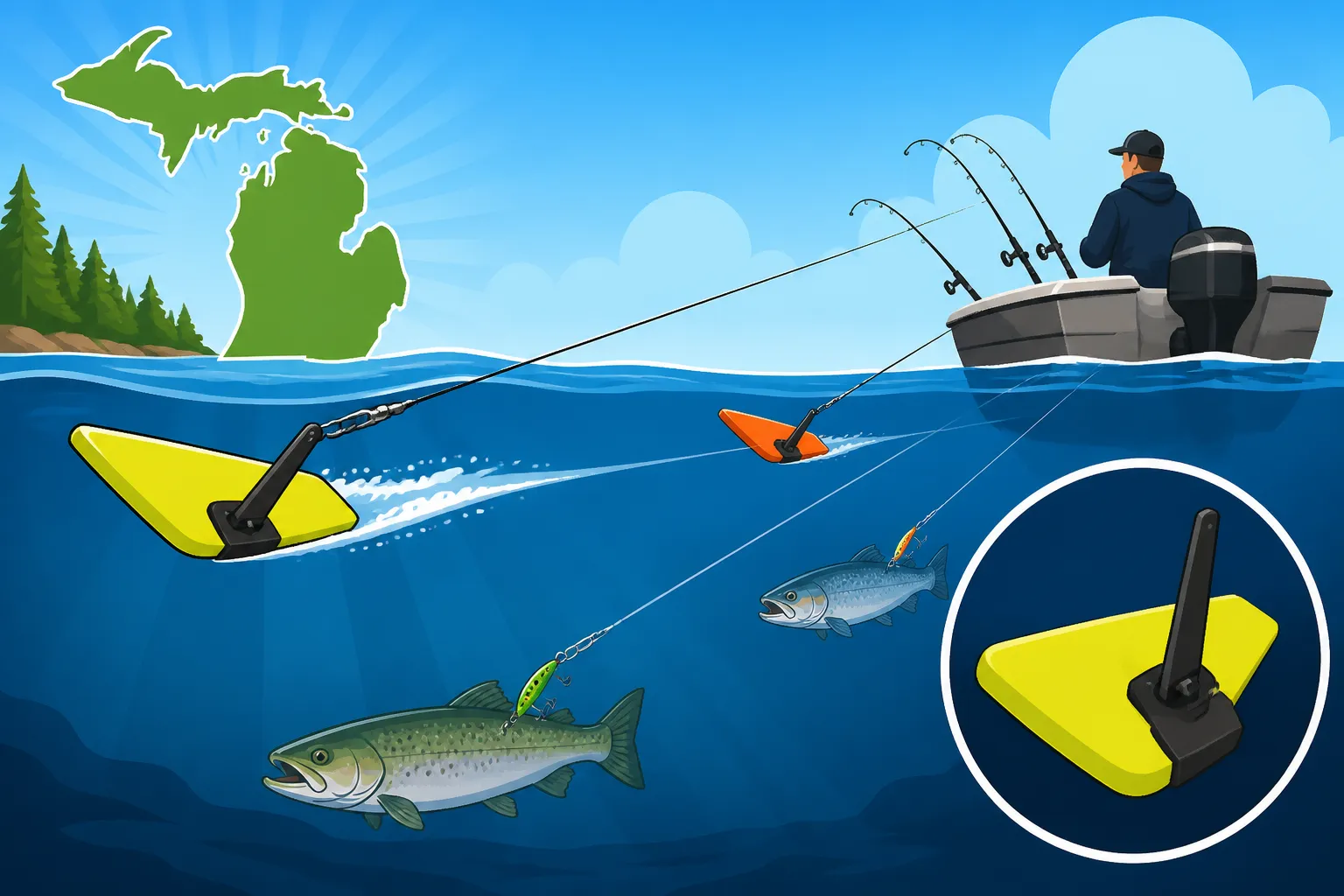
At its heart, a planer board is a simple yet incredibly effective device designed to take your fishing lines away from the boat. Think of it as a small, buoyant wing that uses the resistance of the water to "plane" out to the side as your boat moves forward. The main goal? To significantly widen your trolling spread, allowing you to cover more water and present your baits to fish that might otherwise be spooked by your boat's presence.
Overcoming the Limitations of Traditional Trolling
When you're trolling directly behind your boat, your lures are confined to a relatively narrow path. This presents a couple of challenges, especially when fishing for wary species like salmon, trout, or even educated walleye in clear water. First, the noise and shadow of your boat can push fish away from your immediate path, making them less likely to strike your lures. Second, a narrow spread simply limits the amount of water column you can effectively present your baits in. You might be missing entire schools of fish that are just a little to the left or right of your direct path.
Imagine trying to sweep a large room with a tiny broom – you'd eventually get the job done, but it would take forever and you'd miss a lot. Planer boards are like upgrading to a wide-angle broom, dramatically increasing your coverage. They allow you to put baits in areas where fish feel safer, away from the boat''s disturbance, and also target fish spread out horizontally. This becomes especially critical on big bodies of water like Lake Michigan or Lake Huron, where fish can be scattered over vast areas.
How Planer Boards Achieve a Wider Spread
Planer boards work on a very clever principle of hydrodynamics. They are shaped and weighted to naturally "kite" out to the side when pulled through the water. Your fishing line from your rod connects to the planer board, and then your lure or bait is set back a certain distance behind the board. As the boat moves, the board pulls the line sideways, creating a wide fan-like pattern of lures trailing far from your boat's centerline.
The distance a planer board can pull your line out depends on its size, design, and the speed of your troll. Some larger "big boards" can pull multiple lines hundreds of feet to the side, while smaller in-line boards might extend your reach by 50 to 100 feet per side. This extended reach allows you to mimic schools of baitfish, covering a much larger swath of water than you ever could by simply running lines directly off the transom. It's truly a game-changer for serious trolling, helping you maximize your chances of encountering fish.
Types of Planer Boards and Their Applications
Not all planer boards are created equal. They come in different designs, each suited for specific fishing scenarios and boat setups. Understanding the distinctions between them is key to choosing the right tool for your Michigan angling adventures.
Mast Systems (Big Boards) for Great Lakes Trolling
When you think of the expansive waters of the Great Lakes and the pursuit of Chinook salmon or trophy lake trout, you're likely picturing "big boards" or mast systems. These are typically large, rectangular or coffin-shaped boards that are incredibly stable and designed to pull many lines at once. They are deployed from a central mast system usually mounted on the bow of a larger fishing boat. A main line runs from the mast out to the board, and then individual fishing lines are attached to this main line using special releases.
These mast systems are workhorses, capable of pulling upwards of five or even ten lines per side, depending on the boat and conditions. They are fantastic for covering massive amounts of water and creating a truly wide spread, often hundreds of feet from the boat's side. The stability of these large boards helps keep your lures tracking true, even in choppy Great Lakes conditions. If you're serious about How to Troll for Salmon on the Great Lakes or targeting deep-water lake trout on Lake Superior, a big board system is almost a necessity. They do require a larger boat for comfortable deployment and retrieval, but their efficiency in covering water is unmatched for offshore trolling.
In-Line Planer Boards for Versatility
For anglers with smaller boats, or those looking for a more flexible and less permanent setup, in-line planer boards are the answer. These are individual, typically smaller boards that attach directly to each fishing line, rather than running off a central mast system. They are incredibly popular because of their ease of use, versatility, and the fact that you don't need a dedicated mast on your boat.
An in-line board usually has a clip at the front that attaches to your main fishing line and a spring-loaded clip or pin at the back that holds the line in place. When a fish strikes, the rear clip often releases, allowing you to fight the fish directly on your rod without the board putting excessive pressure on the fight. Some boards are designed to stay on the line and slide down to the fish, while others can be easily removed once the fish is near the boat. Brands like Off Shore Tackle and Church Tackle are widely recognized for their reliable in-line planer boards.
These boards are perfect for everything from smallmouth bass fishing on Lake St. Clair to targeting walleye on inland lakes or even light trolling for coho salmon closer to shore on the Great Lakes. They allow you to run multiple lines – typically two to four per side, depending on local regulations and angler skill – without the complexity of a mast system. You can often find a good selection of these boards at outdoor retailers like Bass Pro Shops or even through online vendors like Amazon, making them accessible to a wide range of anglers.
Here's a quick comparison of the two main types:
| Feature | Mast System (Big Board) | In-Line Planer Board |
|---|---|---|
| Boat Size | Larger boats, typically 20 ft+ | Any size boat, from small jon boats to larger cruisers |
| Number of Lines | Multiple lines (5-10+) per side off a main line | One line per board (2-4+ per side) |
| Deployment | Requires a fixed mast, main line, and releases | Attaches directly to individual fishing lines |
| Control | Boards run independently, lines attach to main line | Each board is controlled by its own rod and reel |
| Cost | Higher initial investment for mast and boards | Lower per-board cost, less overall system expense |
| Versatility | Best for large-scale, open-water trolling | Highly versatile for various fish and water types |
| Fish Fight | Board remains on main line, releases allow fighting fish | Board may detach or slide down to fish during fight |
| Popular Species | Chinook Salmon, Lake Trout, Coho Salmon (offshore) | Walleye, Pike, Smallmouth Bass, Coho Salmon (inshore) |
When and Where Planer Boards Shine in Michigan
Michigan offers an incredible diversity of fishing opportunities, and planer boards prove their worth across many of them. While they are famously associated with one type of fishing, their utility extends far beyond.
Trolling for Salmon and Trout on the Great Lakes
This is perhaps the most iconic use of planer boards in Michigan. When you're out on the vast expanses of Lake Michigan, Lake Huron, or Lake Superior, targeting king salmon, coho salmon, or chrome-bright steelhead, planer boards are absolutely essential. The Great Lakes are immense, and the fish, especially mature salmon, are often scattered and wary. Running lines far away from the boat's shadow and engine noise allows you to present your spread in a more natural, less intrusive way.
Imagine a calm summer morning on Lake Michigan off Frankfort. Without planer boards, your six rods might cover a 30-foot wide path directly behind your boat. With a pair of big boards or several in-line boards, you can easily spread those same six lines across a 100-foot or even 200-foot wide corridor. This dramatically increases your chances of intersecting a school of Trolling for Chinook Salmon on Lake Michigan or a lone trophy brown trout. Anglers often combine planer boards with other depth-controlling devices like downriggers to cover both horizontal and vertical portions of the water column simultaneously. This multi-dimensional approach is a hallmark of successful Great Lakes trolling, especially when trying to pinpoint the thermocline where salmon and trout tend to feed. You'll often see charters running an impressive array of lines off each side, making use of every available inch of water, which is a testament to the effectiveness of planer boards.
Walleye and Pike Fishing on Inland Lakes
While the Great Lakes get much of the planer board glory, these tools are also incredibly effective for other species on Michigan's myriad inland lakes. Walleye, known for their light-sensitive eyes and often spooky nature, are prime candidates for planer board tactics. In clearer inland waters like Houghton Lake or Higgins Lake, a boat passing directly over them can send them scattering. By deploying lures far to the side with in-line planer boards, you can present your favorite crankbaits or crawler harnesses to these fish without them ever sensing your boat.
Consider trolling for walleye on Saginaw Bay. The water can vary in clarity, and walleye often feed in relatively shallow flats. Running boards allows you to keep your main boat motor and hull away from the fish, minimizing disturbance. You can often run lines shallower and wider, targeting fish that are hugging structure or scattered over vast, flat bottoms. Similarly, northern pike in large, weedy inland lakes like Lake St. Clair or Burt Lake can be successfully targeted using planer boards. Large spoons or diving crankbaits can be run along weed edges, covering a lot of territory and keeping the boat at a comfortable distance from the pike's ambush points. For species like walleye, which often prefer specific depths and cover, the ability to fan out your offerings across a wide area drastically improves your odds. Michigan Walleye Fishing Techniques often involve covering vast areas, and planer boards are invaluable for that.
Setting Up and Using Planer Boards Effectively
Getting started with planer boards might seem a bit intimidating at first, but with a good understanding of the components and a little practice, you'll be deploying them like a pro. The key is in proper rigging and a systematic approach.
Essential Components of a Planer Board Setup
To run planer boards effectively, you'll need a few key pieces of gear:
- Rods and Reels: For big boards, you'll have specific planer board rods that are often longer and have a moderate action, designed to handle the pull of the board and multiple lines. For in-line boards, sturdy trolling rods in the 7-10 foot range with line counter reels are highly recommended. Line counters are absolutely crucial because they allow you to precisely repeat successful depths and spreads. A good quality reel capable of holding plenty of line, such as a strong baitcasting reel, is ideal.
- Fishing Line: Monofilament or braided line can be used. Braided line offers less stretch and more sensitivity, which can be advantageous, but monofilament is often more forgiving. For big board systems, you'll typically have heavy test monofilament or braid as your main planer line, and then lighter lines off your fishing rods. For in-line boards, stick to a strong mainline on your rod, perhaps 15-20 lb test mono or 30-50 lb braid, depending on the target species.
- Planer Boards: Of course, you need the boards themselves! Whether you opt for a mast system with big boards or individual in-line boards, choose reputable brands known for durability and performance. Consider what you're primarily fishing for when making your choice.
- Releases (for big boards): These are specialized clips that attach your fishing line to the main planer board line. They are designed to hold the line securely but release when a fish strikes, allowing you to fight the fish directly. Adjustable tension releases are preferred so you can fine-tune them for different lures or fish sizes.
- Releases (for in-line boards): In-line boards typically have their own integrated release mechanisms, often a front clip that grips the main line and a rear pin or clip that holds it in place. Ensure these clips are robust and reliable.
- Lures and Baits: The lures you use with planer boards are generally the same ones you'd use for any other trolling scenario: crankbaits, spoons, stickbaits, or bait rigs like crawler harnesses. The key is selecting lures that run true at your chosen trolling speed and depth. Having a selection of different sizes and colors, perhaps from your local Bass Pro Shops, is always a good idea.
Step-by-Step Deployment and Retrieval
Let's walk through a simplified deployment process for in-line planer boards:
- Prepare Your Lure: First, rig your chosen lure or bait and let out enough line to get it to its desired running depth. This might be 50 feet for a shallow-running crankbait or 150 feet for a deep diver.
- Attach the Board: With your lure swimming properly, open the front clip of your in-line planer board and attach it to your main fishing line. Make sure it's secure. Then, open the rear clip or thread the line through the rear pin, ensuring the board is oriented correctly (the "flag" or taller side usually faces forward, away from the boat).
- Let Out Line: Begin to slowly let out more fishing line, allowing the planer board to "plane" out to the side of the boat. Pay attention to the angle and speed at which it's moving away. You'll often let out another 50-150 feet of line, depending on how far you want the board to be from the boat.
- Set the Rod: Once the board is out to your desired distance, engage your reel's clicker (if it has one) or set the drag appropriately, and place the rod in a sturdy rod holder. The rod tip should have a slight bend from the tension of the board pulling.
- Repeat for Other Lines: Deploy subsequent boards on the same side or the opposite side. Typically, you'll deploy the board furthest out first, then work your way closer to the boat. This prevents lines from tangling. Staggering the distances of your lures behind the boards is also crucial to avoid tangles and present a more natural spread.
- Retrieval: When a fish hits, the rod tip will usually snap back or start bouncing wildly. Grab the rod, reel in any slack, and begin fighting the fish. If the board is designed to release, it will slide down the line. If it's a fixed board, you'll fight both the fish and the board until you get closer to the boat, at which point you might be able to detach the board from your line. Always net fish that are brought in on planer board lines carefully, as the board itself can still cause a snag.
Remember, practice makes perfect. Your first few deployments might involve some tangles, but you'll quickly get the hang of it. Consider picking up a Best Planer Board Setup for Salmon guide or watching some videos on YouTube for visual demonstrations.
Advantages and Considerations of Using Planer Boards
Like any piece of specialized fishing gear, planer boards offer significant benefits but also come with a few considerations that anglers should be aware of. Weighing these pros and cons will help you decide if adding planer boards to your Michigan fishing arsenal is the right move for you.
Pros: Increased Coverage and Stealth
The advantages of using planer boards are considerable and often lead to more successful fishing trips, especially on larger bodies of water or for specific species.
- Massive Increase in Coverage: This is the most obvious and impactful benefit. By spreading your lines out laterally, you cover a much wider swath of water than conventional trolling directly behind the boat. This greatly increases the odds of intersecting with scattered schools of fish or finding that lone trophy. On the Great Lakes, where fish can be miles apart, this expanded footprint is invaluable.
- Enhanced Stealth: Fish, particularly those in clear water or under calm conditions, can be incredibly wary of boat noise, shadows, and engine vibrations. Planer boards allow you to present your lures hundreds of feet away from your boat's disturbance, mimicking a natural school of baitfish or a lone meal drifting by. This stealth factor often results in more strikes from otherwise hesitant fish.
- Ability to Run More Lines (Legally): Michigan fishing regulations allow for a certain number of rods per angler. While you'll need to check the specific Michigan Fishing Regulations Every Angler Should Know, planer boards enable a single angler or a team of anglers to effectively manage more lines by keeping them separated and tangle-free. This means maximizing your fishing effort within legal limits.
- Better Presentation in Shallow Water: For species like walleye or pike that often feed in shallower waters or near weed lines, running lures behind and to the side of the boat can keep them in the strike zone longer. The boat isn't running directly over their heads, allowing your baits to move naturally through prime feeding areas.
- Versatility: While often associated with big water trolling for salmon, in-line planer boards can be incredibly versatile for many species and boat sizes, from targeting perch on Lake St. Clair to smallmouth bass on inland lakes. They adapt to different trolling speeds and lure types.
Cons: Learning Curve and Gear Investment
Despite their benefits, adopting planer boards isn't without its challenges, especially for beginners.
- Initial Learning Curve: There's no denying that learning to deploy, manage, and retrieve multiple lines with planer boards, especially big board systems, takes practice. Tangled lines, known as "birds' nests," are a common frustration for newcomers. It requires coordination, understanding of boat speed, and practice with releases. However, like any fishing skill, it becomes second nature with experience. Don't be discouraged by initial struggles; every experienced planer board user started where you are.
- Gear Investment: While in-line boards are relatively inexpensive per unit, outfitting a full planer board setup can add up. For big board systems, the mast, reels, heavy lines, and the boards themselves represent a significant investment. Even for in-line setups, purchasing multiple quality boards and line counter reels can be a considerable expense compared to basic rod and reel combos. Think of it as an investment in increasing your fishing success. You can often find great deals on specific components or full kits on platforms like Amazon or at specialty tackle shops.
- Storage and Transport: Large planer boards and mast systems require dedicated storage space on your boat and in your garage. Even multiple in-line boards can take up more room than you might expect in a tackle box. This is a practical consideration for those with limited space.
- Potential for Fouling: In waters with heavy debris (e.g., leaves, weeds after a storm), planer boards can sometimes pick up trash, affecting their performance and potentially requiring frequent retrieval for cleaning. This is less of an issue in open Great Lakes waters but can be a factor in some inland lakes or rivers.
- Regulations: While planer boards are generally legal in Michigan, always double-check the current fishing regulations regarding the maximum number of lines allowed per angler. Michigan Fishing Regulations Every Angler Should Know outlines these rules to ensure you're compliant.
Ultimately, for anglers looking to seriously elevate their trolling game and increase their catch rates, the benefits of planer boards far outweigh the initial hurdles. They are a powerful tool that transforms your boat into a much more effective fishing platform, covering more water and enticing more fish.
Disclaimer
This article is for general informational purposes only and does not constitute professional advice. Laws, prices and regulations vary by location and change over time. Consult a qualified professional for guidance on your specific situation.